
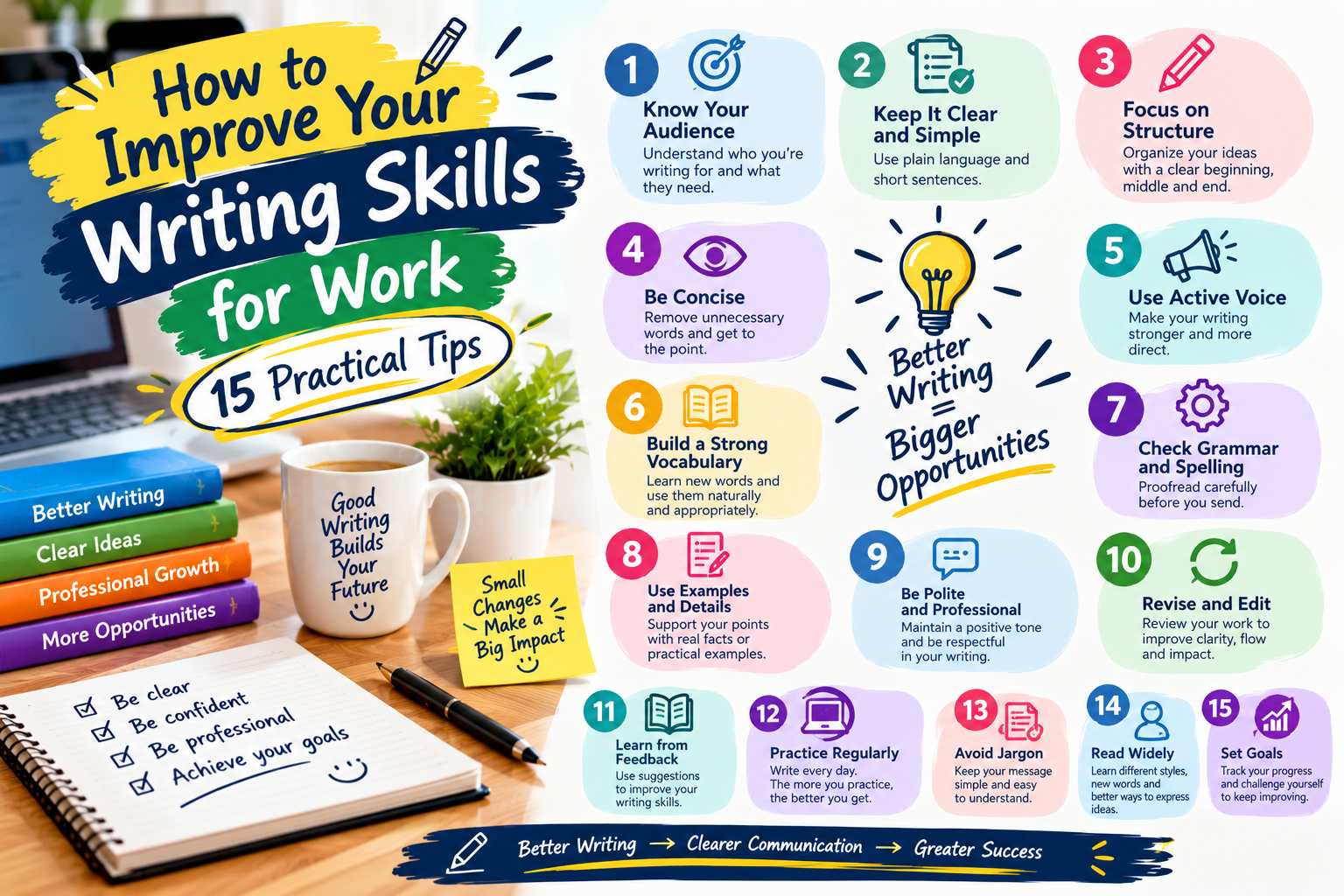
Strong workplace communication depends on more than having good grammar. Employees write emails, reports, proposals, messages, instructions, presentations, and documentation almost every day. Clear writing helps readers understand information quickly, take the right action, and trust the person communicating with them. If you want to develop writing skills for work, the most useful approach is to practice clarity, organization, accuracy, tone, and editing rather than trying to use complicated vocabulary.
Professional writing should make the reader’s job easier. Whether you are applying for a position, responding to a customer, updating a manager, or documenting a project, your message should have a clear purpose. This guide explains practical ways to improve workplace writing, common mistakes to avoid, useful editing techniques, and simple habits that can make your written communication more effective.
Why Writing Matters in the Workplace
Written communication creates a record of decisions, instructions, responsibilities, and important information. A poorly written message can create confusion even when the writer understands the subject perfectly. A well-structured message can save time because readers do not have to guess what the writer means.
Good writing skills for work can also support professional credibility. Managers and colleagues often judge written communication by its clarity, accuracy, organization, and usefulness. This does not mean every message needs to sound formal. Instead, professional writing should match the audience, purpose, and situation.
For example, an internal team message may be short and conversational, while a client proposal may require more structure and careful wording. A technical report may need precise terminology, while a customer response should prioritize clarity and empathy.
What Are the Most Important Writing Skills for Work?
The most useful workplace writing abilities include clear organization, concise sentences, correct grammar, appropriate tone, strong vocabulary, accurate information, logical reasoning, audience awareness, and careful editing.
- Clarity: Make your meaning easy to understand.
- Conciseness: Remove unnecessary words and repetition.
- Organization: Present ideas in a logical order.
- Grammar: Use correct sentence structure and punctuation.
- Tone: Match your language to the reader and situation.
- Accuracy: Check names, dates, numbers, facts, and instructions.
- Audience awareness: Write at the reader’s level of knowledge.
- Editing: Review your work before sending or publishing it.
These abilities work together. Correct grammar cannot rescue a confusing message, and a detailed vocabulary cannot compensate for poor organization. Effective professional writing comes from combining several basic skills consistently.
1. Start With a Clear Purpose
Before writing, decide what you want the reader to understand, know, or do. This simple step can significantly improve writing skills for work because it prevents unnecessary information from entering the message.
Ask yourself three questions: Why am I writing this? Who will read it? What should happen after the reader finishes? Your answers provide a basic direction for the document.
Suppose you need to email a manager about a delayed project. Instead of beginning with a long explanation of everything that happened, identify the purpose. You may need to explain the delay, provide the new expected date, and request approval for an adjustment. Once the purpose is clear, irrelevant details become easier to remove. You can also review professional writing guidance for practical workplace communication tips.
2. Know Your Audience
Effective workplace writing changes according to the reader. A message written for an experienced engineer may contain technical terminology that would confuse a new employee or customer. Similarly, a message to senior management may need a concise summary rather than a detailed description of every process.
Strong writing skills for work include the ability to adjust vocabulary, detail, tone, and structure for different audiences.
Before writing, consider the reader’s role, knowledge, expectations, and likely questions. If the reader needs background information, provide it briefly. If the reader already understands the subject, avoid explaining basic concepts unnecessarily.
3. Use Simple and Direct Language
Bilkul, code ke baghair normal text mein:
3. Use Simple and Direct Language
Professional writing does not need complicated words to sound intelligent. Simple language often communicates ideas more efficiently. Instead of writing “utilize,” use “use” when the meaning is the same. Instead of saying “at this point in time,” simply write “now.” Developing strong writing skills for work means choosing words that communicate your message clearly without making the reader work harder than necessary.
Simple language is especially useful in emails, instructions, reports, customer communication, and workplace documentation. Readers usually want to understand the message without spending extra time decoding it. Clear language is therefore one of the most practical parts of writing skills for work.
When improving writing skills for work, look for long or complicated phrases that can be replaced with ordinary words. This does not mean removing every technical term. Specialized terms are useful when they are familiar to the intended audience and make communication more precise.
4. Write Shorter, Stronger Sentences
Long sentences are not automatically bad, but sentences containing too many ideas can become difficult to follow. If a sentence includes several unrelated points, divide it into two or more sentences. This simple technique can make your writing skills for work more effective because readers can understand each idea more quickly.
For example, instead of writing, “The project was delayed because the supplier changed the delivery date, which affected testing and created additional scheduling problems for the team,” you could write, “The supplier changed the delivery date. This delayed testing and affected the team’s schedule.”
The second version separates the cause from the effects. It is easier to scan and understand. Learning to create direct sentences is an important part of developing writing skills for work, especially when writing business documents and professional updates. business writing.
5. Improve Your Workplace Vocabulary
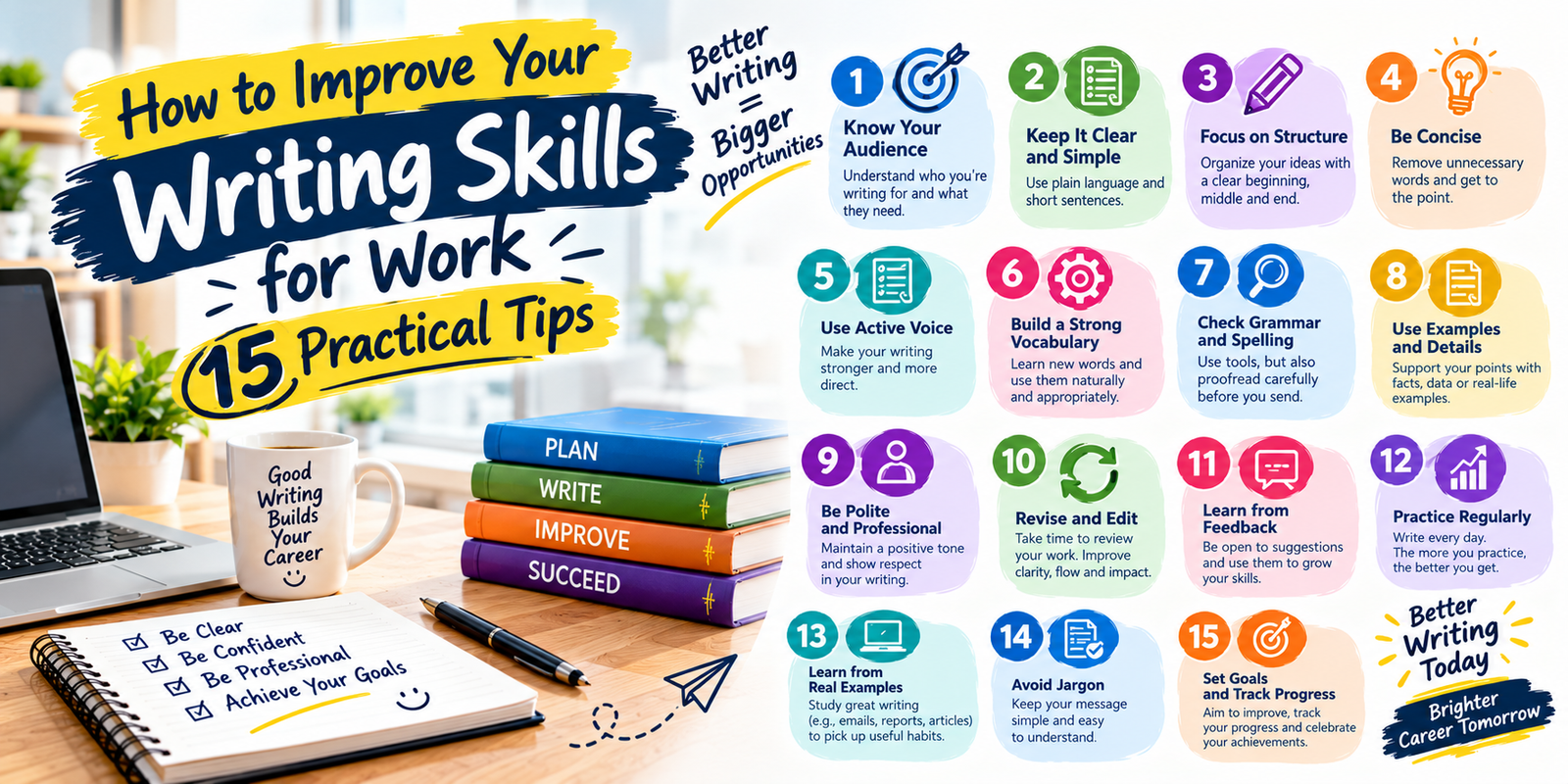
A useful professional vocabulary helps you communicate precise ideas. However, vocabulary development should focus on words you can use accurately rather than collecting difficult words simply to sound sophisticated. Effective writing skills for work depend more on accurate word choice than on using impressive vocabulary.
When reading reports, professional articles, business documents, or industry publications, notice words that repeatedly appear in your field. Learn their meanings, observe how experienced writers use them, and then practice using them in your own sentences. This approach can gradually expand your professional vocabulary while improving your confidence.
Better writing skills for work come from practical vocabulary. For example, words such as “clarify,” “prioritize,” “evaluate,” “confirm,” “recommend,” “implement,” and “coordinate” can be useful in many professional settings when used correctly.
6. Organize Information Before Writing
Organization is one of the most important parts of professional communication. Even strong sentences can become ineffective when ideas appear in a confusing order. Good writing skills for work require you to think about the order in which your reader needs to receive information.
Before starting a longer document, create a simple outline. Write down the main point, supporting information, evidence or examples, and required action. Then arrange these elements in an order that makes sense to the reader.
For an internal report, a practical structure might include the purpose, current situation, key findings, problems, recommendations, and next steps. For an email, you may need only the purpose, important details, and requested action. This type of planning strengthens writing skills for work because it prevents unnecessary information from distracting readers.
7. Make Your Main Point Easy to Find
Busy professionals often scan messages before deciding whether to read them closely. Your most important information should therefore be easy to locate. Clear organization is a key element of effective writing skills for work.
Put the main purpose near the beginning. Use descriptive headings in longer documents. Use bullet points when presenting several related items. Highlight deadlines, decisions, or requested actions through clear wording rather than excessive formatting.
Developing writing skills for work means thinking about how people actually read workplace content. A message that is technically correct but difficult to scan may still fail to communicate effectively.
8. Learn to Write Better Emails
Work emails should usually be concise, specific, and action-oriented. A useful email often contains a clear subject line, a short opening, the necessary context, the requested action, and a professional closing. These habits are central to strong writing skills for work because emails are among the most common forms of workplace communication skills.
Instead of writing a long paragraph containing several requests, separate important points into short paragraphs or bullet points. If you need an answer by a certain date, state the deadline clearly.
For example, rather than writing “Please let me know what you think whenever you have time,” write “Could you review the attached proposal and share your feedback by Thursday?” The second version tells the reader exactly what is needed. Practicing this approach regularly can make your writing skills for work more precise, professional, and useful.
9. Practice Professional Tone
Tone refers to the attitude or feeling conveyed through your words. Professional writing should generally be respectful, clear, and appropriate for the relationship.
Be especially careful when discussing mistakes, disagreements, delays, or sensitive issues. Avoid wording that sounds accusatory when a neutral explanation will work better. Instead of saying, “You failed to send the document,” consider “I have not received the document yet. Could you please send it when available?”
Good writing skills for work include knowing when to sound formal and when a conversational style is appropriate. Professional does not have to mean cold or unnecessarily formal.
10. Use Active Voice When Appropriate
Active voice often makes workplace writing more direct. In active voice, the person or team performing an action is usually clear.
Compare “The report was completed by the marketing team” with “The marketing team completed the report.” Both sentences are grammatically correct, but the second is more direct.
Passive voice is not always wrong. It can be useful when the action matters more than the person performing it or when the responsible person is unknown. The goal is not to eliminate passive voice completely but to use it deliberately.
11. Strengthen Grammar and Punctuation
Grammar errors can distract readers and sometimes change meaning. You do not need to memorize every grammar rule, but you should become comfortable with common areas such as subject-verb agreement, sentence fragments, verb tense, pronoun use, commas, apostrophes, and capitalization.
One effective method is to notice the mistakes you make repeatedly. Keep a personal list of common errors and review it before submitting important documents.
For people developing writing skills for work, targeted grammar practice is usually more useful than trying to study every rule at once.
12. Read Professional Writing Regularly
Reading is one of the simplest ways to improve writing because it exposes you to effective sentence structures, vocabulary, organization, and professional tone.
Read material related to your career field, including industry publications, company reports, professional newsletters, research summaries, and well-written business articles. Pay attention to how authors introduce topics, explain evidence, transition between ideas, and conclude sections.
Do not simply read for information. Study how the information is communicated. Notice which sentences are easy to understand and why they work.
13. Practice Writing Every Day
Writing improves through repeated practice. You do not need to write a long essay every day. A short daily exercise can be enough.
- Rewrite a long email in half the number of words.
- Summarize an article in five sentences.
- Write a short explanation of a work process.
- Turn a paragraph into a bullet-point list.
- Rewrite an informal message in a professional tone.
- Explain a complicated topic as if speaking to a beginner.
Regular practice makes it easier to develop writing skills for work because you begin noticing unnecessary words, weak transitions, unclear sentences, and repeated ideas more quickly.
14. Learn to Edit Your Own Work
Writing and editing are different activities. When drafting, focus on getting the ideas onto the page. During editing, examine whether the ideas are clear, accurate, relevant, and well organized. Developing strong writing skills for work means understanding that good writing usually requires more than one review.
Start with the biggest issues. Ask whether the document has a clear purpose and whether the main point is easy to find. Then review paragraphs, sentences, grammar, punctuation, spelling, and formatting. This editing process is an important part of improving writing skills for work because it helps you identify problems before your reader does.
Reading your work aloud can reveal awkward phrases and overly long sentences. Changing the font or viewing the document on another screen can also help you notice mistakes you overlooked during the first review. These simple techniques can make your writing skills for work more accurate and polished.
15. Remove Unnecessary Words
Concise writing is not about making every sentence extremely short. It is about ensuring that every word contributes something useful. Strong writing skills for work include knowing when a word adds value and when it only makes a sentence longer.
Look for repeated ideas, unnecessary introductions, weak qualifiers, and phrases that can be simplified. For example, “due to the fact that” can usually become “because,” while “in order to” can often become “to.” Removing unnecessary wording makes professional communication easier to understand and supports better writing skills for work.
Editing for conciseness can make reports, emails, proposals, and instructions easier to read without removing important information. With regular practice, concise writing becomes a natural part of your writing skills for work.
16. Improve Your Report Writing
Reports require more structure than ordinary emails. Begin by identifying the report’s purpose and intended audience. Then organize information into logical sections. This structured approach is an important element of effective writing skills for work.
Use headings to separate major topics. Present evidence clearly and distinguish facts from interpretations or recommendations. When using numbers, explain what they represent instead of assuming the reader will understand them automatically.
A good report should allow a reader to understand the main findings without searching through every paragraph. Detailed supporting information can follow the key points. Developing these habits can significantly strengthen your writing skills for work.
17. Develop Better Writing Skills for Work Through Feedback
Feedback can show you problems that are difficult to notice in your own writing. Ask a trusted colleague, supervisor, teacher, or mentor to review an important document when appropriate.
Do not simply ask whether the writing is “good.” Ask specific questions. Is the main point clear? Is anything confusing? Are any sections too detailed? Does the tone fit the audience? Is the requested action obvious?
Specific feedback makes it easier to identify patterns and improve writing skills for work over time.
18. Use Writing Tools Carefully
Grammar checkers, spell checkers, style tools, dictionaries, and AI writing assistants can support the editing process. They can help identify possible spelling mistakes, unclear sentences, repeated words, and some grammar problems.
However, automated tools can misunderstand context. A suggested change is not automatically correct. Review every important suggestion and make the final decision based on your intended meaning, audience, and professional standards. Strong leadership skills can also support better communication decisions.
AI tools can also help generate practice exercises, explain grammar concepts, suggest alternative wording, or identify areas that may need clarification. They should support your judgment rather than replace careful review.
19. Avoid Common Workplace Writing Mistakes
Several mistakes appear frequently in professional communication. One is burying the main point under too much background information. Another is using vague language that leaves the reader uncertain about what is expected.
- Do not send important messages without checking names and attachments.
- Do not use technical terms that the audience may not understand.
- Do not include unnecessary details that hide the main point.
- Do not rely entirely on automated grammar suggestions.
- Do not write when angry and immediately press send.
- Do not assume the reader knows information that you have not provided.
- Do not use an overly casual tone in sensitive professional situations.
Avoiding these problems can make your writing skills for work more reliable in everyday communication.
20. Create a Personal Editing Checklist
A short checklist can help you review important writing consistently. Before sending a professional message or submitting a document, ask:
- Is my purpose clear?
- Is the main point easy to find?
- Did I include the information the reader needs?
- Did I remove unnecessary repetition?
- Are the sentences clear and reasonably concise?
- Is the tone appropriate?
- Did I check names, dates, numbers, and links?
- Are grammar and spelling correct?
- Did I clearly state any requested action or deadline?
Using the same checklist repeatedly can turn editing into a routine instead of something you remember only when a document is important.
21. Adapt Writing for Different Workplace Formats
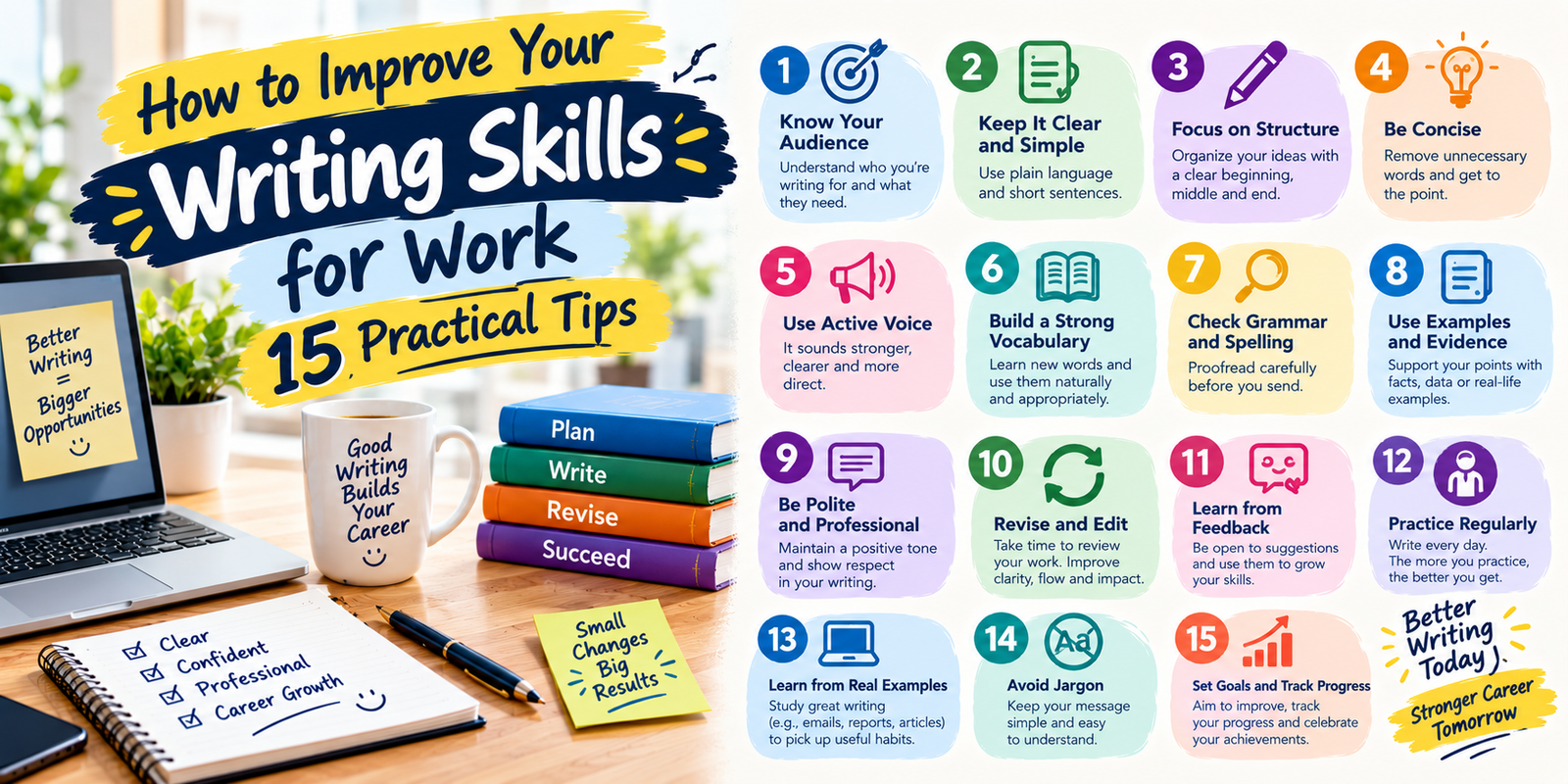
Different forms of communication require different approaches. An email should usually be brief and action-oriented. A report needs stronger structure and evidence. A proposal should explain a problem, solution, benefits, costs or resources where relevant, and next steps. A presentation needs short, readable points rather than dense paragraphs.
Learning to adapt your style is a major part of writing skills for work. The goal is not to develop one fixed writing style but to communicate effectively across different situations.
22. Make Your Writing More Persuasive Without Overstating
Professional writing sometimes requires persuasion, such as when proposing a project, requesting resources, or explaining a recommendation. Persuasive writing should be based on relevant evidence and clear reasoning.
State the problem, explain why it matters, present the proposed solution, and provide evidence or practical reasoning. Address reasonable concerns rather than ignoring them. Avoid exaggerated claims that cannot be supported.
Credibility grows when your writing clearly distinguishes established facts, assumptions, estimates, and recommendations.
23. Improve Writing for Job Applications
Workplace writing begins before employment. Resumes, cover letters, application emails, and professional profiles all require clear communication.
Use specific language to describe responsibilities and achievements. Avoid copying generic descriptions that could apply to anyone. When writing a cover letter, connect your relevant experience to the position instead of simply repeating your resume. Strong research skills can help you identify relevant information and tailor your application.
Strong writing skills for work can help job seekers present qualifications clearly and professionally, although the quality of writing should always support accurate representation rather than exaggeration.
24. Build a Long-Term Improvement Routine
Improving writing is easier when you use a repeatable routine. Set aside a small amount of time each week to review something you wrote. Choose one area to improve, such as sentence length, punctuation, structure, tone, or vocabulary.
Keep examples of writing you have improved. Comparing an earlier version with a revised version can help you recognize patterns in your writing and measure progress more realistically.
You can also maintain a personal vocabulary list, collect useful sentence patterns, and record grammar mistakes that you frequently make. Over time, these small habits can make professional writing more natural.
Frequently Asked Questions
How can I improve my writing skills for work quickly?
Start by practicing concise writing, reading professional material, editing your own work, and requesting specific feedback. Focus on one improvement area at a time instead of trying to change everything immediately.
What writing skills are most important for employees?
Clarity, organization, grammar, conciseness, audience awareness, professional tone, accuracy, and editing are among the most useful workplace writing abilities.
How can I write better professional emails?
Use a clear subject line, state the purpose early, provide only necessary context, make requests specific, identify deadlines when needed, and review the message before sending it.
Can reading improve workplace writing?
Yes. Reading high-quality professional material exposes you to useful vocabulary, sentence structures, organization methods, and appropriate communication styles. Studying how strong writers present information can make your own writing more effective.
Should I use AI tools to improve my writing?
AI tools can support brainstorming, editing, grammar practice, and alternative wording. However, review their suggestions carefully because automated systems can misunderstand context or change the intended meaning.
How do I make my professional writing more concise?
Identify the main point, remove repetition, replace wordy phrases with simpler alternatives, shorten unnecessary introductions, and delete information that does not help the reader understand or act on the message.

Conclusion
Improving professional communication does not require complicated vocabulary or a perfect writing style. The most effective approach is to make your purpose clear, understand your audience, organize information logically, use direct language, and edit carefully before sending or publishing your work. These habits become more valuable as you use them consistently across emails, reports, proposals, applications, and workplace documentation.
The best way to strengthen writing skills for work is to combine regular practice with deliberate editing and useful feedback. Read strong professional writing, study the techniques behind it, experiment with clearer sentence structures, and keep track of mistakes that you repeatedly make. With consistent practice, your writing can become clearer, more concise, and more useful to the people who depend on your communication.