

Working online requires more than knowing how to use a computer or a particular software platform. Freelancers, virtual assistants, content writers, digital marketers, customer support workers, researchers, and remote employees regularly need to find information, check facts, understand unfamiliar topics, and solve problems independently. Strong online research skills make these tasks faster, more accurate, and easier to manage.
When a client asks for information, a manager needs a report, or a customer has a question, the quality of the final answer often depends on the quality of the research behind it. A professional online worker should know how to search effectively, recognize reliable sources, compare information, verify claims, organize notes, and use digital tools responsibly.
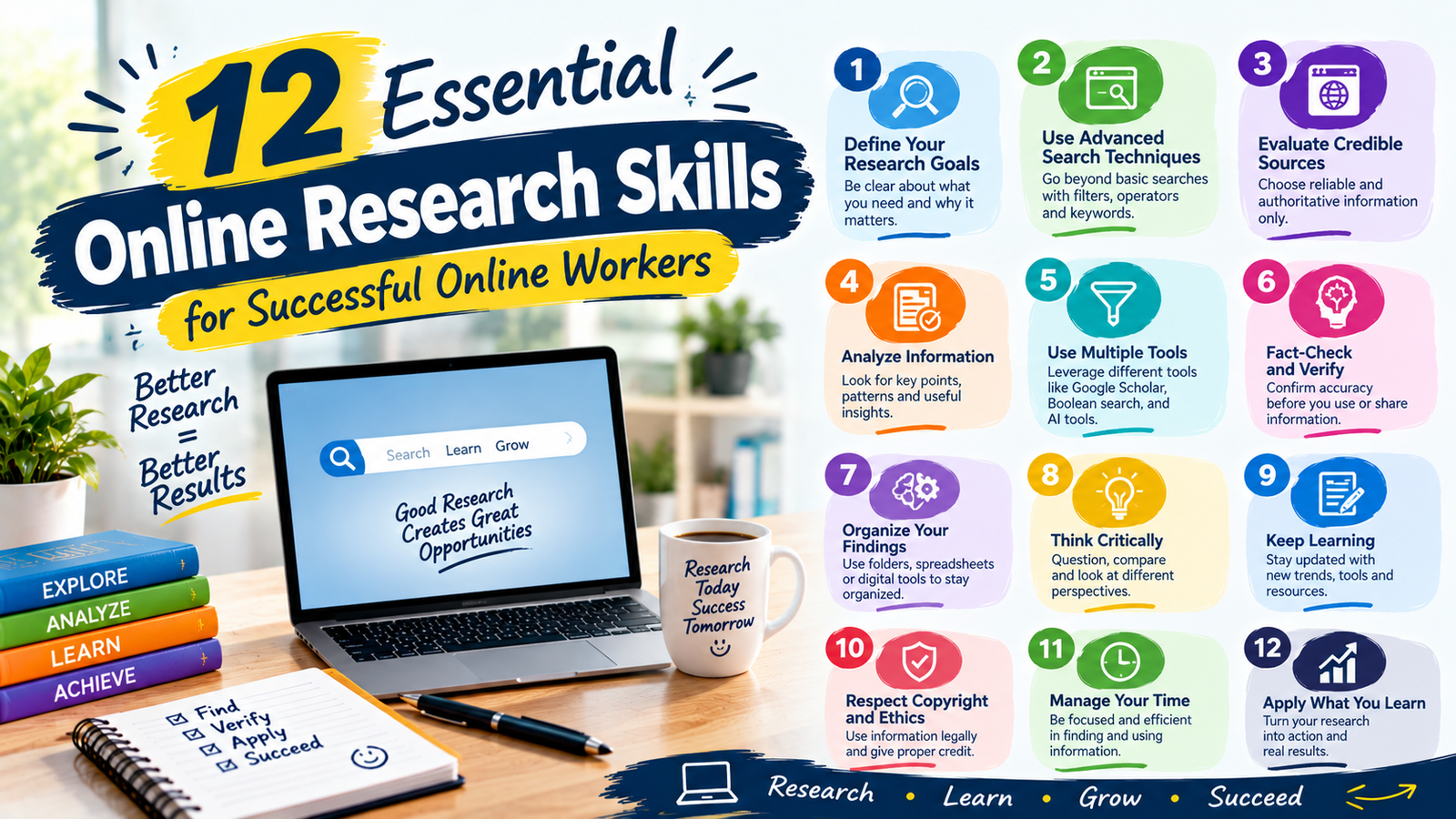
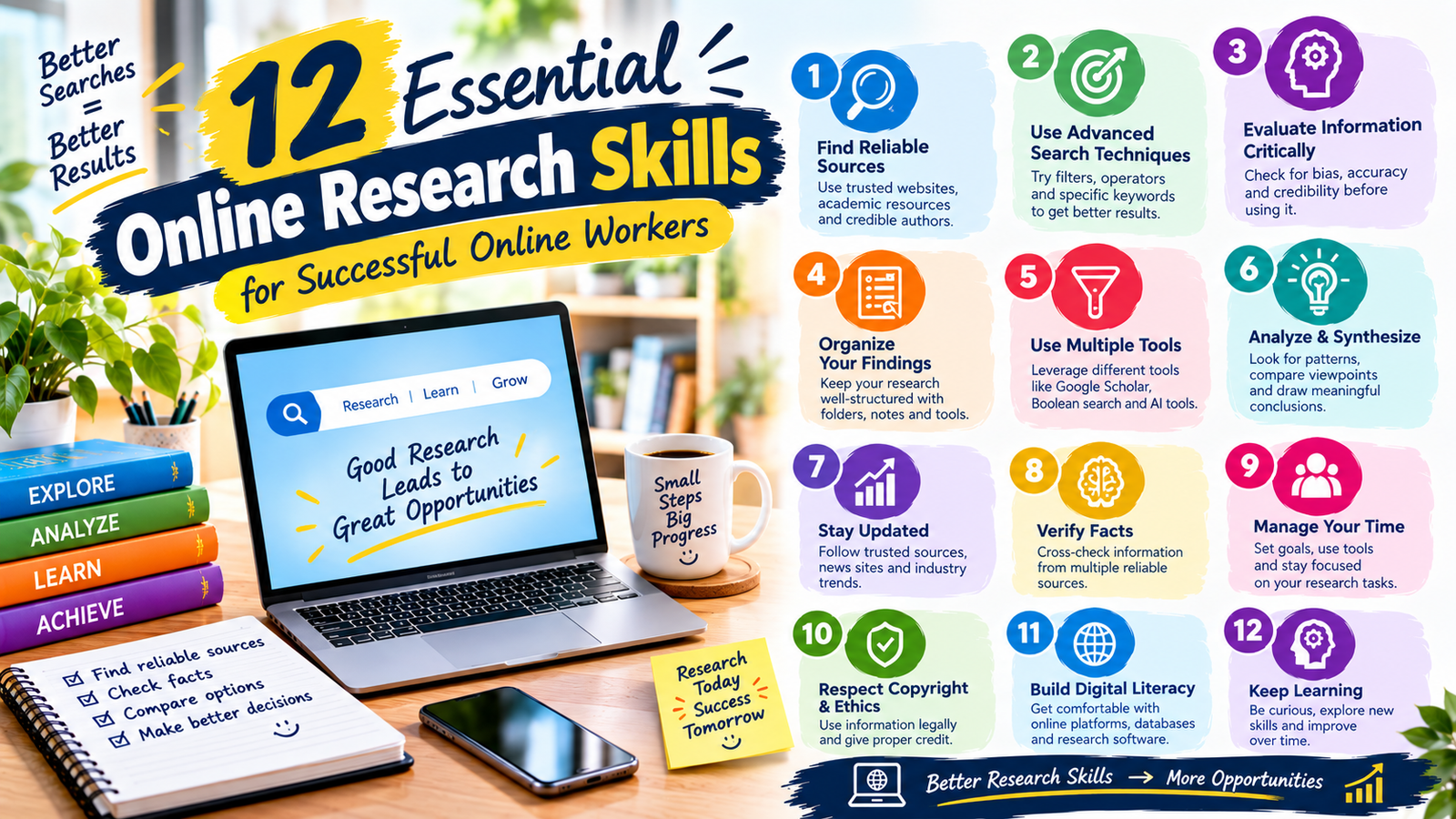
This guide explains 12 practical online research skills that can help remote workers improve accuracy, productivity, decision-making, and professional communication. It also covers common mistakes, AI-assisted research, source evaluation, and a simple workflow you can use for everyday assignments.
Why Research Skills Matter for Online Workers
Online workers often operate with a high level of independence. In a traditional office, you may be able to ask a colleague for help immediately. In remote work, however, you may need to investigate the problem yourself before asking for assistance.
That is why online research skills are useful in almost every digital career. A content writer researches before preparing an article. A virtual assistant may investigate a company, product, or travel option. A social media manager may verify a claim before publishing it. A customer service representative may search technical documentation to solve a user’s problem.
Research also reduces avoidable mistakes. Instead of guessing an answer, you can locate supporting information and verify it before using it. This creates a more reliable work process and can increase a client’s confidence in your work.
1. Learn How to Define the Research Question
The first of the essential online research skills is the ability to define exactly what you need to find. Many research problems become difficult because the question is too broad.
For example, searching for “social media marketing” can produce millions of results. A more specific question such as “Which social media metrics should a small business monitor each month?” gives you a clearer research direction.
Before searching, identify:
- What information do I need?
- Why do I need it?
- Who will use the information?
- How current must the information be?
- What type of source is most appropriate?
- What decision or task will the research support?
A clearly defined question saves time because it prevents you from collecting information that looks interesting but does not actually help complete the assignment.
Turn Broad Topics Into Specific Questions
If the topic is large, divide it into smaller questions. Instead of researching “remote work,” you might investigate remote communication tools, productivity practices, online security, common job roles, and required digital skills separately.
This approach creates a logical research path and makes your final work easier to organize.
2. Master Search Engine Techniques
Knowing how to search is one of the most valuable online research skills because search engines are often the first place online workers begin looking for information.
Good researchers do not simply type a long question and open the first result. They adjust keywords, test different phrases, and use search operators when necessary.
Useful search techniques include:
- Use specific keywords instead of extremely broad terms.
- Place an exact phrase in quotation marks when you need a precise match.
- Use site: to search within a particular website or domain.
- Add a date or year when current information matters.
- Use filetype: when searching for documents such as PDFs.
- Try synonyms if your first search produces weak results.
- Include location terms when the information is geographically specific.
For example, a worker looking for official software guidance could search the company’s documentation website rather than relying on random tutorials. A researcher looking for public information may use government or university domains when appropriate.
The goal is not to collect hundreds of search results. The goal is to locate the most relevant and trustworthy information efficiently.
3. Evaluate Source Credibility
Finding a webpage does not mean that the information on it is reliable. Evaluating sources is therefore one of the most important online research skills for anyone who works with information.
Consider several factors before using a source:
- Author: Is the author identified, and do they have relevant expertise?
- Organization: Who published the information?
- Evidence: Are important claims supported by data, references, documents, or other evidence?
- Date: Is the information recent enough for your task?
- Purpose: Is the source educational, commercial, promotional, political, personal, or informational?
- Accuracy: Can important claims be confirmed elsewhere?
A source does not become reliable simply because it looks professional. A well-designed website can still contain outdated or unsupported information. At the same time, a simple-looking document can contain valuable primary evidence. Evaluate the substance rather than the appearance. Understanding source credibility is important when deciding whether information deserves to be trusted.
4. Understand Primary and Secondary Sources
Another useful research ability is understanding the difference between primary and secondary sources. Strong Online Research Skills include knowing where information originally comes from and how different sources present that information. A primary source generally provides information directly from an original institution, creator, document, dataset, record, or participant.
A secondary source usually explains, summarizes, analyzes, or comments on information from other sources. Developing reliable Online Research Skills means learning when to use a secondary source for context and when to return to the original material for verification.
Is mein “primary source” par 2-word external link lagana natural rahega:
For example, an official company announcement can be a primary source for information about that company’s own product. A technology blog discussing the announcement is a secondary source.
Anchor: primary source
Secondary sources can be helpful because they provide context and explanations. However, when an important detail matters, checking the original source can help you confirm exactly what was stated. This source-checking habit is an important part of effective Online Research Skills because it reduces the risk of relying on incomplete or incorrectly interpreted information.
Develop the habit of asking, “What is the original source behind this claim?” This question can uncover copied information, missing context, or inaccurate summaries. Asking this question regularly can make your Online Research Skills more reliable and useful in professional situations.
5. Build Strong Fact-Checking Habits
Fact-checking is essential for writers, marketers, researchers, assistants, and anyone whose work contains factual claims. Strong Online Research Skills include the ability to verify information before presenting it as fact.
A simple fact-checking process is:
- Identify the exact claim.
- Find the original source when possible.
- Check the publication date.
- Read enough surrounding context to understand the claim.
- Compare important information with another appropriate source.
- Record the evidence and source details.
This process strengthens your Online Research Skills because it encourages you to investigate claims instead of accepting information at face value.
Fact-checking is especially important when dealing with statistics, legal information, financial information, health topics, product specifications, software features, employment requirements, or current events.
Do not assume that a statement is true simply because several websites repeat it. Many websites may be copying the same original source, so repetition alone does not prove accuracy. Effective Online Research Skills require you to examine the evidence behind repeated claims rather than judging accuracy by the number of websites making the same statement.
6. Compare Information From Multiple Sources
Good research often requires more than one source. Comparing credible sources can help you identify differences, missing details, conflicting interpretations, or changes over time. This is another practical way to strengthen your Online Research Skills and develop a more balanced understanding of a topic.
For example, if you are researching an online service, you might check its official documentation for features, independent publications for analysis, and user discussions for common practical issues.
However, comparison does not mean treating every source as equally authoritative. A government document, academic publication, official product manual, and anonymous social media comment can have very different levels of evidentiary value.
Bilkul, 2-word anchor “evaluate sources” par external link laga diya hai:
Ask why each source should be trusted for the particular question you are investigating. The strongest source depends on the subject. Learning to evaluate sources according to their purpose, evidence, authority, and relevance is one of the most valuable Online Research Skills for online workers.
7. Learn to Use Academic, Government, and Professional Sources
Search engines are useful starting points, but some research tasks require specialized sources. Developing online research skills includes knowing where high-quality information is likely to be found.
Useful source categories include:
- Government departments and official portals
- Universities and academic institutions
- Peer-reviewed research databases
- Professional associations
- Official company documentation
- Industry organizations
- Public reports and official datasets
For technical work, official documentation is often more useful than an unrelated blog. For academic topics, university resources and research publications may provide stronger evidence. For regulations, official government sources are usually more appropriate than informal summaries.
Choosing the correct source type can dramatically reduce research time.

8. Improve Digital Note-Taking and Organization
Research becomes much more useful when you can find your information again. Effective note-taking is therefore another important part of online research skills.
For each useful source, record information such as:
- Source title
- Author or organization
- Publication date
- Important finding
- Supporting evidence
- Source link or document location
- Questions that still need verification
Keep your own interpretation separate from direct facts. This makes it easier to distinguish what the source actually says from what you think the information means.
For larger projects, use folders, spreadsheets, digital notebooks, or reference management tools. A consistent system is more valuable than using a complicated tool that you rarely maintain.
9. Develop Basic Data Interpretation Skills
Online workers frequently encounter percentages, charts, survey results, performance reports, tables, and business metrics. You do not need to become a professional statistician to understand basic data, but you should know how to question numbers.
When reviewing data, ask:
- What exactly is being measured?
- What time period does the data cover?
- How large is the sample?
- How was the data collected?
- Is the source explaining the methodology?
- Could another factor explain the result?
For example, a percentage without a sample size or time period may provide an incomplete picture. Similarly, two things occurring at the same time does not automatically prove that one caused the other.
Basic data literacy helps online workers avoid misleading conclusions and communicate research more responsibly.
10. Understand Context, Bias, and Purpose
Information can be technically accurate but misleading when presented without context. A sentence, statistic, or quotation may look convincing while leaving out important details.
Strong online research skills require you to ask what the source is trying to accomplish. A company selling a product may naturally present information differently from an independent research organization. A personal blog may reflect the author’s experience rather than a broad population.
Recognizing a source’s purpose does not automatically make the information false. Instead, it helps you interpret the information carefully and decide whether additional verification is needed.
When sources disagree, examine their evidence, definitions, dates, methods, and assumptions before deciding how the disagreement should be represented in your work.
11. Use AI Tools Responsibly During Research
AI tools can make research faster by helping workers brainstorm keywords, organize information, summarize documents, generate questions, and explain difficult concepts. However, AI workplace tools should support research rather than replace verification.
AI-generated answers can contain inaccurate details, incomplete explanations, outdated information, or unsupported claims. This is why online research skills remain important even when AI tools are available.
A practical AI-assisted workflow is:
- Ask the AI tool to help clarify the research question.
- Use it to generate possible search terms and subtopics.
- Find credible sources independently.
- Read and evaluate the relevant sources.
- Use AI to organize or summarize verified material.
- Check important facts against the original sources.
- Review the final output for accuracy and context.
This approach combines automation with human judgment. AI can help with speed, while the researcher remains responsible for evaluating evidence.
12. Learn to Search and Analyze Long Documents
Remote workers often deal with long PDFs, manuals, reports, policy documents, research papers, spreadsheets, and company files. Searching inside these documents is one of the most practical online research skills for administrative and professional work.
Use headings, document search, tables of contents, keywords, and relevant phrases to locate useful sections. However, never rely only on a single matching sentence.
Read the surrounding paragraphs to understand critical thinking context. A statement in a report may have conditions, exceptions, definitions, or limitations that are explained elsewhere.
When working with long documents, record the page number, section heading, or other location information for important findings. This makes later verification much easier.
How to Manage Research Time Without Losing Accuracy
Research can become a productivity problem when there is no clear stopping point. Some online workers continue opening new sources long after they have enough reliable information to complete the assignment.
Set a clear research goal before you begin. Decide which questions must be answered and what level of evidence is appropriate.
A short client question may require only a few trustworthy sources. A detailed business report may require much deeper research. The amount of research should match the complexity and consequences of the task.
Use a simple rule: stop collecting information when the main questions have been answered, important claims have been verified, and the evidence is sufficient for the required work.
Common Research Mistakes Online Workers Should Avoid
Even experienced professionals can make mistakes when working under deadlines. Avoiding these common problems can make your research more reliable.
Relying on the First Search Result
The first result is not automatically the most authoritative source. Search rankings are designed to help users find relevant information, but ranking position should not be treated as proof of credibility.
Using Only One Source
One source may have incomplete information or a particular perspective. Important claims should be checked against appropriate additional sources.
Ignoring Dates
Information about software, regulations, prices, products, employment rules, and market conditions can change. Always consider whether the source is current enough for your purpose.
Copying Without Understanding
Research is not simply collecting text. You need to understand the information and represent it accurately in your own work.
Confusing Opinions With Facts
A confident statement is not necessarily evidence. Identify whether a source is reporting a fact, presenting research, giving an opinion, interpreting data, or promoting something.
Failing to Save Sources
If you cannot remember where an important claim came from, verifying it later becomes difficult. Save useful source information while you research.
A Simple Research Workflow for Remote Workers
You can turn online research skills into a repeatable workflow by following these steps:
- Define the objective: Write the exact question or problem you need to solve.
- Break it into smaller questions: Identify the information required for each part.
- Create search terms: Choose specific keywords and useful variations.
- Start with strong sources: Look for official, academic, professional, or primary sources when appropriate.
- Collect evidence: Record useful facts and source details.
- Verify important claims: Check dates, context, and supporting evidence.
- Compare information: Investigate meaningful differences between credible sources.
- Organize findings: Group information according to the assignment.
- Prepare the final work: Turn verified findings into the required report, article, answer, or recommendation.
- Review everything: Check names, numbers, dates, links, and important factual statements.
This workflow is flexible. A simple question may take only a few minutes, while a complex research project may require several hours or multiple stages of verification.
Research Skills for Different Online Careers
| Online Role | Typical Research Work | Important Skills |
|---|---|---|
| Content Writer | Topic research, fact-checking, source gathering | Search, verification, note-taking |
| Virtual Assistant | Company, product, travel, and information research | Searching, organization, accuracy |
| Digital Marketer | Audience, competitor, keyword, and market research | Data analysis, comparison, trend research |
| Customer Support Worker | Product and troubleshooting research | Documentation search, problem-solving |
| Freelance Researcher | Detailed information gathering and reporting | Source evaluation, verification, documentation |
| Remote Administrative Worker | Reports, policies, vendors, and business information | Document search, organization, accuracy |
How to Improve Your Research Ability Through Practice
Reading about research methods is useful, but practical exercises are what turn knowledge into a professional habit. Regular practice helps strengthen your Online Research Skills and makes research tasks easier to manage.
Choose a subject that interests you and complete a small research project. You could investigate three software platforms, verify claims from an online article, summarize an official report, compare product documentation, or locate the original source behind a statistic. These activities allow you to apply your Online Research Skills in realistic situations.
After finishing, review your process. Ask yourself whether you defined the question clearly, used efficient search terms, selected appropriate sources, verified important information, and saved useful references. This self-review can reveal areas where your Online Research Skills need improvement.
Repeat this exercise with different subjects. Working across different topics can improve your ability to adapt your Online Research Skills to new research requirements.
Over time, you will become faster at recognizing which searches are useful and which sources deserve closer examination. With consistent practice, your Online Research Skills can become a dependable part of your professional workflow.
Expert Tips for More Reliable Research
- Search for evidence rather than confirmation: Do not look only for information that supports your first assumption.
- Prefer original sources when possible: Primary information can reduce the risk of repeating someone else’s interpretation.
- Match source quality to task importance: Higher-risk decisions require stronger verification.
- Save research as you go: Recording sources immediately prevents unnecessary work later.
- Separate facts from interpretation: Make it clear which information is directly supported and which represents your analysis.
- Review before delivery: A final accuracy check can catch errors that were missed during the initial research.
- Use AI carefully: Let AI assist with organization and exploration while independently checking important factual claims.
Frequently Asked Questions
What are the most important online research skills for remote workers?
The most important online research skills include defining research questions, searching effectively, evaluating sources, fact-checking, comparing information, organizing notes, understanding basic data, and recognizing outdated or misleading content.
How can I improve my online research skills?
Practice with real research tasks. Define a specific question, search using several keyword variations, evaluate credible sources, compare important information, save your evidence, and verify key claims before using them.
Why are research skills important for freelancers?
Freelancers often work independently and may receive assignments involving unfamiliar subjects. Strong online research skills help freelancers understand client requirements, find reliable information, solve problems, and produce more accurate work.
Can AI tools replace research skills?
No. AI can help with brainstorming, summarization, organization, and exploration, but important information still needs verification. Human judgment is necessary for evaluating source quality, context, accuracy, and relevance. Strong Online Research Skills remain important even when AI tools are used as part of the research process.
How do I know if an online source is trustworthy?
Check who created the information, who published it, when it was published, what evidence supports the claims, what purpose the source serves, and whether important information can be confirmed through appropriate additional sources. These evaluation habits are an essential part of developing reliable Online Research Skills.
How much research is enough for an online assignment?
The answer depends on the task. Simple questions may require only a few reliable sources, while complex or high-impact assignments may require multiple sources and deeper verification. Stop when the key questions have been answered and the important claims are adequately supported. Good Online Research Skills help you decide when additional searching is useful and when you already have sufficient evidence.
Developing Online Research Skills also means knowing how to balance research depth with efficiency. Spending more time searching does not always produce better results if the additional sources add little useful evidence.
For online workers, strong Online Research Skills can make it easier to evaluate information, support professional decisions, and produce work that is accurate, relevant, and properly supported.
Conclusion
Strong online research skills can improve almost every part of remote work. They help you find information faster, recognize credible evidence, avoid unnecessary mistakes, understand data, and communicate reliable findings to clients, colleagues, and customers.
The most useful approach is to develop a repeatable process. Start by defining the question, search strategically, evaluate sources, verify important claims, organize your notes, and review the final information before using it. When AI tools are involved, use them to support the process rather than replacing independent verification.
Whether you work as a freelancer, writer, virtual assistant, marketer, researcher, administrator, or remote employee, online research skills can become an important part of your professional toolkit. The more consistently you practice these skills, the easier it becomes to investigate unfamiliar topics, solve problems independently, and produce dependable work.