

The digital world gives people instant access to news, research, opinions, videos, social media posts, online courses, AI-generated answers, and business information. The challenge is no longer simply finding information. The real challenge is deciding which information deserves trust, what evidence supports a claim, and how different sources should influence a decision. Strong Critical Thinking Skills help people handle this challenge with greater care and confidence.
Whether you are a student, employee, manager, researcher, entrepreneur, or regular internet user, Critical Thinking Skills can improve the way you evaluate information and solve problems. These abilities help you question assumptions, recognize weak evidence, compare different perspectives, identify misleading arguments, and make decisions based on relevant facts rather than immediate reactions.
This guide explains the most important Critical Thinking Skills for the digital age, why they matter, how to apply them when using search engines and social media, how artificial intelligence changes information evaluation, and how you can build stronger reasoning habits through practical daily exercises.
What Are Critical Thinking Skills?
Critical Thinking Skills are the abilities people use to examine information, evaluate evidence, identify assumptions, compare alternatives, and reach reasonable conclusions. Critical thinking does not mean automatically rejecting information or assuming that every source is unreliable. Instead, it means examining information carefully before deciding what to believe or what action to take.
A critical thinker asks useful questions before reaching a conclusion. For example, you might ask who created a piece of information, what evidence supports it, whether the evidence is relevant, whether important context is missing, and whether another explanation could fit the same facts.
Good reasoning also requires knowing the difference between a fact, an interpretation, and an opinion. A fact can potentially be verified. An interpretation explains what those facts may mean. An opinion expresses a judgment or preference. Keeping these categories separate makes online research and everyday decision-making more reliable.
Why Critical Thinking Skills Matter in the Digital Age
The internet has made information easier to access, but greater access does not automatically mean better understanding. Search engines can return thousands of results. Social platforms can show highly engaging posts within seconds. Video platforms can recommend content based on previous viewing behavior. AI systems can generate polished answers almost instantly.
These technologies are useful, but they also increase the need for careful evaluation. Critical Thinking Skills help users slow down when necessary and examine information before accepting or sharing it.
- They help people evaluate online claims.
- They improve research and source-checking habits.
- They help separate evidence from opinion.
- They reduce the risk of reacting to misleading content.
- They support better academic and workplace decisions.
- They make AI-assisted research more responsible.
- They encourage people to consider alternative explanations.
- They improve problem-solving and professional judgment.
The purpose is not to question every sentence you encounter. Instead, the goal is to match the amount of evaluation to the importance and potential consequences of the information.
Core Critical Thinking Skills You Need
Strong Critical Thinking Skills are built from several connected abilities. Some are used while researching information, while others become important when solving problems or making decisions.
1. Information Evaluation
Information evaluation means examining whether information is relevant, credible, current, complete, and supported by evidence. A professional-looking website does not automatically make its content reliable.
When reviewing an online source, check the author’s identity, publication date, supporting evidence, purpose, and connection to the subject. Also consider whether the content is designed primarily to inform, persuade, entertain, promote a product, or generate attention. This process of source evaluation can help you determine whether the information is credible and appropriate for your needs.
One of the most useful Critical Thinking Skills is learning to look beyond presentation quality. Attractive graphics and confident language can make weak information appear convincing. Evidence deserves more attention than appearance.
2. Source Verification
Source verification involves tracing important information back to its original or most authoritative source. This is particularly useful when information concerns employment, education, money, public safety, research, technology, or other consequential subjects.
If an article says that a study reached a particular conclusion, look for the study when possible. If a post discusses an official announcement, check the relevant official publication. If someone quotes a person, look for the original statement and surrounding context.
This approach is one of the most practical Critical Thinking Skills because online information is often copied, shortened, summarized, or reposted without enough context.
3. Evidence-Based Reasoning
Evidence-based reasoning means connecting conclusions to information that actually supports them. A confident statement is not automatically evidence. Neither are popularity, repetition, attractive design, or the number of people who agree with a claim.
Suppose someone says that a particular study technique always improves academic performance because one student used it successfully. The example may show that the technique worked for that student, but it does not prove that the method will always produce the same result.
Strong Critical Thinking Skills require you to ask whether the evidence is large enough, relevant enough, and reliable enough to support the conclusion being presented.
4. Logical Reasoning
Logical reasoning helps determine whether a conclusion actually follows from the information provided. It is useful in academic work, business analysis, technical troubleshooting, financial decisions, and everyday problem-solving.
A common reasoning error is assuming that because two things happened at the same time, one caused the other. Another is drawing a broad conclusion from a very small number of examples. Recognizing these patterns helps prevent weak conclusions.
Practicing Critical Thinking Skills means looking at the connection between evidence and conclusion rather than simply agreeing with an argument that sounds persuasive.
5. Questioning Assumptions
Assumptions are ideas people accept without fully examining them. They can influence decisions even when nobody explicitly states them.
For example, a manager may assume that an employee is unproductive because the employee works remotely. A more careful approach would examine measurable outcomes, deadlines, workload, communication, resources, and other factors before deciding what caused a performance problem.
Questioning assumptions is among the most valuable Critical Thinking Skills because hidden assumptions can shape an entire decision-making process.
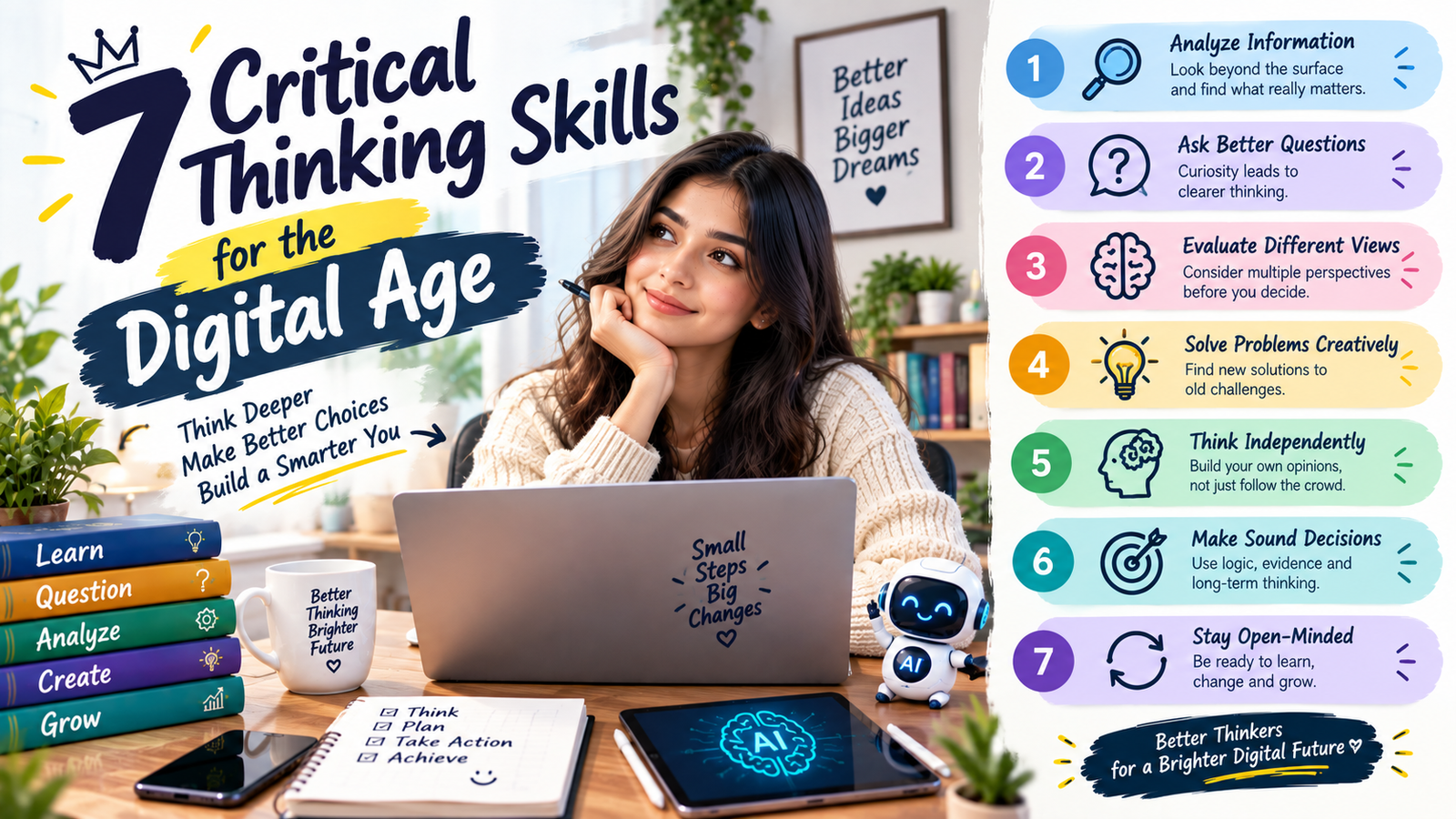
6. Perspective-Taking
People often interpret the same information differently because they have different experiences, goals, responsibilities, and sources of information. Perspective-taking helps you understand another person’s reasoning without automatically accepting their conclusion.
This skill is valuable in teamwork, leadership, customer service, education, negotiation, and online discussions. Understanding another viewpoint can reveal information you had not previously considered.
7. Problem-Solving
Problem-solving combines several reasoning abilities. Instead of immediately selecting a solution, define the problem, identify possible causes, collect relevant information, develop alternatives, compare trade-offs, and evaluate the result.
A practical process includes:
- Define the problem clearly.
- Separate symptoms from possible causes.
- Collect relevant evidence.
- Generate several possible solutions.
- Compare advantages and limitations.
- Select an approach based on the available evidence.
- Review the outcome and adjust the approach when necessary.
These steps turn Critical Thinking Skills into an everyday problem-solving process rather than an abstract academic concept.
Critical Thinking Skills for Online Information
Online information requires special attention because users frequently encounter content without knowing exactly where it originated. A headline, screenshot, short video, or social media caption may provide only part of a larger story.
When information appears important, pause before accepting it. Find the original source, examine the complete context, and determine whether the evidence supports the claim. This simple habit can significantly improve digital information literacy.
Check the Original Context
A quotation may have been shortened. A photograph may have been taken years earlier. A statistic may refer to a different population than the one being discussed. A video clip may remove what happened immediately before or after the section being shared. Context matters when evaluating whether information accurately represents the original source.
Strong Critical Thinking Skills encourage you to investigate the complete context before drawing a conclusion from a small piece of content.
Separate Facts From Interpretation
Imagine that a report states that a company increased sales during a particular period. The increase itself is a factual claim that can potentially be checked. Saying that a specific management strategy caused the increase is a further interpretation that may require additional evidence.
Learning to separate facts from interpretations makes it easier to recognize where evidence ends and opinion begins.
Watch for Emotional Language
Online content often uses emotional wording to capture attention. Emotional language does not automatically make information false, but it can encourage people to react before evaluating the underlying evidence.
When a post makes you immediately angry, excited, or afraid, pause and ask what the actual claim is. Then look for the evidence supporting it. This pause is a simple way to apply Critical Thinking Skills in everyday digital life.
How to Evaluate Online Sources
A useful source evaluation process can focus on authority, evidence, relevance, currency, and purpose.
| Evaluation Area | Questions to Ask |
|---|---|
| Authority | Who created or published the information? |
| Evidence | What information supports the main claims? |
| Relevance | Does the source actually address the question? |
| Currency | Is the information recent enough for this topic? |
| Purpose | Is the source informing, selling, persuading, or entertaining? |
These factors should be considered together. An older source may still be appropriate for historical research, while a new webpage may provide weak information if it lacks evidence or transparency.
Developing Critical Thinking Skills means learning how to judge a source according to the question being asked rather than relying on one simple rule.
Critical Thinking Skills and Artificial Intelligence
Generative AI has changed the way people search for and process information. AI tools can summarize documents, explain concepts, generate ideas, organize information, and assist with writing. These capabilities can save time, but fluent output should not automatically be treated as verified information.
AI-generated content may contain errors, missing context, outdated information, or unsupported statements. The appropriate response is not to reject AI completely. Instead, users should combine AI assistance with human evaluation and source verification.
How to Evaluate AI-Generated Information
- Define the task: Be clear about what you want the AI system to help with.
- Identify important claims: Separate major factual statements from general explanation.
- Verify consequential information: Check important facts using reliable sources.
- Examine assumptions: Ask what the answer may have overlooked.
- Compare alternatives: Consider whether another interpretation is possible.
- Keep human judgment involved: Use AI as an assistant rather than an unquestioned authority.
These practices make Critical Thinking Skills especially valuable when working with AI because users remain responsible for deciding whether generated information is suitable for the situation.
Critical Thinking Skills for Students
Students can develop stronger reasoning by moving beyond memorization and practicing evidence-based learning. When answering a question, students should be encouraged to explain not only what the answer is but also why it is supported.
Useful classroom and study activities include:
- Comparing two sources about the same subject.
- Identifying the evidence behind an argument.
- Checking the original source of a statistic.
- Finding assumptions in an opinion piece.
- Writing arguments from more than one perspective.
- Reviewing an incorrect answer and identifying the reasoning error.
- Explaining why one source is more relevant to a particular question.
Students can also build Critical Thinking Skills through research projects that require them to gather evidence, compare information, explain conclusions, and acknowledge uncertainty.
Critical Thinking Skills in the Workplace
Modern workplaces require employees to process information, solve problems, communicate decisions, and respond to changing circumstances. These tasks occur in almost every professional field.
A marketing employee may need to determine whether campaign results actually support a proposed strategy. A financial employee may need to investigate unusual numbers in a report. A software professional may need to determine whether a technical issue comes from code, configuration, data, or an external service. Strong data analysis skills can help professionals examine evidence and identify the most relevant explanation.
In each case, Critical Thinking Skills help employees avoid jumping to conclusions. The process involves defining the problem, collecting evidence, testing possible explanations, comparing alternatives, and reviewing the outcome.
Why Employers Value These Skills
Reasoning ability can improve the quality of workplace communication because employees can explain why they support a particular recommendation. It can also reduce avoidable mistakes by encouraging people to check assumptions before acting.
Employees with strong Critical Thinking Skills can contribute more effectively when information is incomplete or when a problem does not have an obvious solution.
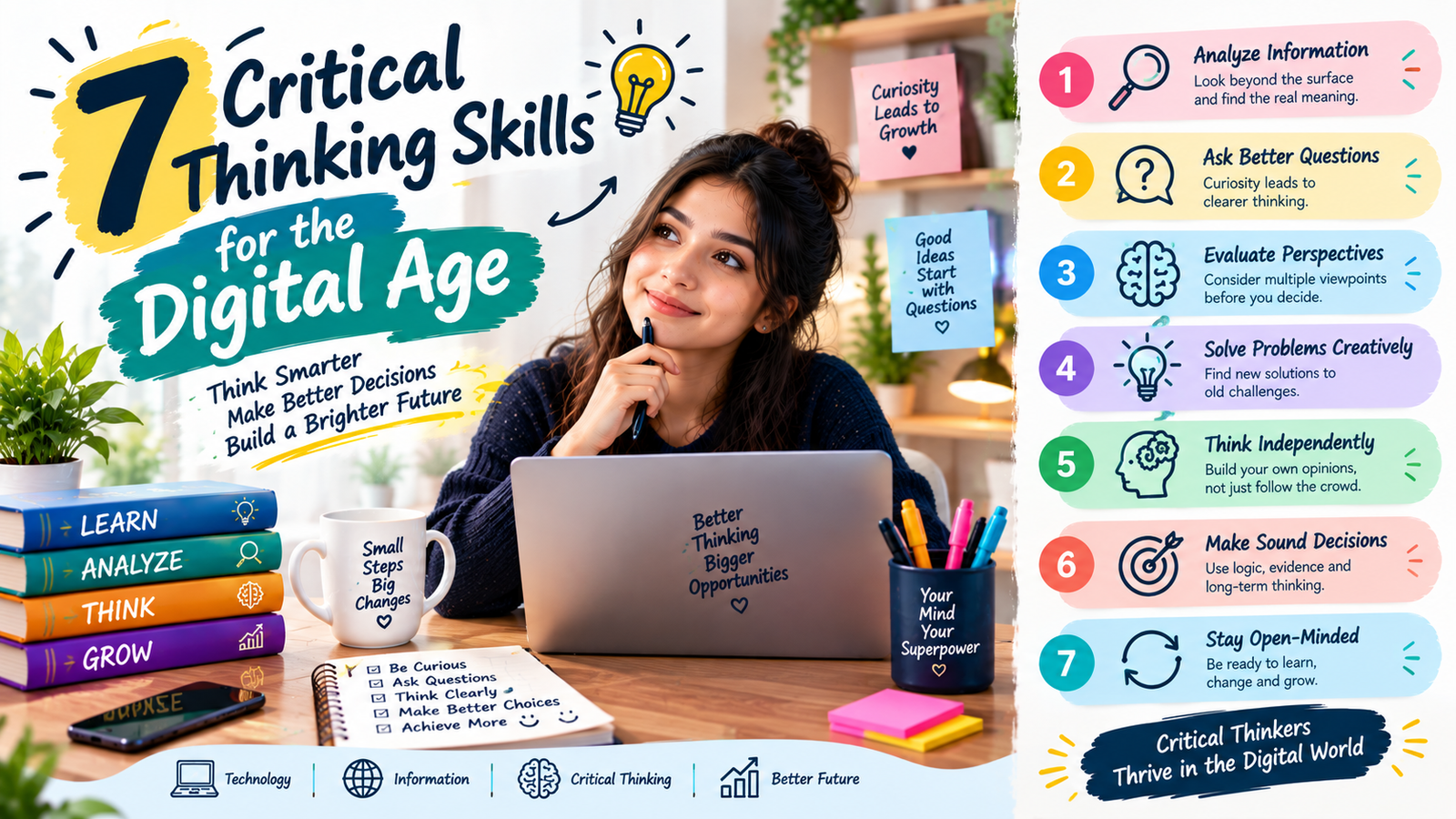
How to Develop Critical Thinking Skills
These abilities improve through regular practice rather than through memorizing a list of definitions. You can strengthen your reasoning by changing how you read, research, discuss, and review decisions.
Use the Five-Question Method
When you encounter an important claim, ask five basic questions:
- What exactly is being claimed?
- What evidence supports the claim?
- Where did the information come from?
- What assumptions are being made?
- What other explanation could fit the evidence?
Using these questions repeatedly can make Critical Thinking Skills part of your normal research routine.
Compare Multiple Credible Sources
For important topics, compare more than one reliable source. Look for agreement, disagreement, differences in evidence, missing context, and differences in interpretation.
The goal is not to find two sources that disagree and assume that both are equally credible. Instead, examine the quality and relevance of the evidence each source provides.
Keep a Reasoning Journal
A simple reasoning journal can record important decisions and the thinking behind them. Write down the decision, the evidence you considered, the assumptions you made, the alternatives you examined, and the result.
Review these notes later. If the outcome differed from what you expected, identify which assumption or piece of evidence was inaccurate. This creates a useful feedback loop for improving future decisions.
Explain Your Reasoning
Try explaining an important conclusion in three parts: what you believe, what evidence supports it, and what uncertainty remains. If you cannot explain the connection clearly, you may need more research.
This simple exercise develops Critical Thinking Skills while also improving communication because clear reasoning is easier for other people to evaluate.
Common Mistakes That Weaken Critical Thinking
Accepting Information Because It Looks Professional
Good design and confident language can create an impression of authority. However, visual quality is not evidence. Check who produced the information and what supports the claims.
Confusing Popularity With Accuracy
A post can receive thousands of views without being accurate. Popularity tells you that content attracted attention; it does not independently prove the underlying claim.
Searching Only for Information You Already Agree With
Confirmation bias can cause people to give more attention to evidence that supports existing beliefs. One way to reduce this problem is to deliberately search for credible information that challenges your initial conclusion.
Using One Example to Create a General Rule
Personal experiences can provide useful information, but a single example rarely proves a universal rule. Ask whether the evidence is broad enough to justify the conclusion.
Making Important Decisions Too Quickly
Speed is useful for routine decisions, but high-impact decisions deserve more careful analysis. Create a pause when the consequences of an error are significant.
Recognizing these mistakes is itself part of developing stronger Critical Thinking Skills.
Practical Examples of Critical Thinking
Example 1: Evaluating a Viral Claim
You see a social media post claiming that a product has an extraordinary benefit. Instead of sharing it immediately, identify the original source, check whether evidence exists, examine whether the information is promotional, and look for independent confirmation.
Example 2: Investigating a Workplace Problem
A project falls behind schedule and one employee is immediately blamed. A more careful process examines the timeline, workload, dependencies, communication, resources, and unexpected changes before deciding what caused the delay.
Example 3: Checking an AI Answer
An AI system gives you a detailed answer containing several specific facts. Rather than assuming the answer is correct because it sounds professional, identify the facts that matter most and verify them with reliable sources.
Example 4: Choosing an Online Course
A course advertisement promises fast professional results. A careful learner examines the curriculum, instructor information, learning outcomes, practical requirements, independent evidence, and whether the promised outcome is realistic for the learner’s situation.
These examples show how Critical Thinking Skills can be applied to ordinary situations instead of being limited to academic discussions.
Critical Thinking vs. Skepticism
Critical thinking is not the same as rejecting every claim. A person who refuses to believe anything without considering evidence is not necessarily reasoning well.
Good reasoning can result in accepting, rejecting, or temporarily withholding judgment about a claim. If evidence is strong, acceptance may be reasonable. If evidence is weak, rejection may be appropriate. If evidence is incomplete, uncertainty may be the most honest conclusion.
This distinction is important because effective Critical Thinking Skills require openness to evidence rather than automatic agreement or automatic disagreement.
Using Critical Thinking for Better Decisions
Better decisions often begin with better questions. Instead of asking only which option you should choose, first define the problem and identify the information that actually matters.
- Define the objective: What result are you trying to achieve?
- Identify constraints: What limits your choices?
- Gather evidence: Which information is relevant?
- Generate alternatives: What other approaches are available?
- Assess trade-offs: What advantages and disadvantages come with each option?
- Make the decision: Select an approach based on the available evidence.
- Review the result: Identify what worked and what should change next time.
This framework turns Critical Thinking Skills into a practical decision-making system that can be used at school, at work, or in personal projects.
Expert Tips for Stronger Digital Reasoning
- Pause before sharing: Verify important information before passing it to others.
- Trace claims backward: Find the original study, document, statement, or dataset when possible.
- Separate uncertainty from ignorance: Not knowing enough to conclude something is different from proving it false.
- Use primary sources when practical: Original material can provide context that summaries may omit.
- Challenge your first explanation: Ask what else could explain the same evidence.
- Match research effort to risk: Spend more time verifying information when an error could have serious consequences.
- Review your decisions: Learn from outcomes instead of treating every decision as finished once it has been made.
These habits make Critical Thinking Skills easier to apply consistently because they turn abstract reasoning into repeatable actions.
Building a Daily Critical Thinking Practice
You do not need to wait for a difficult problem to practice reasoning. Everyday digital activities can become opportunities to strengthen your analytical habits.
When reading an article, identify its main claim. When watching a video, ask what evidence supports its conclusion. When using an AI tool, verify important factual statements. When someone presents a strong opinion, separate the underlying facts from the interpretation. These habits can be strengthened through practical computer skills.
You can also choose one piece of online information each day and spend five minutes checking its original source. Over time, this simple routine can improve your ability to identify credible information quickly.
Another useful exercise is to write down one belief you currently hold and ask what evidence could change your mind. The exercise encourages intellectual flexibility and reduces the tendency to treat existing beliefs as permanently fixed.
With regular practice, Critical Thinking Skills become less like a formal technique and more like a natural part of how you process information.
How Critical Thinking Supports Digital Literacy
Digital literacy involves more than knowing how to use devices, websites, applications, and online services. It also includes understanding how digital information is created, distributed, interpreted, and evaluated.
A digitally capable person can search effectively, but a critically minded digital user also understands that search results are not automatically evidence. A person can use AI, but should also know when AI output requires verification. A person can participate in social media while recognizing that engagement does not equal accuracy.
For this reason, Critical Thinking Skills are an important part of practical digital literacy. They help users make better use of technology without surrendering their judgment to whatever information appears first.
Why Lifelong Learning Requires Better Reasoning
Information changes continuously. New technologies appear, professional requirements evolve, and established practices can be updated by new research. Lifelong learners therefore need the ability to evaluate new information instead of relying entirely on what they learned in the past.
This does not mean abandoning previous knowledge. It means understanding that good knowledge can be refined when better evidence becomes available.
People who consistently practice Critical Thinking Skills are better prepared to ask whether new information is relevant, whether an old assumption still applies, and what additional evidence is needed before changing a decision.
Frequently Asked Questions
What are Critical Thinking Skills?
Critical Thinking Skills are abilities used to evaluate information, examine evidence, question assumptions, compare alternatives, solve problems, and reach reasonable conclusions. They help people make decisions based on evidence rather than impulse or unsupported claims.
Why are Critical Thinking Skills important in the digital age?
Critical Thinking Skills are important because people encounter large amounts of information through search engines, social media, websites, videos, and AI systems. Careful reasoning helps users determine which information is relevant, credible, and adequately supported.
How can students improve Critical Thinking Skills?
Students can improve Critical Thinking Skills by comparing credible sources, asking evidence-based questions, explaining their reasoning, identifying assumptions, examining alternative viewpoints, and reviewing mistakes to understand where their reasoning went wrong.
How does AI affect Critical Thinking Skills?
AI can support research, brainstorming, writing, and analysis, but users still need Critical Thinking Skills to evaluate generated information. Important claims should be checked against appropriate sources before they are used for consequential decisions.
Are Critical Thinking Skills the same as skepticism?
No. Skepticism can support careful evaluation, but Critical Thinking Skills also require considering evidence fairly. The goal is not to reject information automatically but to reach conclusions that match the quality of the available evidence.
Can Critical Thinking Skills be learned?
Yes. Critical Thinking Skills can be developed through repeated practice with source evaluation, evidence analysis, problem-solving, questioning assumptions, comparing alternatives, and reviewing previous decisions.
Conclusion
The digital age has made information more accessible, but accessibility does not guarantee accuracy, relevance, or context. Strong Critical Thinking Skills provide a practical framework for navigating this environment with greater care.
The most useful habits are straightforward: identify the claim, examine the evidence, verify important sources, question assumptions, consider alternative explanations, separate facts from opinions, and remain willing to update your conclusion when stronger evidence becomes available.
These abilities can support students, professionals, researchers, entrepreneurs, and everyday internet users. By practicing Critical Thinking Skills consistently, you can become more deliberate about the information you consume, the problems you solve, and the decisions you make in an increasingly digital world.