
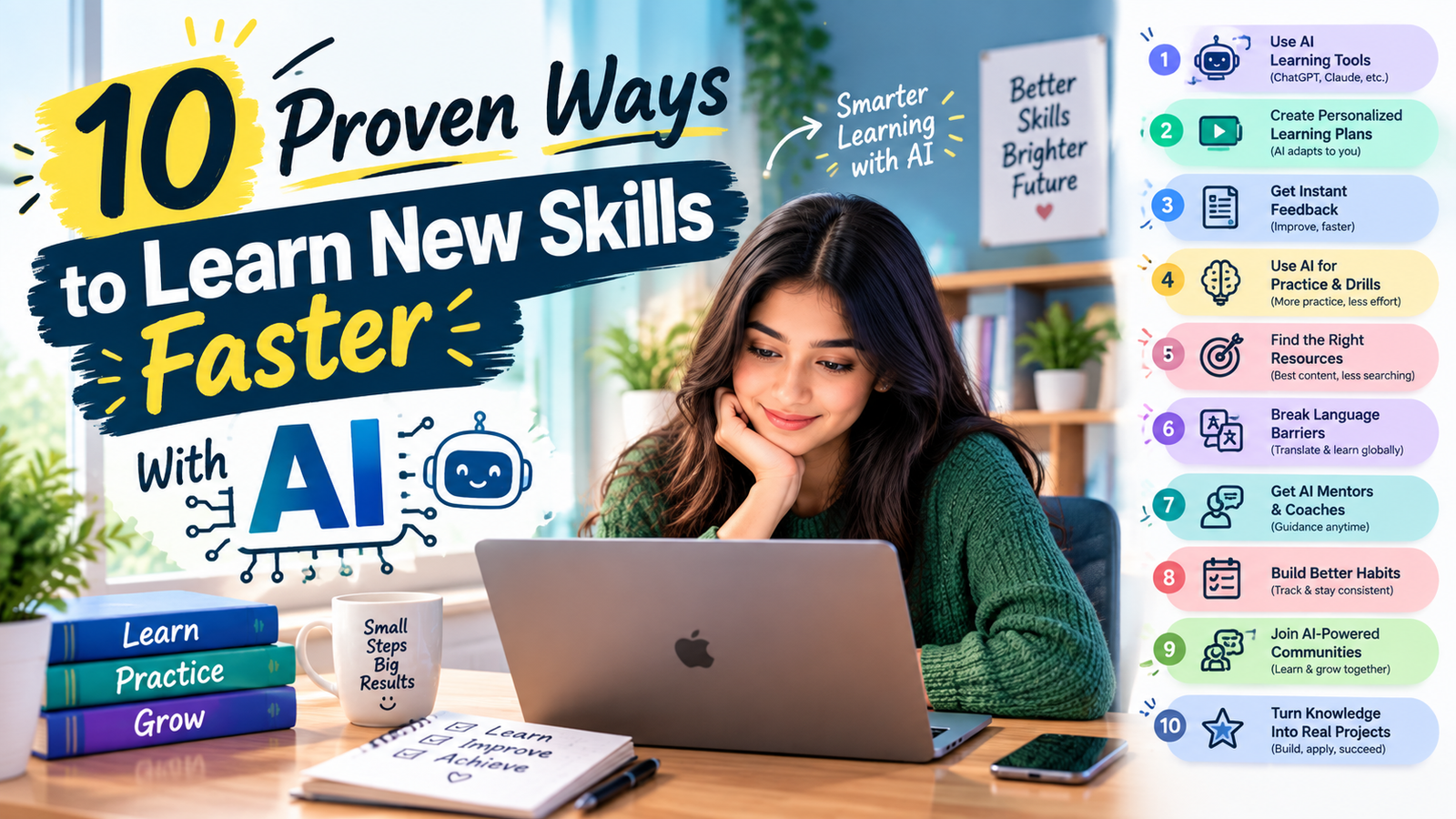
Learning a valuable skill can improve your career, increase your confidence, and open the door to new opportunities. The challenge is knowing what to study, how to practice, and how to measure real progress. Artificial intelligence has made this process more flexible because learners can now receive explanations, exercises, feedback, quizzes, examples, and practice scenarios on demand. Used properly, AI can help you learn new skills faster without removing the effort required to build genuine ability.
The purpose of using AI for education is not to avoid thinking or practice. Instead, it is to make learning more focused and interactive. You can use AI as a tutor when a concept is confusing, a practice partner when you need repetition, and a reviewer when you want feedback on your work. This approach can make the learning process more efficient while keeping human judgment and independent problem-solving at the center.
Whether you want to improve writing, coding, communication, marketing, research, design, data analysis, project management, or another professional skill, AI can support your learning journey. This guide explains ten practical ways to use AI effectively, along with common mistakes, useful prompting methods, and strategies for turning knowledge into real-world ability.
1. Define Exactly What You Want to Learn
The first step to learn new skills faster is creating a specific learning goal. A broad objective such as “I want to learn technology” is difficult to act on because technology includes hundreds of subjects. A better goal identifies a specific ability and the result you want to achieve.
For example, instead of saying that you want to learn digital marketing, you could decide that you want to create SEO content for a small business website. Instead of saying that you want to learn programming, choose a language and identify what you want to build with it.
A clear goal helps AI provide more relevant assistance. When you explain your current experience, desired outcome, available time, and intended use of the skill, AI can help organize the learning process around those requirements.
Before beginning, ask yourself:
- What exact skill do I want to develop?
- Why do I want to develop it?
- Where will I use the skill?
- What should I be able to do independently?
- How will I know that I have improved?
A measurable goal also prevents unnecessary learning. You do not need to master every part of a subject if your actual objective requires only a specific set of abilities.
2. Ask AI to Build a Personalized Learning Roadmap
One of the most practical ways to learn new skills faster is to create a structured roadmap before starting. A roadmap gives you a logical sequence and prevents you from jumping randomly between unrelated tutorials.
Suppose you want to learn data analysis. Your roadmap might begin with spreadsheet fundamentals, followed by formulas, data cleaning, visualization, basic statistics, SQL, and reporting. Each stage builds on knowledge from the previous stage. For additional guidance, explore data analysis.
Ask AI to divide your chosen skill into beginner, intermediate, and advanced levels. You can also ask it to identify prerequisites. This is especially helpful when you are unfamiliar with the subject and do not know which concepts should come first.
A useful roadmap can include:
- Core concepts
- Practical exercises
- Learning milestones
- Small projects
- Review sessions
- Common mistakes
- Suggested next steps
However, an AI-generated roadmap should be treated as a planning tool rather than an unquestionable curriculum. For technical, academic, or professional subjects, compare important information with reliable books, official documentation, recognized institutions, and other authoritative resources.
3. Turn AI Into a Personal Tutor
AI can help you learn new skills faster by providing an interactive learning experience. Instead of reading an entire lesson and waiting until the end to discover that something is confusing, you can ask questions immediately.
For example, if you are studying accounting and do not understand a balance sheet, ask AI to explain it using a simple business example. Then ask for a short practice question. Complete the question independently and request feedback afterward.
The same method works for programming, writing, design, communication, mathematics, research, and many other subjects. You can ask AI to explain one concept at a time and adjust the explanation according to your level.
If an explanation feels too technical, ask for simpler language. If it feels too basic, request a more advanced example. You can also ask for analogies, practical scenarios, quizzes, or step-by-step exercises.
This makes learning conversational instead of passive. Rather than consuming a fixed lesson, you can actively investigate the areas that are most difficult for you.
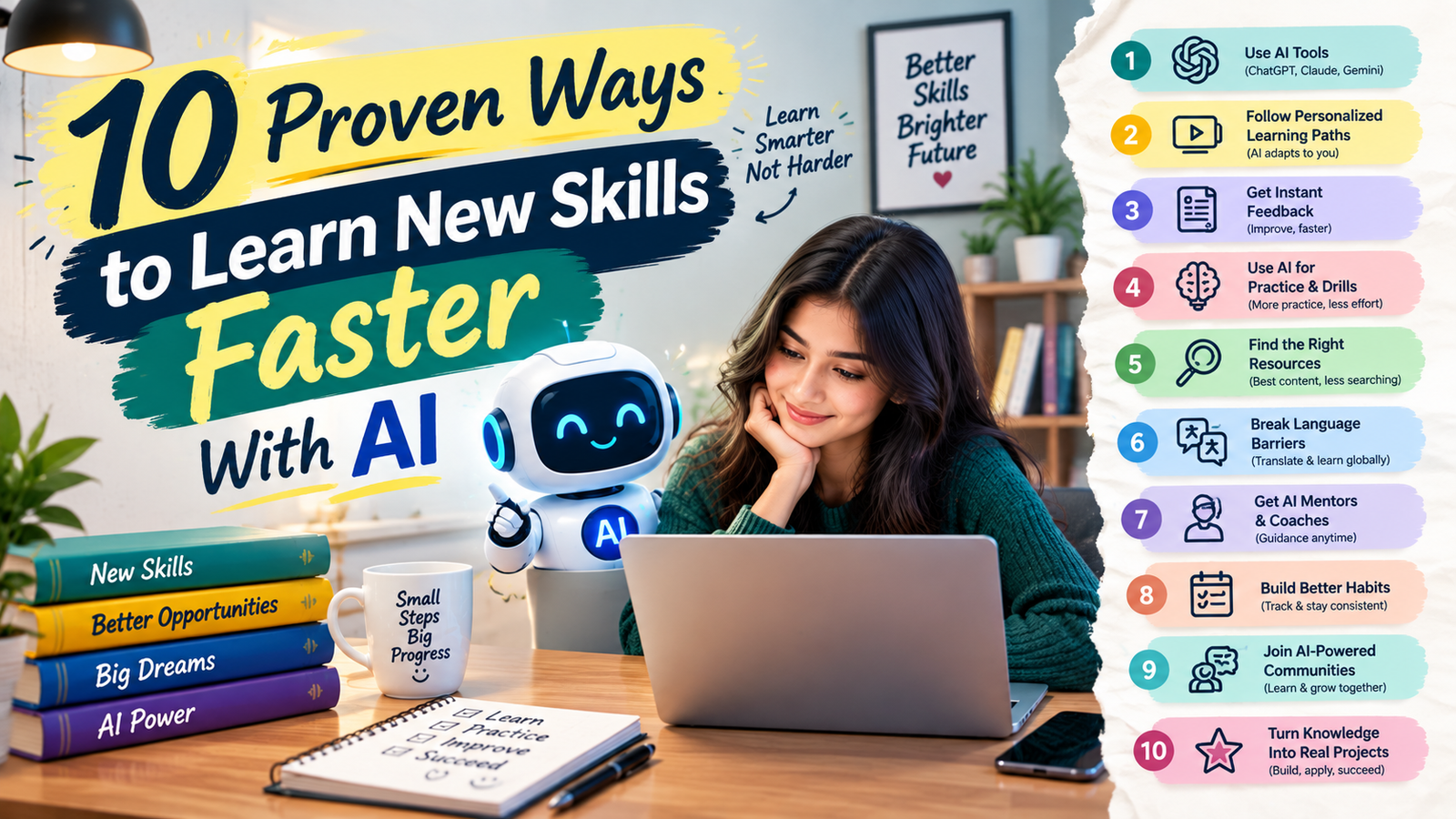
4. Break Difficult Subjects Into Smaller Lessons
Trying to understand an entire subject at once can make learning stressful. A better strategy to learn new skills faster is to divide complex topics into smaller units.
Consider search engine optimization as an example. Instead of trying to understand all SEO concepts at once, separate the subject into search intent, keyword research, on-page optimization, internal linking, technical SEO, content quality, structured data, and performance analysis. Explore SEO basics for additional guidance
Ask AI to teach one area at a time. After each lesson, complete a short exercise that demonstrates your understanding. Once you can apply the concept independently, move to the next topic.
This approach reduces information overload and makes revision easier. If you later discover a weakness, you can return to one specific concept instead of repeating an entire course.
Breaking a large skill into smaller lessons is also useful for busy professionals. Even a short daily session can produce meaningful progress when the learning objective is focused.
5. Prioritize Active Practice Over Passive Reading
Reading about a skill is not the same as being able to perform it. To learn new skills faster, spend a significant portion of your study time doing practical work.
If you are learning writing, write. If you are learning coding, create programs. If you are learning graphic design, produce designs. If you are learning public speaking, practice speaking. If you are learning data analysis, work with datasets and create reports.
AI can generate exercises based on your current ability. Start with manageable tasks and increase the difficulty as your confidence grows.
A simple practice cycle is:
- Study one concept.
- Attempt a task independently.
- Review your result.
- Identify mistakes.
- Correct the mistakes.
- Repeat the task with greater difficulty.
This method forces you to retrieve and apply knowledge. It also reveals weaknesses that may remain hidden when you only watch videos or read explanations.
Whenever possible, attempt an exercise before asking AI for the solution. The struggle involved in solving a problem is part of the learning process.
6. Use AI to Understand Your Mistakes
Feedback is essential if you want to learn new skills faster. Instead of simply asking AI to correct your work, ask it to explain why your mistake happened.
For example, a beginner programmer can provide an error message and ask AI to explain the underlying concept. A writer can submit a paragraph and ask which sentences reduce clarity. A spreadsheet learner can ask why a formula produces an unexpected result.
A useful instruction is: “Review my work like a tutor. Identify my three most important mistakes, explain why they occurred, and give me one exercise for each weakness.”
This approach turns correction into education. You are not simply receiving a replacement answer. You are learning the principle that allows you to avoid the same mistake later.
Keep track of recurring problems. If the same weakness appears several times, ask AI to create targeted practice around that area. Repeated practice can gradually turn a weak point into a strength.
7. Build a Consistent Daily Learning Routine
Consistency can make it easier to learn new skills faster because regular practice keeps important ideas active in your memory. You do not necessarily need several hours every day. A focused routine can be more sustainable.
A 45-minute learning session might include:
- 10 minutes reviewing previous material
- 15 minutes learning a new concept
- 15 minutes completing a practical exercise
- 5 minutes recording mistakes and planning the next session
You can adjust this schedule based on your responsibilities. Students may use shorter sessions during busy periods, while professionals may study before or after work.
AI can help prepare your next exercise, create review questions, and organize weekly milestones. This reduces the time you spend deciding what to study.
The best routine is not necessarily the most intensive one. It is the routine you can maintain consistently for weeks and months.
8. Use Quizzes and Active Recall
Another effective way to learn new skills faster is to test your knowledge instead of repeatedly reading the same material. Familiarity with an explanation does not always mean that you can recall or apply the concept independently.
Ask AI to create short quizzes based on topics you have already studied. Tell it to hide the answers until you respond. This forces you to retrieve information from memory.
You can request:
- Multiple-choice questions
- Short-answer questions
- Scenario-based problems
- True-or-false questions
- Practical exercises
- Explain-it-in-your-own-words questions
Start with basic questions and gradually move toward application-based problems. If you repeatedly struggle with one concept, return to the relevant lesson and practice it again.
AI can also mix old and new topics in the same quiz. This helps you determine whether you actually understand the concepts rather than simply remembering the order in which they were presented. Explore active learning for additional learning strategies.
9. Build Real Projects
Projects provide an important bridge between knowledge and practical ability. If you want to learn new skills faster, create something that requires you to use several concepts together.
If you are learning web development, create a simple website. If you are studying data analysis, prepare a report using a public dataset. If you are learning marketing, develop a campaign plan for a fictional company. If you are improving communication, prepare and deliver a professional presentation.
AI can help you define project requirements, divide the project into milestones, generate test cases, review your work, and identify possible gaps.
However, avoid allowing AI to complete the entire project for you. If the goal is learning, you should make the important decisions and attempt the challenging parts yourself.
A useful project should resemble the type of work you eventually want to perform. Realistic projects also give you something concrete to show employers, clients, teachers, or collaborators.
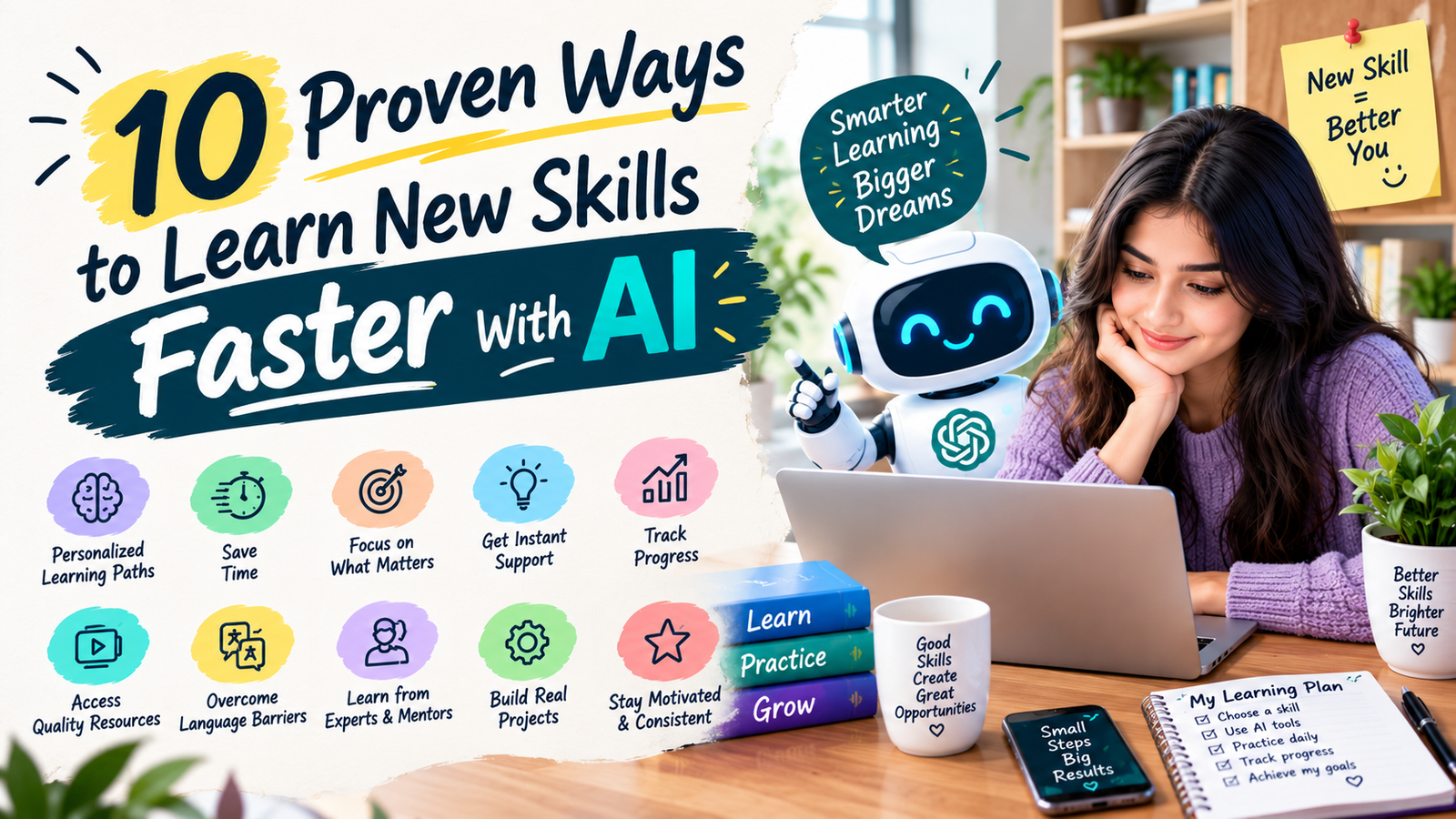
10. Simulate Real-World Problems With AI
Real professional situations rarely provide perfectly structured questions. To learn new skills faster at a practical level, you need to practice situations where information is incomplete and decisions are required. This approach can help you learn new skills faster by developing practical judgment.
AI can simulate these situations. Ask it to create a customer complaint, job interview, business problem, technical issue, research challenge, or project requirement. Then respond as though you were handling the situation professionally. Practicing realistic scenarios can help you learn new skills faster through active problem-solving.
A person learning sales could practice responding to an unhappy customer. A job seeker could simulate an interview. A manager could practice giving constructive feedback. A developer could troubleshoot a fictional software issue.
After the exercise, ask AI to review your reasoning. Instead of asking for a simple score, request specific observations about what worked, what was missing, which assumptions were weak, and what could be improved. Detailed feedback makes it easier to learn new skills faster and correct mistakes.
Simulation helps you move beyond memorized information and develop judgment that can be applied in unfamiliar situations. By combining realistic practice with feedback, you can learn new skills faster and become more confident when facing real professional challenges.
How to Write Better AI Prompts for Learning
Well-structured prompts can help you learn new skills faster because they provide AI with the context needed to produce useful learning material. A vague request often produces a broad answer that may not match your level or objective.
A useful learning prompt can include five elements:
- Current level: Tell AI whether you are a beginner, intermediate learner, or experienced professional.
- Learning goal: Explain exactly what you want to accomplish.
- Context: Describe where you expect to use the skill.
- Learning format: Request lessons, examples, exercises, quizzes, or simulations.
- Feedback method: Explain how you want mistakes to be reviewed.
For example, instead of asking “Teach me Excel,” explain that you want to analyze sales data for a small business. Ask for a beginner roadmap, short lessons, practical exercises, and a final project. Tell the AI not to reveal answers until you attempt each exercise.
Specific prompts create a more useful learning environment because the AI understands both your destination and your current starting point.
Use Spaced Review to Strengthen Memory
Fast understanding is useful, but long-term retention matters too. When you learn new skills faster, you should still create opportunities to review important information after the initial lesson.
AI can turn your previous notes into short review questions. Instead of rereading everything, test whether you can explain important ideas from memory.
You can review a topic after a short interval, then again later in the week and at longer intervals. Difficult concepts can receive more frequent review, while familiar material can be reviewed less often.
Ask AI to mix older concepts with newer ones. This makes practice more challenging and helps you identify which concept should be used in different situations.
Spaced review is especially useful for terminology, formulas, vocabulary, technical concepts, procedures, and other information that needs to remain accessible over time.
Combine AI With Human Feedback
AI can help you learn new skills faster, but human feedback remains valuable for many forms of learning. Teachers, mentors, colleagues, managers, and experienced professionals can provide practical context that an automated system may miss.
For example, AI might identify grammar problems in a report, while an experienced manager can explain whether the report actually supports a business decision. AI can explain programming concepts, while an experienced developer may identify maintainability or workflow concerns.
Whenever possible, combine AI-assisted practice with human review. Ask knowledgeable people to evaluate important projects and compare their observations with AI feedback.
Different perspectives can reveal weaknesses that are difficult to identify on your own. This combination is particularly valuable when learning professional skills that involve judgment, communication, teamwork, or industry-specific standards.
Verify Important Information
Critical thinking remains essential if you want to learn new skills faster with AI. AI systems can sometimes produce inaccurate, incomplete, or outdated information.
This matters most in high-stakes areas such as medicine, law, finance, safety, professional regulations, and technical subjects that change frequently.
When studying software or programming, use official documentation as an important reference. For academic subjects, consult recognized educational institutions, textbooks, and primary research when appropriate. When learning about regulations or official requirements, check the relevant authority.
AI is useful for explaining information and organizing learning, but important decisions should be based on reliable sources rather than an unchecked response.
Measure Progress Through Performance
A practical way to learn new skills faster is to measure what you can actually do instead of counting how many hours you studied.
Completing a ten-hour course does not prove mastery. A better measure is whether you can perform a realistic task without step-by-step assistance.
For example, someone learning Excel should eventually be able to analyze a dataset independently. A writing learner should be able to produce clear content for a specific audience. A beginner programmer should be able to build and troubleshoot a small project.
Useful progress indicators include:
- Completing tasks without assistance
- Explaining important concepts clearly
- Correcting mistakes independently
- Handling unfamiliar problems
- Creating useful projects
- Applying the skill in realistic situations
These outcomes provide stronger evidence of development than the number of lessons, videos, or AI prompts completed.
Common Mistakes When Using AI for Learning
Although AI can help people learn new skills faster, poor use of the technology can reduce learning quality. The biggest problem is allowing AI to perform all the difficult work.
If AI writes every paragraph, solves every problem, creates every design, or produces every line of code, you may receive a finished result without developing the ability to create that result independently.
Other common mistakes include:
- Starting without a specific goal
- Collecting information without practicing
- Copying answers without understanding them
- Skipping foundational concepts
- Using overly broad prompts
- Ignoring repeated mistakes
- Accepting AI responses without verification
- Trying to learn too many subjects at the same time
The solution is to keep yourself responsible for the actual learning. Use AI for guidance and feedback, but attempt important tasks yourself before asking for a complete solution.
Stay Motivated With Small Milestones
Motivation can change during a long learning journey. Small milestones can make it easier to learn new skills faster without becoming overwhelmed by the size of the final goal.
Instead of focusing only on becoming an expert, recognize smaller achievements. Completing a first project, solving a difficult problem independently, explaining a complicated concept, or improving a weak area are all useful indicators of progress.
Keep a simple learning record containing what you studied, what you practiced, what mistakes you made, and what you can now do independently.
AI can review this record and suggest a suitable next challenge. However, avoid turning learning into a race. Sustainable progress is more valuable than completing a large number of lessons quickly.
Create a Repeatable AI Learning System
Once you begin to learn new skills faster with AI, build a repeatable process that can be applied to different subjects.
A simple four-stage system is:
- Learn: Study one focused concept.
- Practice: Apply the concept without unnecessary assistance.
- Review: Use AI and human feedback to identify weaknesses.
- Apply: Use the skill in a realistic project or situation.
Store useful notes, project lessons, mistakes, and important examples in an organized location. Over time, this creates a personal knowledge system that can make future learning easier.
You can also ask AI to connect new concepts with things you already understand. Connecting new information with existing knowledge can make unfamiliar topics easier to remember and apply.
Which Skills Can You Learn With AI?
Many knowledge-based and communication-focused abilities can benefit from AI-assisted learning. These include writing, coding, research, marketing, data analysis, language learning, presentation skills, project planning, customer communication, and many areas of digital work. AI can provide personalized explanations and practice opportunities that help learners learn new skills faster.
AI is particularly useful when a learner needs frequent explanations, repeated practice, or immediate feedback. Language learners can simulate conversations, writers can review drafts, and programmers can discuss debugging strategies. These interactive learning methods make it easier to learn new skills faster while building confidence through regular practice.
Learners can also use AI to create customized exercises based on their current ability. By adjusting the difficulty and receiving targeted feedback, they can learn new skills faster without spending too much time on topics they already understand.
However, AI cannot replace every real-world learning environment. Physical skills may require equipment, instructors, workshops, laboratories, supervised practice, or direct observation. AI can explain a process, but hands-on experience remains important when the skill depends on physical performance. Combining AI guidance with practical experience can help people learn new skills faster and apply their knowledge more effectively.
For the best results, use AI as a learning assistant rather than a complete replacement for practice, instructors, or real-world experience. This balanced approach can help you learn new skills faster while developing skills that remain useful beyond the learning environment.
How to Get Better Results From AI Learning
If you want to learn new skills faster, focus on quality rather than the number of prompts you send. Give AI enough context to understand your goal, but keep each learning task focused. A clear, targeted approach can help you learn new skills faster without becoming overwhelmed by too much information.
Ask for one concept, one exercise, and one feedback cycle at a time. This prevents long responses from becoming overwhelming and gives you a practical way to learn new skills faster. When you finish an exercise, ask AI to identify the most important weakness instead of listing every minor issue.
You can also ask AI to challenge your assumptions. Tell it to provide counterexamples, difficult scenarios, common misconceptions, or problems that require you to combine several concepts. This type of practice can help you learn new skills faster by making your learning more active and challenging.
This encourages deeper learning because you are not simply memorizing standard explanations. You are testing whether you can adapt your knowledge to unfamiliar situations, which makes it easier to learn new skills faster and apply what you know in real-world situations.
Regularly reviewing your progress also helps you learn new skills faster because you can identify what is working and where you need more practice.
A Practical Weekly Plan
A weekly structure can help you learn new skills faster while keeping your workload manageable. A clear routine gives you regular opportunities to learn new skills faster without feeling overwhelmed by a heavy study schedule.
On the first day, define the week’s learning objective and study the core concept. On the second day, complete basic exercises. On the third day, practice a slightly harder task. On the fourth day, review mistakes and weak areas. On the fifth day, complete a realistic project task. On the sixth day, test yourself with AI-generated questions. On the seventh day, review progress and plan the following week. Following this cycle can help you learn new skills faster by balancing different types of learning activities and developing practical job skills.
This structure can be adjusted to fit your schedule. The important principle is to combine learning, practice, review, and application rather than spending the entire week consuming information. When these activities work together, you can learn new skills faster while building stronger long-term understanding.
Frequently Asked Questions
Can AI really help me learn new skills faster?
Yes. AI can provide personalized explanations, practice exercises, quizzes, feedback, simulations, and study plans. However, genuine improvement still requires active practice, independent thinking, repetition, and application.
What is the best way to use AI for learning?
Use AI as a tutor, practice partner, reviewer, and planning assistant. Ask for explanations when confused, exercises when you need practice, and feedback after attempting a task yourself.
Can beginners use AI to develop professional skills?
Yes. Beginners can use AI to break complex subjects into smaller lessons and request explanations that match their current level. Important information should still be verified using reliable sources.
How much time should I spend learning with AI?
There is no universal number of hours. A consistent daily session can be effective when it combines focused learning, active practice, review, and feedback. Your ideal schedule depends on your goal and available time.
Should AI complete exercises for me?
No, not when the objective is genuine skill development. Try the exercise yourself first, then use AI for hints, explanations, feedback, or corrections. This helps you understand the process rather than simply receiving the answer.
How can I tell whether I have actually learned a skill?
Complete a realistic task without assistance. You should be able to explain your decisions, identify and correct mistakes, solve unfamiliar problems, and apply the skill to a practical project.
Conclusion
The goal of AI-assisted learning is not simply to finish lessons quickly. It is to build useful abilities that you can apply independently. To learn new skills faster, begin with a specific goal, create a practical roadmap, break complex topics into smaller lessons, and spend more time practicing than passively reading.
Use AI to explain difficult concepts, generate exercises, test your memory, review mistakes, simulate realistic situations, and suggest the next challenge. At the same time, verify important information and seek human feedback when professional judgment or hands-on experience matters.
The strongest learning system combines technology with deliberate practice. AI can reduce unnecessary friction and provide personalized support, but your own effort remains the foundation of progress. When you use AI as a learning partner rather than a shortcut, you can make the learning process more structured, interactive, and practical while developing skills that remain valuable beyond the technology itself.