
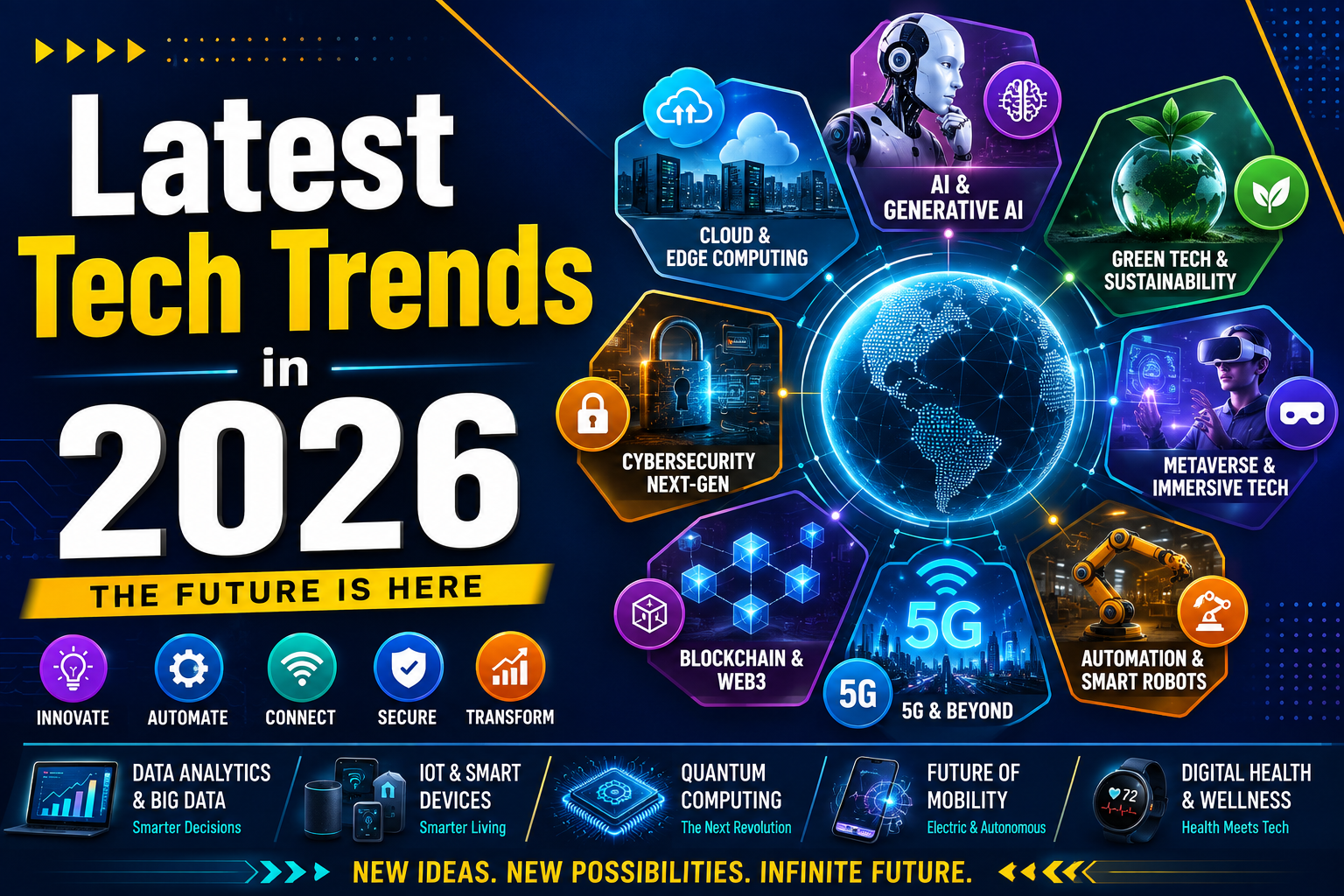
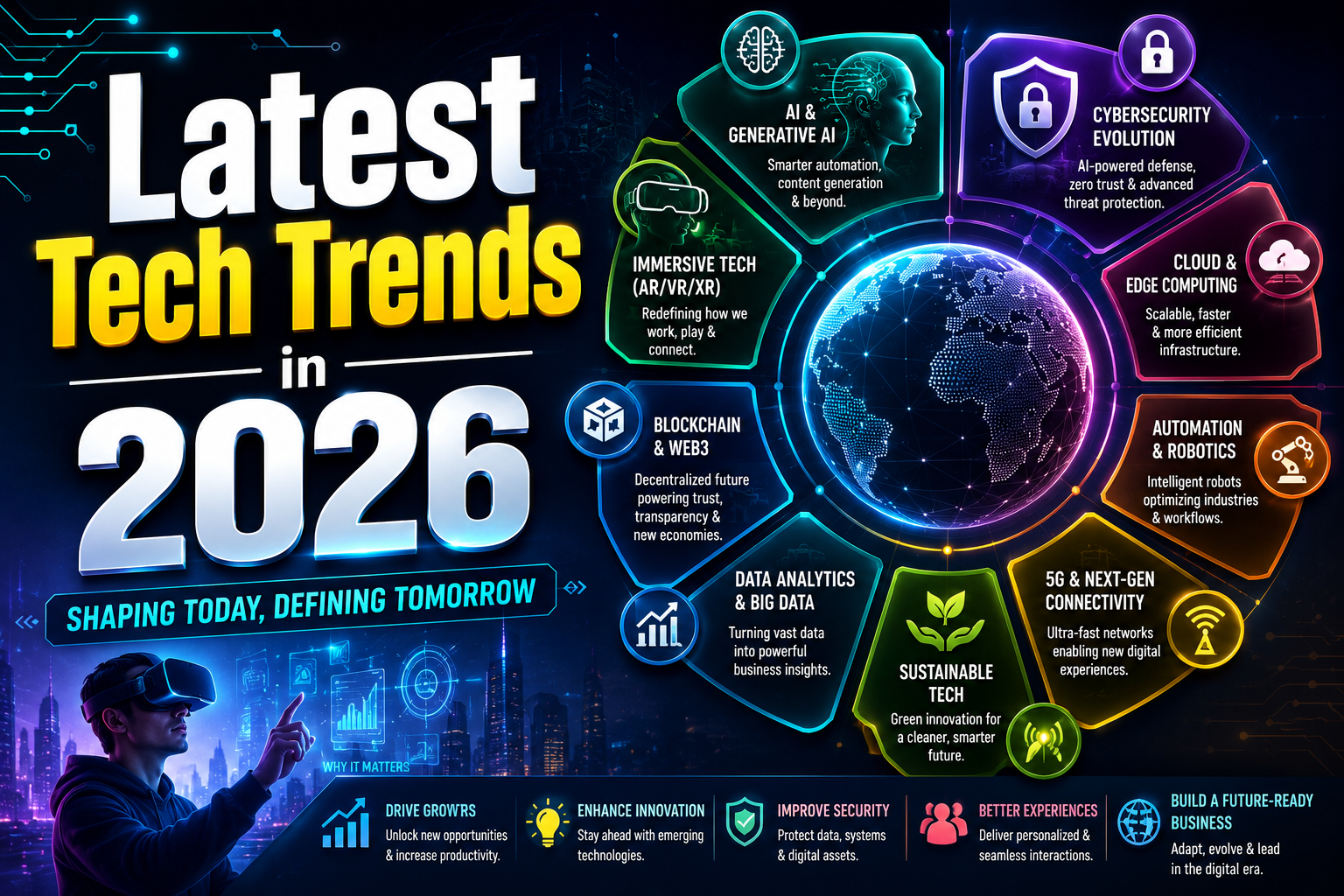
The tech trends in 2026 are moving beyond simple AI chatbots and isolated digital tools. Businesses and consumers are increasingly adopting agentic AI, intelligent robotics, AI-native software, specialized computing, cybersecurity technologies, edge intelligence, quantum technologies, and advanced energy systems.

For anyone trying to understand where technology is heading, these developments matter because they are changing how companies operate, how software is built, how machines interact with the physical world, and how digital information is protected. This guide explores the most important tech trends in 2026, their practical applications, and what businesses and professionals should watch next.
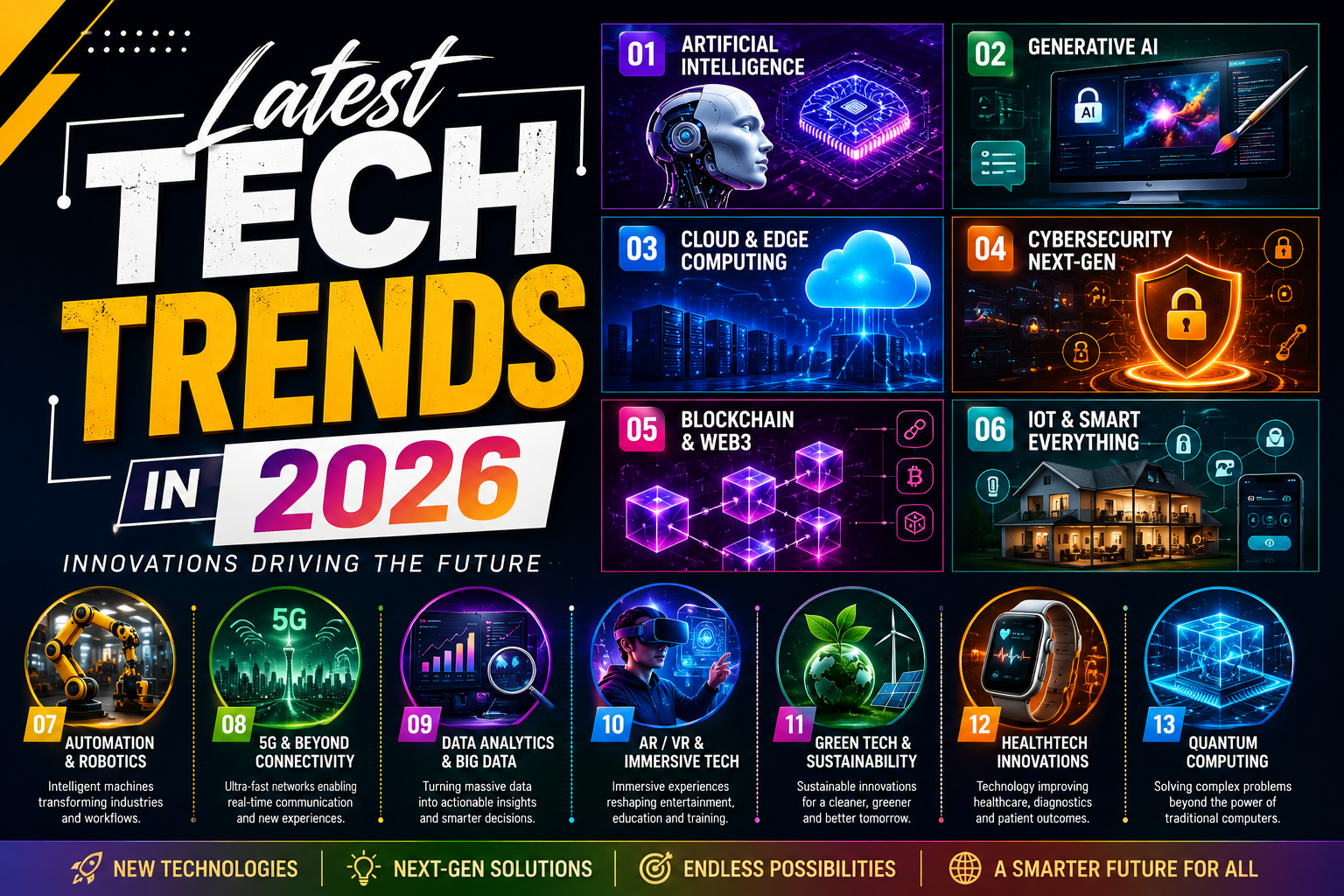
Key Tech Trends in 2026
- Agentic AI and multiagent systems
- Physical AI and advanced robotics
- AI-native software development
- AI supercomputing and specialized chips
- Quantum computing and post-quantum security
- AI cybersecurity and confidential computing
- Digital provenance and trusted information
- Edge AI and distributed computing
- Spatial computing
- AI-powered biotechnology
- Next-generation energy technologies
1. Agentic AI Is Moving From Answers to Actions
One of the most important tech trends in 2026 is agentic AI. Traditional generative AI typically responds to prompts, while AI agents can be designed to plan tasks, use software tools, make decisions, and complete multiple steps toward a defined objective.
Multiagent systems take this concept further by allowing several specialized AI agents to work together. For example, one agent could collect information, another could analyze it, and another could execute a workflow.
This shift makes AI increasingly useful for business operations rather than limiting it to writing, summarization, or question answering. Gartner identifies agentic AI and collaborative multiagent systems among the strategic technology areas gaining attention in 2026.
Where Agentic AI Can Be Used
- Customer service
- Research workflows
- Software development
- Marketing automation
- Data analysis
- Supply chain management
- Business process automation
The main challenge is control. Organizations need appropriate permissions, monitoring, security policies, and human oversight before autonomous systems can make important business decisions.
2. Physical AI and Smarter Robotics
Another major development among the tech trends in 2026 is the expansion of AI into physical environments. Physical AI combines machine learning, computer vision, sensors, robotics, and real-world data to help machines understand and respond to their surroundings.
Robots are already widely used in manufacturing, logistics, warehouses, and other controlled environments. AI can make these systems more adaptable by allowing them to recognize objects, respond to changing conditions, and perform more complex tasks.
Humanoid robots are receiving considerable attention, but industrial robotics may offer more immediate business value because factories and warehouses provide structured environments where automation can be easier to implement.
3. AI-Native Software Development
Software development is also changing rapidly. AI-native development uses artificial intelligence throughout parts of the software lifecycle, including coding, debugging, testing, documentation, and application design.
Developers can use AI coding assistants to generate routine code and explore solutions faster. However, human developers remain important for architecture, security, testing, product decisions, and quality control.
One of the most practical tech trends in 2026 is therefore not replacing software developers but increasing their productivity through AI-assisted workflows.
4. AI Supercomputing and Specialized Chips
The rapid expansion of AI requires powerful computing infrastructure. Modern AI workloads can require large numbers of processors, high-speed networking, advanced memory, and specialized accelerators.
AI-focused hardware includes GPUs, custom accelerators, specialized chips, and increasingly sophisticated data-center systems. These technologies are designed to process AI workloads efficiently at scale.
Gartner forecasts strong growth in worldwide IT spending in 2026, with data-center systems benefiting from the increasing demand for AI infrastructure.
Why AI Hardware Matters
General-purpose processors are not always the most efficient option for intensive AI workloads. Specialized hardware can improve performance for tasks such as model training, inference, simulation, and large-scale data processing.
As AI applications become more common, computing infrastructure will remain an important part of the tech trends in 2026 landscape.
5. Quantum Computing and Post-Quantum Security
Quantum computing remains an emerging technology, but its potential impact on cybersecurity is already influencing technology planning.
Future quantum computers could threaten some cryptographic systems used today. This is why post-quantum cryptography is becoming increasingly important for organizations that manage sensitive information and long-lived digital infrastructure.
NIST has finalized post-quantum cryptographic standards, including ML-KEM and ML-DSA, and encourages organizations to begin preparing for migration.
Quantum computing and post-quantum cryptography should be viewed as related but different areas. Quantum computing focuses on new computational capabilities, while post-quantum cryptography focuses on protecting digital communications against future quantum attacks.
6. AI Security and Confidential Computing
As organizations place more sensitive information into AI systems, security is becoming a central concern. AI security focuses on protecting models, data, applications, users, and autonomous agents.
Confidential computing addresses another part of the problem by protecting sensitive information while it is being processed. Together, these technologies are helping organizations build safer AI environments.
This makes cybersecurity one of the most important supporting areas within the broader tech trends in 2026.
7. Digital Provenance and Trusted Information
AI-generated content creates new challenges around authenticity and ownership. It can become difficult to determine where digital information originated, whether it has been modified, and whether it can be trusted.
Digital provenance technologies can help track the origin and history of digital assets, data, products, and content.
These systems can be valuable in media, intellectual property, supply chains, compliance, and organizations that need to distinguish authentic information from manipulated or synthetic material.
8. Edge AI and Distributed Computing
Cloud computing remains important, but not every AI task needs to be processed in a centralized data center. Edge AI brings computation closer to the device or location where data is created.
This can reduce latency and improve reliability for applications that require fast local decisions. Examples include smart cameras, industrial equipment, connected vehicles, medical devices, and intelligent buildings.
The combination of cloud computing, edge devices, local AI models, and specialized processors is likely to become increasingly important as more products gain built-in intelligence.
9. Spatial Computing and Intelligent Environments
Spatial computing combines digital information with physical environments using technologies such as computer vision, sensors, 3D interfaces, augmented reality, and spatial mapping.
Businesses can use spatial technologies for training, product design, industrial maintenance, visualization, navigation, and remote collaboration.
Rather than treating the screen as the only interface, spatial computing allows software to understand and interact with physical spaces.
10. AI-Powered Biotechnology
Artificial intelligence is increasingly being applied to biology, healthcare, drug discovery, materials research, and scientific analysis.
Machine learning can help researchers analyze large datasets, identify patterns, predict molecular behavior, and prioritize experiments. The combination of AI and biotechnology could accelerate scientific research while reducing some of the manual work involved in analyzing complex information.
This intersection of computing and biology is one of the more important emerging areas to watch among the tech trends in 2026.
11. Next-Generation Energy Technologies
AI infrastructure requires substantial computing resources, which makes energy technology increasingly important. Data centers, electric vehicles, smart buildings, and connected devices are creating new demands on energy systems.
Emerging approaches include advanced batteries, smarter electrical grids, distributed energy systems, nuclear technologies, and systems that allow connected assets to interact with the power grid.
The World Economic Forum’s 2026 emerging technology research highlights technologies that can connect energy-consuming assets with the wider electricity system.
How These Tech Trends Are Connecting
The most important lesson from the tech trends in 2026 is that these technologies are not developing independently. They are increasingly being combined to create more capable systems.
A smart factory, for example, could combine AI agents, robotics, computer vision, edge computing, cybersecurity, digital twins, and specialized processors. A healthcare organization could combine AI, biotechnology, secure computing, robotics, and advanced data analysis.
This convergence can create new capabilities that would be difficult to achieve through any single technology.
Which Tech Trends Matter Most for Businesses?
| Technology | Business Impact | Priority |
|---|---|---|
| Agentic AI | Automates complex workflows | High |
| AI Development | Improves software development productivity | High |
| AI Infrastructure | Supports large-scale AI workloads | High |
| Cybersecurity | Protects data, systems, and AI applications | High |
| Physical AI | Automates physical operations | Medium-High |
| Edge AI | Enables faster local intelligence | Medium |
| Quantum Computing | Offers long-term specialized computing potential | Emerging |
How to Prepare for the Tech Trends in 2026
- Identify real problems first. Choose technology based on measurable business needs rather than hype.
- Start with controlled AI use cases. Automate repetitive workflows where results can still be reviewed.
- Strengthen cybersecurity. AI adoption should include strong identity, access, monitoring, and data protection.
- Train employees. Technology creates more value when employees understand how to use it responsibly.
- Review infrastructure. AI workloads may require changes to computing, networking, storage, and energy planning.
- Monitor emerging technologies. Keep track of quantum computing, robotics, biotechnology, and other developing areas without assuming every new technology is immediately ready for your business.
- Focus on convergence. Combining several technologies can sometimes produce greater value than adopting one technology in isolation.
Frequently Asked Questions
What are the biggest tech trends in 2026?
The biggest areas include agentic AI, robotics, AI-native development, AI infrastructure, cybersecurity, quantum technologies, edge computing, biotechnology, and next-generation energy systems.
Is AI still the biggest technology trend in 2026?
Yes. AI remains a major driver of technology development, but its role is expanding from content generation into autonomous agents, software development, robotics, scientific research, cybersecurity, and physical systems.
Will robotics become more common in 2026?
Robotics is becoming more capable as AI improves machine perception and decision-making. Industrial, logistics, and warehouse applications are among the most practical areas.
Why is post-quantum cryptography important?
Future quantum computers could threaten some existing encryption methods. Post-quantum cryptography is designed to protect digital systems against attacks using future quantum capabilities.
What technology should businesses invest in first?
Businesses should prioritize technologies that solve measurable problems. AI-assisted workflows, cybersecurity, software automation, data infrastructure, and employee training can be practical starting points.
What is the most important long-term trend to watch?
Technology convergence is a major long-term trend. AI, robotics, computing, biotechnology, energy, and advanced materials are increasingly being combined to create new products and services.
Conclusion
The tech trends in 2026 point toward a future of more intelligent, autonomous, connected, and physical technology. Agentic AI is moving toward action, robotics is becoming smarter, AI infrastructure is expanding, cybersecurity is adapting, and quantum technologies are influencing long-term security planning.
Businesses and professionals do not need to adopt every emerging technology. Instead, they should focus on technologies that solve real problems, create measurable value, and can be deployed responsibly.
Understanding the tech trends in 2026 can help organizations make better technology decisions today while preparing for the next stage of digital transformation.