

The job market can change quickly as employers adopt new technologies, update workplace expectations, and look for specialised skills. Learning how to stay competitive in the job market can help you remain relevant, improve your career options, and respond confidently to new opportunities. The key is to keep developing useful skills while building a professional profile that clearly shows your value.
What Does It Mean to Stay Competitive in the Job Market?
Staying competitive means maintaining skills, experience, knowledge, and professional habits that employers value. Understanding how to Stay Competitive in Job Market does not mean competing with everyone or constantly changing careers. Instead, it means understanding what your industry needs and continuously improving your ability to contribute. A clear plan can help you Stay Competitive in Job Market without constantly changing your career direction.
A competitive professional typically combines technical knowledge with communication, problem-solving, adaptability, digital literacy, and the ability to learn new things. These qualities can make it easier to Stay Competitive in Job Market as workplace expectations evolve. Developing relevant skills is an important way to Stay Competitive in Job Market and remain prepared for new opportunities.
To Stay Competitive in Job Market, professionals should regularly review the skills required in their industry and identify areas where they can improve. This approach helps you Stay Competitive in Job Market by keeping your knowledge aligned with changing workplace needs.
Practical experience also plays an important role. Completing projects, gaining certifications, joining professional activities, or taking on new responsibilities can help you Stay Competitive in Job Market while giving you useful evidence of your abilities.
Finally, adaptability and continuous learning can help you Stay Competitive in Job Market over the long term. Instead of trying to master every new trend, focus on relevant skills that support your career goals and help you Stay Competitive in Job Market with confidence.
How to Stay Competitive in Job Market
1. Keep Your Skills Up to Date
Skills that are valuable today may change as industries evolve. Review the requirements of jobs in your field and identify skills that appear frequently in current job descriptions. This is one of the most practical ways to stay competitive in the job market.
Focus on skills that are directly connected to your career goals rather than trying to learn everything. Online courses, professional training, workshops, books, and practical projects can help you continue learning.
2. Develop In-Demand Technical Skills
Technical skills can make your professional profile more relevant. The right skills depend on your industry and role. Developing relevant technical abilities is another effective strategy to stay competitive in the job market.
Examples may include:
- Data analysis
- Digital marketing
- Software development
- Cybersecurity
- Cloud technologies
- Graphic design
- Project management
- Search engine optimization
- Industry-specific software
Choose technical skills that complement your existing experience and have a clear connection to the work you want to perform.
3. Strengthen Your Soft Skills
Technical ability is only one part of professional success. Employers also need people who can communicate clearly, work with colleagues, manage responsibilities, and solve problems. Improving these abilities can help you stay competitive in the job market across different roles.
Important soft skills include:
- Communication
- Teamwork
- Leadership
- Critical thinking
- Time management
- Adaptability
- Problem-solving
These skills can be developed through projects, presentations, teamwork, volunteering, and professional responsibilities.
4. Build a Strong Professional Portfolio
A resume tells employers what you have done, but a portfolio can demonstrate what you can actually do. This is particularly useful for professionals in writing, design, marketing, programming, photography, video editing, and other project-based fields.
Include your strongest and most relevant work. For each project, briefly explain the objective, your role, the skills you used, and the final result when it can be stated accurately. A strong portfolio can help you stay competitive in the job market by giving employers clear evidence of your abilities.
5. Improve Your Resume
Your resume should make it easy for a recruiter to understand your qualifications. Avoid filling it with unrelated information. Instead, emphasise relevant skills, accomplishments, projects, education, certifications, and experience.
Whenever appropriate, describe your contribution and results rather than simply listing responsibilities. Use clear language and review the document carefully for spelling and formatting errors. An updated resume is essential if you want to stay competitive in the job market.
6. Strengthen Your LinkedIn Profile
A professional online presence can support your job search and networking efforts. Your LinkedIn profile should have a clear headline, relevant skills, an accurate summary, education, experience, and appropriate professional accomplishments.
Keep your information consistent with your résumé. Sharing useful professional insights or participating in relevant discussions can also help you stay visible within your field and stay competitive in the job market.
7. Gain Practical Experience
Experience does not always have to come from a full-time job. Internships, freelance projects, volunteer work, student projects, apprenticeships, and personal projects can help you develop practical knowledge.
If you are changing careers, practical projects can also help demonstrate your new capabilities before you have extensive professional experience in the new field. Practical experience can therefore help you stay competitive in the job market even when your formal experience is limited.
8. Learn How to Use New Technology
Digital tools are increasingly part of everyday work. Depending on your profession, you may need to understand productivity software, collaboration platforms, data tools, automation, or artificial intelligence applications.
You do not need to become an expert in every new technology. Focus on tools that are relevant to your work and learn how they can improve productivity, accuracy, research, communication, or decision-making. Learning relevant technology is a smart way to stay competitive in the job market.
9. Build a Professional Network
Networking is more than collecting contacts. Strong professional relationships can help you discover industry information, learn about opportunities, exchange knowledge, and find potential mentors.
You can build your network by attending professional events, joining industry communities, participating in relevant online groups, contacting former classmates, and maintaining relationships with previous colleagues. A useful professional network can help you stay competitive in the job market by keeping you connected to new opportunities.
10. Follow Changes in Your Industry
Industry awareness can help you anticipate changes instead of reacting to them at the last moment. Follow reputable professional publications, organisations, company announcements, conferences, and job postings related to your field.
Pay attention to recurring requirements in job descriptions. If employers increasingly request a particular skill, consider whether developing that skill would strengthen your career plans and help you stay competitive in the job market.

Job Market Skills That Can Increase Your Value
| Skill Area | Why It Matters | How to Develop It |
|---|---|---|
| Communication | Helps you explain ideas clearly | Presentations and professional writing |
| Digital Skills | Supports modern workplace tasks | Courses and practical projects |
| Problem-Solving | Helps handle workplace challenges | Case studies and real projects |
| Adaptability | Supports adjustment to change | Learn new tools and methods |
| Leadership | Builds responsibility and influence | Lead projects or team activities |
| Time Management | Improves organization and productivity | Planning and prioritization |
How to Stay Competitive During a Career Change
Changing careers can feel difficult when your previous experience does not perfectly match the new role. Learning how to Stay Competitive in Job Market during a career change starts with identifying transferable skills that apply to both careers.
For example, customer service experience may demonstrate communication and conflict-resolution abilities. Administrative work can demonstrate organization and time management. Project experience can demonstrate planning, teamwork, and problem-solving. These transferable abilities can help you Stay Competitive in Job Market even when moving into a new industry.
Next, identify the gaps between your current abilities and the requirements of your target position. Developing the right skills is essential to Stay Competitive in Job Market and improve your chances of finding suitable opportunities.
Take relevant courses, complete practical projects, or gain experience through volunteering and freelance work. These activities can help you Stay Competitive in Job Market while building evidence of your new capabilities.
After gaining new skills, update your resume to highlight transferable experience and relevant achievements. A targeted resume can help you Stay Competitive in Job Market by showing employers how your previous experience connects to the new role.
You should also update your professional portfolio and LinkedIn profile. Clearly presenting your skills and projects can strengthen your professional presence and help you Stay Competitive in Job Market during a career transition.
Networking is another useful strategy. Connecting with professionals in your target industry can provide valuable information about roles, skills, and career opportunities. Building these relationships can help you Stay Competitive in Job Market and understand what employers are looking for.
Most importantly, stay focused on skills that support your new career direction. You do not need to learn everything at once. A focused development plan can help you Stay Competitive in Job Market while making your career transition more manageable and purposeful.
How to Stay Competitive Without Constantly Changing Careers
You do not need to chase every new trend. A better strategy is to build depth in your current field while adding complementary skills.
For example, a writer can learn SEO, a designer can learn basic marketing, a healthcare professional can improve digital documentation skills, and a project coordinator can develop data analysis abilities. Combining related skills can create a stronger professional profile and help you stay competitive in the job market without constantly changing your career direction.
Common Mistakes That Can Hurt Your Career Competitiveness
Ignoring Skill Gaps
If job descriptions repeatedly mention skills you do not have, ignoring that pattern can limit your opportunities. Identify the most relevant gaps and work on them systematically.
Relying Only on Your Degree
Education provides an important foundation, but professional development does not necessarily end after graduation. Employers may also consider practical experience, skills, projects, and the ability to adapt.
Using an Outdated Resume
A résumé that does not reflect your latest skills and achievements may undersell your qualifications. Review it periodically and tailor it to relevant positions.
Learning Without Practice
Completing a course does not automatically create professional competence. Apply new knowledge through projects, simulations, volunteer work, or workplace tasks whenever possible.
Following Every Trend
Not every new tool or skill is relevant to your career. Spending time on unrelated trends can distract you from capabilities that employers in your target field actually need.
A Simple 90-Day Career Competitiveness Plan
- Days 1–30: Review job descriptions in your target field and identify three skills worth developing.
- Days 31–60: Study those skills and complete at least one practical project.
- Days 61–75: Update your resume, LinkedIn profile, and portfolio with relevant evidence.
- Days 76–90: Apply for suitable positions, connect with professionals, request feedback, and continue practising.
This approach keeps career development focused. Instead of trying to improve everything at once, you create measurable progress around skills that connect directly to your professional goals. Following a structured plan makes it easier to stay competitive in the job market over time.
Frequently Asked Questions
How can I stay competitive in the job market?
To stay competitive in the job market, keep your skills current, develop relevant technical and soft skills, gain practical experience, maintain a strong resume and portfolio, build professional relationships, and follow changes in your industry.
What skills are most valuable in today’s job market?
The most useful skills vary by industry, but communication, digital literacy, problem-solving, adaptability, teamwork, time management, and relevant technical expertise are broadly useful.
Is a degree enough to stay competitive?
A degree can provide valuable knowledge and qualifications, but ongoing skill development and practical experience can also be important for remaining relevant as job requirements change.
How often should I update my resume?
Review your resume whenever you gain a significant skill, qualification, project, or achievement. It is also useful to tailor the resume for specific positions rather than relying on one generic version.
How can I stay competitive in the job market without spending a lot of money?
You can stay competitive in the job market by building skills through free educational resources, practical projects, professional communities, books, public lectures, volunteering, and hands-on practice. Focus on resources that directly support your career goals.
Should I learn AI to remain competitive?
Learning relevant AI concepts and tools can be useful in many fields, but the right approach depends on your profession. Focus on practical applications that can improve your work rather than learning AI simply because it is popular.
Conclusion
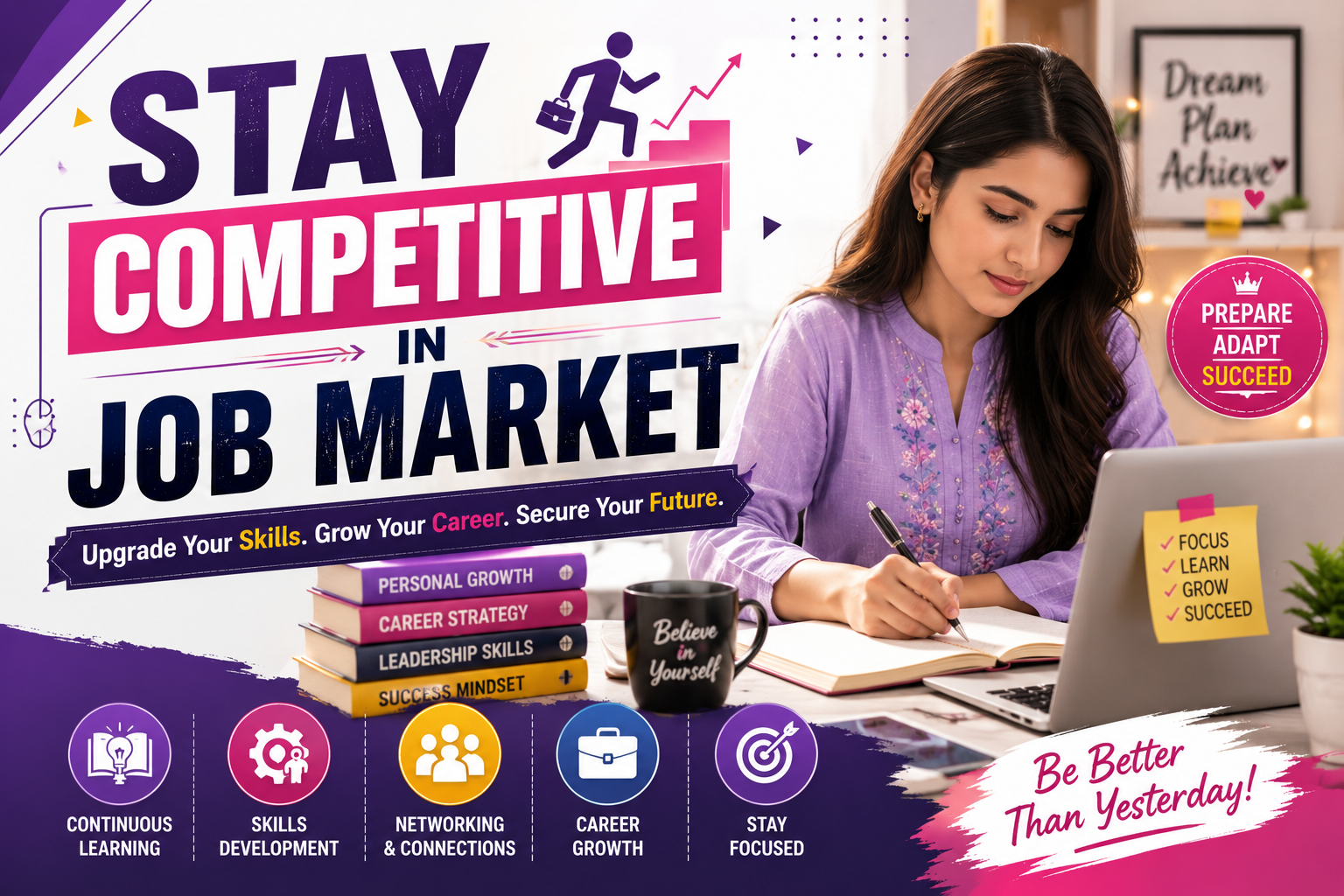
Learning how to stay competitive in the job market is an ongoing process rather than a one-time task. Professionals can strengthen their position by keeping their skills current, gaining practical experience, improving communication, learning relevant technology, building professional networks, and understanding changes in their industry.
You do not need to master everything. Choose skills that match your career direction, practise them consistently, and keep evidence of what you can accomplish. A focused approach to professional development can help you stay-competitive-in-job-market, become more adaptable, and stay better prepared for future opportunities.