
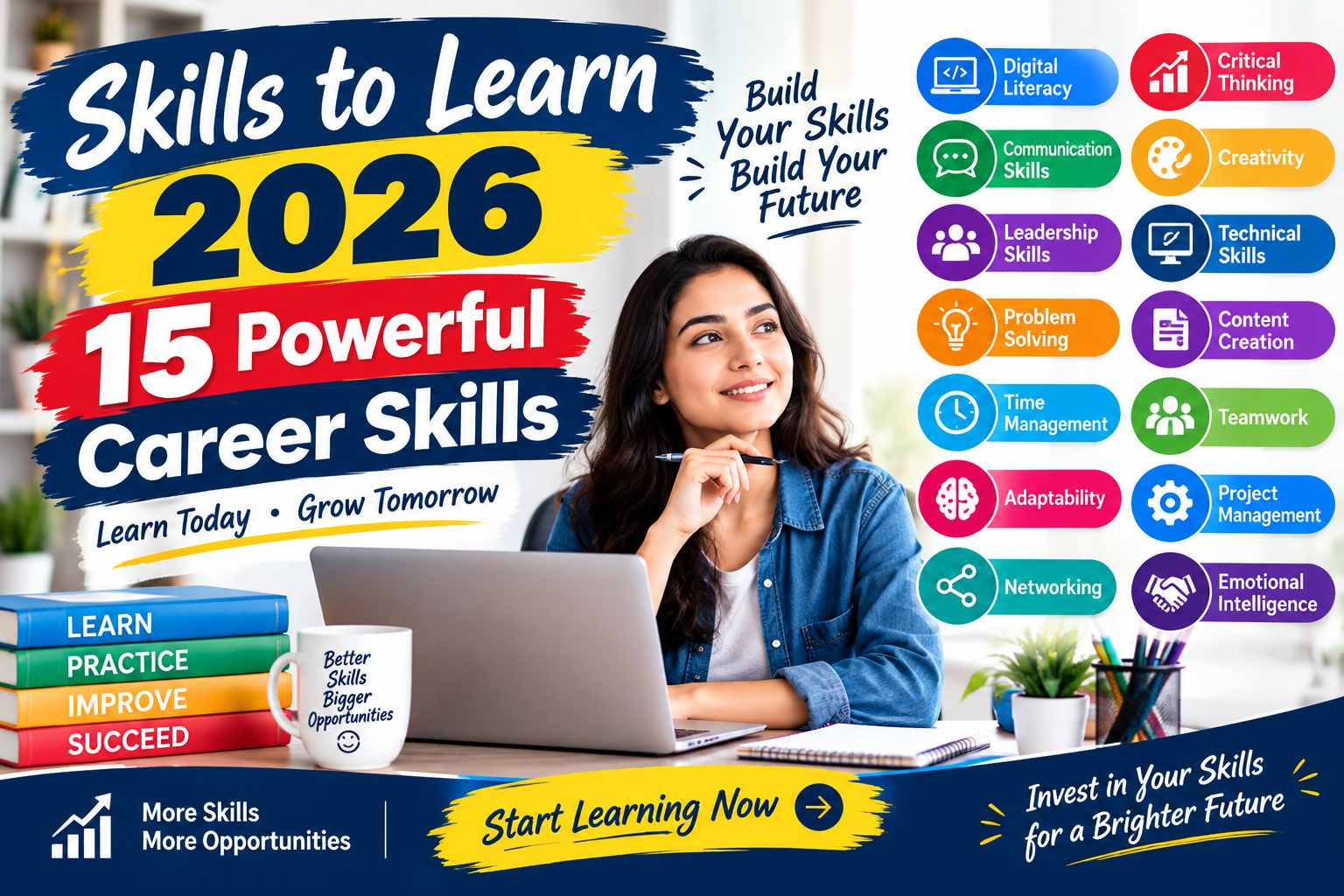
The workplace is changing quickly, and choosing the right abilities can make a major difference for students, job seekers, freelancers, and working professionals. If you are deciding which skills to learn 2026 should be on your personal development plan, focus on abilities that combine technology knowledge with strong human judgment. Employers increasingly need people who can work with AI, understand data, solve problems, communicate clearly, and adapt when tools or processes change.
The skills to learn 2026 conversation is not limited to coding or artificial intelligence. The World Economic Forum’s Future of Jobs Report 2025 identifies AI and big data, networks and cybersecurity, technological literacy, creative thinking, resilience, flexibility, agility, curiosity, leadership, analytical thinking, and environmental stewardship among skills expected to rise in importance through 2030.
For students and job seekers, understanding the skills to learn 2026 can help create a more focused career development plan. Instead of trying to master every new technology, learners can select abilities that match their target industry and build practical experience around them.
Professionals can also use the skills to learn 2026 trend to identify areas where their current knowledge needs improvement. Combining technical abilities with communication, critical thinking, creativity, and adaptability can make professional development more useful across different roles.
This guide explains the most useful skills to learn 2026, why they matter, what jobs can benefit from them, and how beginners can start building practical evidence of their skills.
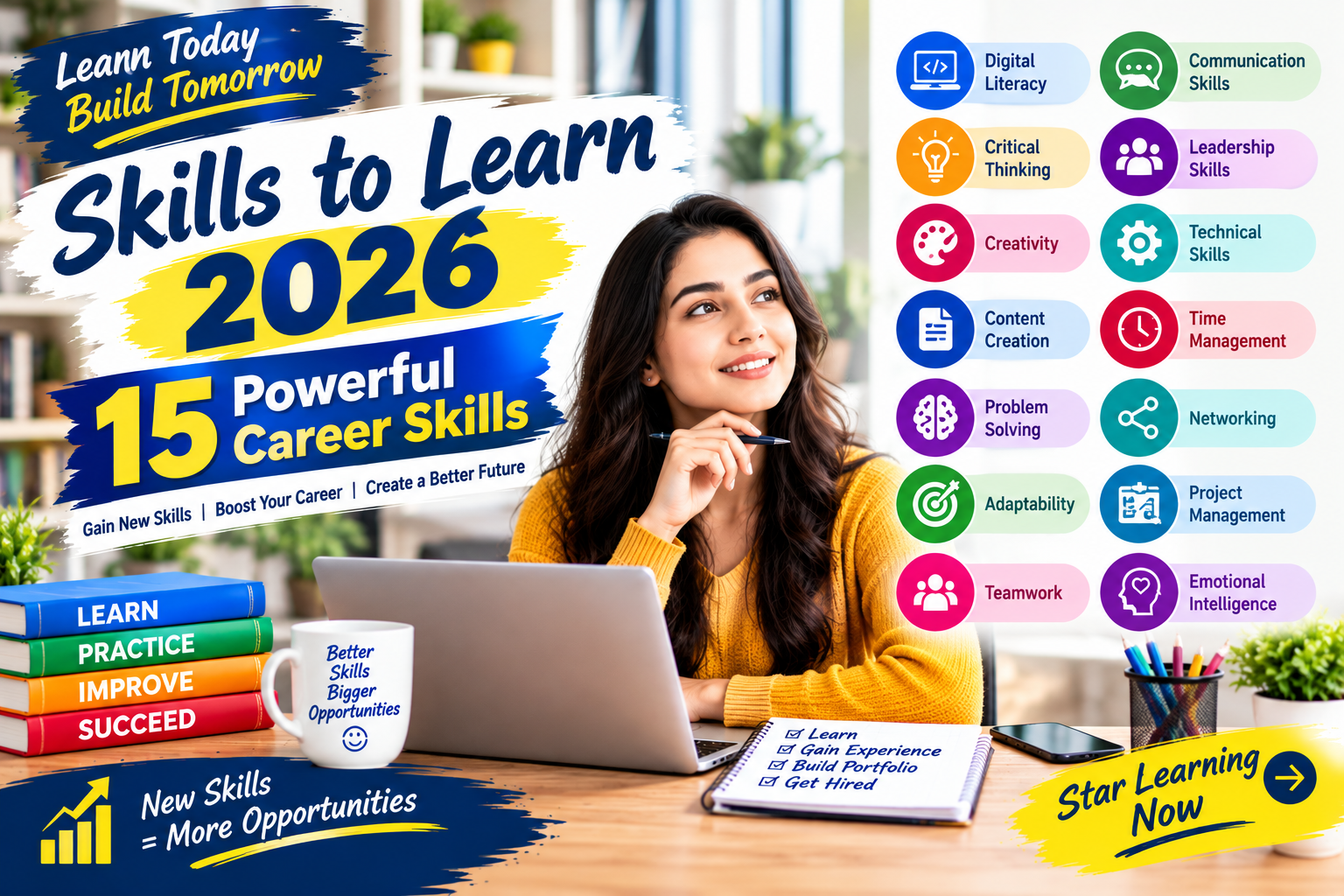
Quick Overview of the Skills Employers Need
The skills to learn 2026 landscape can be divided into several connected groups. Technical skills help you work with modern systems, while human skills help you make decisions, collaborate, and handle uncertainty.
- Artificial intelligence and AI literacy
- Data analysis and data literacy
- Cybersecurity and digital security
- Technological and digital literacy
- Analytical and critical thinking
- Creative thinking
- Communication and collaboration
- Adaptability and resilience
- Leadership and people management
- Project and workflow management
- Digital marketing and content strategy
- User experience and design thinking
- Environmental and sustainability skills
- Continuous learning and self-management
No single ability guarantees employment. A stronger strategy is to combine one technical area with communication, problem-solving, and business awareness. That combination can make a skill more useful across different industries.
1. Artificial Intelligence and AI Literacy
For many professionals, skills to learn 2026 should begin with practical AI literacy. You do not necessarily need to become a machine learning engineer. Many workers can benefit from understanding how generative AI works at a basic level, how to write useful prompts, how to check AI-generated information, and how to use AI responsibly in everyday tasks.
AI literacy can support marketing, customer service, administration, education, software development, research, finance, human resources, and many other fields. The OECD research on AI and skills also highlights the growing importance of digital skills, data interpretation, problem-solving, creativity, and innovation alongside specialized AI knowledge.
What to learn
- Generative AI fundamentals
- Prompt writing and task instructions
- AI-assisted research and summarization
- Fact-checking AI outputs
- AI ethics, privacy, and responsible use
- Workflow automation concepts
Instead of collecting certificates without practice, create useful projects. For example, build an AI-assisted content workflow, document a customer-support process, or demonstrate how AI can organize research while a human reviews the final result.
2. Data Analysis and Data Literacy
Data is another important area when evaluating skills to learn 2026. Businesses generate information through sales, websites, customer interactions, operations, finance, and digital platforms. Employees who can turn raw information into understandable insights can contribute to better decisions.
Beginners can start with spreadsheets before moving into more advanced tools. Excel or Google Sheets can teach formulas, sorting, filtering, pivot tables, charts, and basic data cleaning. Later, learners can explore SQL, Power BI, Tableau, Python, or other analytics tools depending on their career goals.
Practical data skills
- Spreadsheet formulas and functions
- Data cleaning
- Charts and dashboards
- Basic statistics
- SQL fundamentals
- Data visualization
- Business reporting
The goal is not simply to operate software. A valuable analyst knows which question the data should answer, recognizes unreliable information, explains patterns clearly, and connects findings to a business decision.
3. Cybersecurity and Digital Security
Cybersecurity belongs on any serious list of skills to learn 2026 because organizations depend on digital systems for communication, payments, customer information, cloud services, and daily operations. Security is therefore relevant beyond specialist cybersecurity departments.
Basic security awareness can benefit almost every employee. More advanced learners can study networking, identity management, security monitoring, penetration testing, cloud security, incident response, or security governance.
Where beginners can start
Learn strong password practices, multi-factor authentication, phishing awareness, access controls, secure file sharing, basic networking, and common cyber threats. If you want to build your skills to learn 2026 around technology, continue into Linux, networking, security tools, scripting, cloud platforms, and recognized cybersecurity training.
Cybersecurity is one of the important skills to learn 2026 because digital threats continue to evolve. It also rewards curiosity because threats and defensive methods change constantly. A strong professional learns to investigate unusual activity rather than simply following a checklist.
For beginners, cybersecurity can become one of the practical skills to learn 2026 when combined with hands-on practice. Start with basic security concepts, then gradually explore networks, operating systems, cloud security, and threat detection.
Developing cybersecurity knowledge alongside other skills to learn 2026 can help professionals understand how to protect accounts, systems, files, and business information while adapting to new digital risks.
4. Technological and Digital Literacy
Not everyone needs advanced programming ability, but skills to learn 2026 should include broad technological literacy. This means understanding how common digital systems work and being comfortable learning new software.
Digital literacy can include cloud storage, collaboration platforms, office applications, file management, online research, digital communication, cybersecurity basics, automation, and responsible use of AI tools.
For office workers, strong skills in Microsoft Excel, Word, PowerPoint, email, document management, calendars, video conferencing, and cloud collaboration can improve everyday productivity. For students and freelancers, these same abilities can make remote work and online projects easier to manage.
The most useful approach is to understand concepts rather than memorize one software interface. When a company changes platforms, conceptual knowledge makes it easier to transfer your skills.
5. Analytical and Critical Thinking
Among the most valuable skills to learn 2026 are analytical thinking and critical thinking. Technology can process information quickly, but people still need to determine whether an answer makes sense, whether evidence is reliable, and what action should follow.
Analytical thinking involves breaking a complex problem into smaller parts, identifying relationships, comparing evidence, and reaching a logical conclusion. Critical thinking adds the ability to question assumptions and recognize weak reasoning.
How to build this skill
- Compare multiple sources before accepting a claim.
- Ask what evidence supports a conclusion.
- Separate facts from assumptions.
- Break large problems into smaller questions.
- Consider alternative explanations.
- Use data rather than intuition when appropriate.
These abilities are useful in management, finance, research, healthcare, engineering, education, consulting, marketing, and administration. They also make AI-assisted work safer because you remain responsible for reviewing the output.
6. Creative Thinking
Creative thinking deserves attention in discussions about skills to learn 2026 because automation does not eliminate the need for new ideas. Organizations still need people who can identify opportunities, develop concepts, improve customer experiences, and approach difficult problems from different angles.
Creativity is not limited to artists. A software developer can create a simpler product workflow. A marketer can develop a new campaign concept. A teacher can design a more engaging learning activity. A manager can redesign a process that wastes time.
To develop creative thinking, practice generating several possible solutions before selecting one. Study how different industries solve similar problems. Keep a record of ideas and test small experiments instead of waiting for a perfect concept.
7. Communication and Collaboration
Strong communication remains one of the most practical skills to learn 2026. Technical knowledge becomes more valuable when you can explain it to customers, managers, colleagues, or nontechnical stakeholders.
Written communication includes emails, reports, proposals, documentation, presentations, and professional messages. Verbal communication includes meetings, interviews, presentations, negotiations, and everyday teamwork.
Important communication abilities
- Clear business writing
- Active listening
- Professional presentation skills
- Concise reporting
- Conflict-aware communication
- Remote collaboration
- Audience-focused explanations
Good collaboration also requires reliability. Meeting deadlines, documenting decisions, asking useful questions, and keeping teammates informed can be just as important as technical expertise.
8. Adaptability, Resilience, and Agility
When considering skills to learn 2026, adaptability is easy to overlook because it is not tied to one software package or job title. Yet careers can change when businesses adopt new technology, markets shift, or organizations restructure their processes.
Adaptability means learning what has changed, identifying what still matters, and adjusting your approach. Resilience involves recovering from setbacks without abandoning useful long-term goals. Agility means responding to changing conditions without becoming unnecessarily slow.
You can practice adaptability by regularly learning small new tools, accepting constructive feedback, taking on unfamiliar tasks, and reviewing your work after major projects. The objective is not to chase every trend. It is to become comfortable with reasonable change.
9. Leadership and People Management
Leadership is another important category within skills to learn 2026. You do not need to manage a large department to develop leadership ability. Leadership can appear in project ownership, mentoring, decision-making, team coordination, and taking responsibility for outcomes.
Useful leadership skills include delegation, goal setting, feedback, conflict management, coaching, prioritization, and stakeholder communication. Good leaders also understand that different people may need different types of support.
For early-career professionals, leadership can begin with small responsibilities. Volunteer to coordinate a project, organize a team task, mentor a new colleague, or take ownership of a recurring process. These experiences can provide evidence of leadership beyond a job title.
10. Project Management and Workflow Management
Project management is one of the practical skills to learn 2026 for people working in technology, business, marketing, construction, education, consulting, and many other fields.
Project management involves defining objectives, creating timelines, assigning responsibilities, managing resources, identifying risks, tracking progress, and communicating changes. You can learn these principles without immediately pursuing an advanced certification.
Useful project management concepts
- Scope and objectives
- Task prioritization
- Milestones and deadlines
- Risk management
- Resource planning
- Team communication
- Project documentation
Tools such as task boards, spreadsheets, calendars, and project management platforms can support these practices. The tool matters less than the ability to organize work clearly and deliver agreed outcomes.
11. Digital Marketing and Content Strategy
Digital marketing can be a valuable choice among skills to learn 2026 for people interested in freelancing, entrepreneurship, agencies, e-commerce, or business growth.
The field includes search engine optimization, content marketing, social media, email marketing, paid advertising, analytics, conversion optimization, and audience research. AI can assist with parts of this work, but marketers still need strategy, positioning, creativity, research, and judgment.
A beginner can build a portfolio by creating a sample website strategy, keyword research document, content calendar, email campaign, social media plan, or basic performance report. Practical projects make your learning easier to demonstrate to employers or clients.
12. User Experience and Design Thinking
User experience is another useful area when selecting skills to learn 2026. Businesses compete not only through products but also through how easy those products are to understand and use.
UX skills include user research, journey mapping, wireframing, usability testing, information architecture, interface design, and web accessibility. Design thinking adds a structured approach to understanding users, defining problems, developing ideas, and testing solutions.
You do not have to become a professional designer to benefit from UX thinking. Developers, marketers, product managers, entrepreneurs, and customer-service professionals can all improve their work by considering what users actually need.
13. Environmental and Sustainability Skills
Environmental awareness is increasingly relevant to skills to learn 2026 because organizations face questions about energy use, waste, resource efficiency, climate risk, sustainable operations, and environmental reporting.
The World Economic Forum lists environmental stewardship among the skills expected to rise in importance during the 2025–2030 period.
Professionals can explore sustainability reporting, energy efficiency, environmental management, sustainable supply chains, renewable energy concepts, circular economy principles, or green technology depending on their industry.
This field is particularly relevant for engineering, manufacturing, construction, energy, agriculture, logistics, finance, and corporate operations. Even professionals outside these sectors can benefit from understanding basic sustainability terminology.
14. Continuous Learning and Self-Management
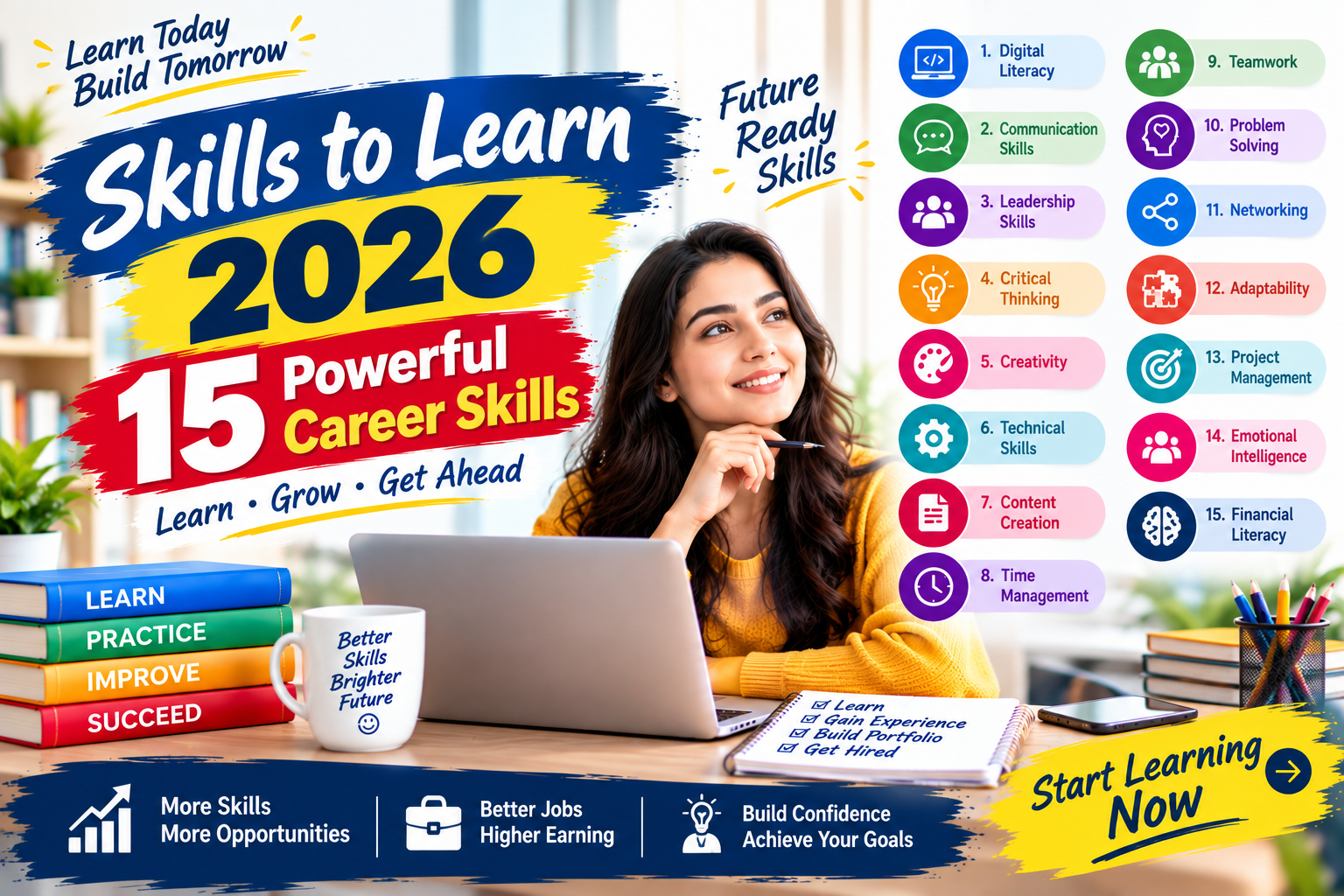
One of the most durable skills to learn 2026 is the ability to keep learning. The World Economic Forum identifies curiosity and lifelong learning among skills expected to increase in importance. Developing a strong learning mindset can also help you adapt to other skills to learn 2026 as workplace requirements change.
Continuous learning does not mean spending every evening taking courses. It means being able to identify a useful skill, find reliable learning material, practice it, receive feedback, and apply it to real work. This approach makes the skills to learn 2026 journey more practical and focused, especially when developing freelancing skills.
Self-management supports this process. Set realistic weekly targets, divide large subjects into smaller lessons, protect focused study time, and review what you have actually produced. These habits can make it easier to develop the skills to learn 2026 that are relevant to your career goals.
A simple portfolio project can often demonstrate learning more effectively than a long list of unfinished courses. By consistently practicing and applying the skills to learn 2026, learners can build useful evidence of their abilities while continuing to improve.
How to Choose the Right Skill for Your Career
Not everyone should choose the same skills to learn 2026. Your decision should reflect your current abilities, career direction, industry, available time, and preferred type of work.
| Career Goal | Useful Skill Combination | Possible Starting Point |
|---|---|---|
| Technology | AI, programming, data, cybersecurity | Choose one technical foundation and build projects |
| Office careers | Excel, digital literacy, communication, analysis | Practice spreadsheets and business reporting |
| Marketing | SEO, content, analytics, AI literacy | Create a sample campaign and content plan |
| Management | Leadership, communication, project management | Take ownership of a small project |
| Freelancing | One marketable technical skill plus communication | Create three portfolio samples |
| Green careers | Sustainability, data, environmental knowledge | Study industry-specific sustainability practices |
A useful rule is to avoid learning five unrelated subjects at once. Pick one primary skill, one supporting skill, and one human skill. For example, someone interested in digital marketing could combine SEO, analytics, and communication.
How to Learn These Skills Without Wasting Time
The best skills to learn 2026 strategy is based on deliberate practice rather than passive consumption. Watching tutorials can introduce concepts, but applying them creates usable ability.
- Choose one career direction. Identify the jobs or freelance services you want to pursue.
- Study job descriptions. Look for recurring requirements instead of copying one vacancy.
- Select one core skill. Avoid starting too many courses simultaneously.
- Build a small project. Apply the skill to a realistic problem.
- Document your work. Save reports, dashboards, designs, code, campaigns, or case studies.
- Ask for feedback. Use mentors, peers, instructors, or professional communities.
- Improve the project. Show that you can respond to feedback and refine your work.
- Update your CV and portfolio. Describe outcomes and tools rather than only listing course names.
For example, someone studying data analysis could take a public dataset, clean it, create a dashboard, explain three findings, and publish a short case study. That process demonstrates practical ability much more clearly than simply saying “completed a data course.”
Common Mistakes to Avoid
One common mistake when choosing skills to learn 2026 is chasing every new technology. Trends change quickly, while fundamental abilities such as analytical thinking, communication, data literacy, and adaptability remain useful across many roles.
Another mistake is collecting certificates without developing evidence of practical ability. A certificate can support your profile, but a portfolio, project, work sample, internship, freelance assignment, or documented achievement can show how you apply knowledge.
- Do not learn tools without understanding the underlying concept.
- Do not rely on AI output without checking important information.
- Do not choose a skill only because it is trending on social media.
- Do not ignore communication and teamwork.
- Do not wait until you feel “fully ready” before creating projects.
- Do not put every course you have started on your CV.
Frequently Asked Questions
What are the most valuable skills to learn in 2026?
The strongest skills to learn 2026 choices include AI literacy, data analysis, cybersecurity, technological literacy, analytical thinking, creative thinking, communication, adaptability, leadership, and sustainability-related knowledge. The best choice depends on the career you want to pursue.
Do I need coding skills to stay competitive in 2026?
No. Coding can be highly valuable for technical careers, but many professionals can build strong careers through data analysis, AI literacy, digital marketing, project management, communication, design, cybersecurity, or industry-specific expertise. The right choice depends on the role.
Which skills are useful for remote jobs?
Remote workers can benefit from communication, digital collaboration, time management, project management, digital literacy, AI literacy, customer service, data analysis, and specialized professional skills. Employers may also value the ability to work independently and document progress clearly.
How long does it take to learn a new professional skill?
There is no universal timeline. Basic familiarity can develop quickly, while job-ready proficiency may require months of consistent practice. A better measure is whether you can complete realistic tasks independently and demonstrate the results.
Should students focus on technical or soft skills?
Students generally benefit from combining both. Technical abilities can provide career-specific capability, while communication, critical thinking, teamwork, creativity, and adaptability help those abilities work effectively in real organizations.
How can I prove that I have these skills?
Create evidence through projects, internships, freelance work, case studies, presentations, portfolios, dashboards, documentation, or measurable work outcomes. A clear example of what you built or improved can make a skill more credible than a simple keyword on a CV.

Conclusion
The most useful skills to learn 2026 are not necessarily the newest ones. Strong career development comes from combining technology awareness with human judgment, communication, creativity, problem-solving, and the ability to keep learning. AI, data, cybersecurity, digital literacy, analytical thinking, leadership, marketing, project management, UX, and sustainability all offer different paths depending on your goals.
Instead of trying to master everything, choose one skill that matches the work you want to do, add a complementary ability, and build real evidence through projects. Review your progress regularly and adjust your learning plan as employer requirements change. The most valuable long-term advantage is not simply knowing one tool; it is being able to learn, apply, evaluate, and improve your skills as work evolves.