
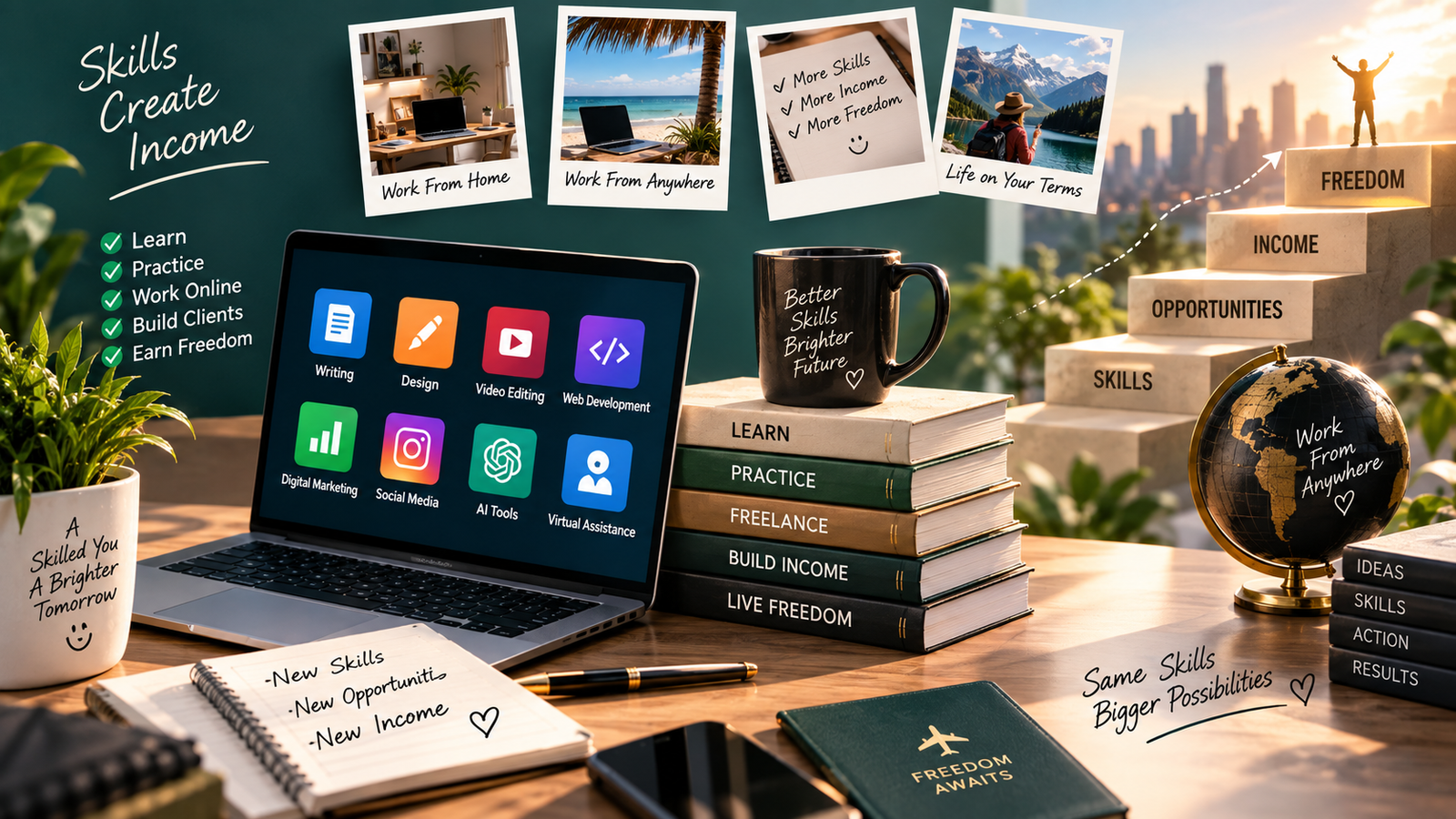
If you want to build an online income without relying on a traditional office job, learning digital skills in 2026 can give you several practical ways to earn. Businesses need people who can create websites, manage online stores, produce content, analyze data, support customers, edit videos, manage social media, and use AI tools effectively.
The important point is that you do not need to master dozens of skills at once. A better approach is to choose one useful skill, build practical experience, create proof of your ability, and then offer that skill to businesses or individual clients.
This guide explains how to make money with digital skills in 2026, which skills can be monetized, how beginners can get their first clients, and how to turn a single skill into a more stable freelance or online business.

Quick Summary
- Choose one marketable digital skill instead of trying to learn everything.
- Practice the skill through real projects and create a small portfolio.
- Use freelance platforms, social media, networking, and direct outreach to find clients.
- Combine AI tools with human skills instead of depending entirely on AI-generated work.
- Start with a clear service and improve your pricing as your experience grows.
- Build repeat-client relationships to make your income more consistent.
Why Digital Skills Matter in 2026
Businesses increasingly operate through websites, ecommerce stores, social platforms, digital advertising, online communities, and cloud-based tools. This creates demand for people who can perform practical digital tasks.
At the same time, AI has changed how many digital tasks are completed. Some repetitive work can now be accelerated with AI, but businesses still need people who understand their goals, check the quality of outputs, communicate with customers, solve problems, and make decisions.
That means the most useful digital skills in 2026 are not necessarily skills that avoid AI. They are skills where AI can make a capable person faster and more productive.
Best Digital Skills to Make Money in 2026
There is no single digital skill that works for everyone. Your best choice depends on your interests, existing experience, learning time, and the type of clients you want to serve.
1. Web Design and Website Development
Businesses need websites for ecommerce, lead generation, portfolios, booking systems, publishing, and brand building. This makes web design a practical skill for freelancers Upwork — High-Demand Careers in 2026.
Beginners can start with website builders and gradually learn HTML, CSS, JavaScript, content management systems, or ecommerce platforms.
Common services include:
- Business website design
- Landing page creation
- WordPress website setup
- Shopify store design
- Website customization
- Mobile responsiveness improvements
- Website content updates
You do not necessarily need to become a full-stack developer before earning. A focused service, such as Shopify theme customization or WordPress landing-page design, can be easier to package and sell.
2. Shopify and Ecommerce Skills
Ecommerce continues to create opportunities for people who understand online stores. Shopify-related work can include product uploads, store design, theme customization, collections, navigation, product pages, inventory management, and basic ecommerce SEO.
If you already understand ecommerce, you can combine several related skills into one service. For example, instead of simply offering product uploading, you could offer ecommerce product listing and optimization.
This approach makes your service more valuable because the client receives a complete solution rather than a single repetitive task.
3. Digital Marketing
Digital marketing covers a wide range of activities that help businesses attract and convert customers online http://U.S. Bureau of Labor Statistics — Computer and Information Technology.
Potential services include:
- Search engine optimization
- Social media marketing
- Email marketing
- Content marketing
- Paid advertising
- Conversion optimization
- Marketing automation
Instead of learning every area immediately, choose one specialization. For example, a beginner might focus on SEO content optimization or social media management before expanding into additional services.
4. SEO and Content Optimization
Search engine optimization can help businesses improve their visibility in search engines. SEO work can involve keyword research, content optimization, internal linking, technical checks, metadata, search intent analysis, and content planning http://Google SEO Starter Guide.
Modern SEO also requires understanding helpful content, user experience, topic coverage, and search intent rather than simply repeating keywords.
A freelancer can package SEO into services such as:
- On-page SEO
- SEO content optimization
- Keyword research
- Product SEO
- Local SEO support
- Content briefs
- SEO audits
5. Graphic Design
Businesses need visual content for websites, social media, advertisements, presentations, ecommerce stores, and marketing campaigns.
Graphic design can be monetized through services such as social media graphics, thumbnails, banners, presentations, product images, brochures, and brand assets.
Tools such as Canva can make it easier for beginners to start creating professional-looking designs, while advanced designers can expand into tools such as Photoshop, Illustrator, or other professional design software.
6. Video Editing
Short-form video is an important content format for many businesses and creators. Video editing can therefore become a useful freelance skill.
Possible services include:
- Short-form video editing
- YouTube video editing
- Instagram Reels editing
- TikTok video editing
- Captions and subtitles
- Product videos
- Promotional videos
A beginner can start by learning basic cutting, transitions, captions, audio cleanup, and visual pacing. More advanced editors can add motion graphics, color correction, storytelling, and branded editing.
7. Social Media Management
Many businesses have social media accounts but do not have enough time to plan content, create posts, respond to comments, analyze performance, and maintain a consistent publishing schedule.
A social media manager can help with content calendars, captions, graphics, scheduling, community management, and basic reporting.
Learning how different platforms work can make this service more valuable. You can also combine social media management with graphic design, copywriting, or short-form video editing and other social media tools ai-social-media-tools.
8. Copywriting and Content Writing
Businesses need written content for websites, product pages, emails, advertisements, blogs, social media, and sales pages.
AI tools can help with research, brainstorming, outlining, and drafting, but effective writing still requires understanding the audience, brand voice, context, accuracy, and purpose.
Writers can specialize in areas such as:
- Website copy
- Blog content
- Product descriptions
- Email copy
- Landing pages
- Social media captions
- SEO content
9. Virtual Assistance
Virtual assistance is one of the more accessible ways to start selling digital services. A virtual assistant can handle administrative and ecommerce tasks remotely.
Services may include:
- Email management
- Calendar management
- Data entry
- Customer support
- Product listing
- Order processing
- Research
- Spreadsheet management
As you gain experience, you can specialize in areas such as ecommerce VA work, executive assistance, customer support, or operations support.
10. Data Analysis
Businesses collect information from websites, ecommerce platforms, advertising systems, customer databases, and other sources. People who can turn that information into useful insights can provide valuable services.
Useful skills include spreadsheets, data visualization, basic statistics, dashboards, and analytical thinking. Learning tools such as Excel or Google Sheets can provide a foundation before moving into more advanced analytics tools.
11. AI-Assisted Business Services
AI has created another category of digital work. Businesses may need help using AI tools for content workflows, research, customer support, automation, document processing, and internal productivity.
The opportunity is not simply knowing how to write prompts. A stronger service combines AI with an existing business skill.
For example, instead of selling generic AI services, you could offer AI-assisted:
- Content production
- Customer support workflows
- Research
- Marketing processes
- Data organization
- Product descriptions
- Business documentation
How to Choose the Right Digital Skill
Choosing a skill based only on what appears popular online can lead to frustration. A better approach is to evaluate several factors.
Consider Your Existing Experience
If you already know something related to ecommerce, design, writing, customer service, or technology, build on that foundation. You may be able to monetize an existing ability much faster than starting from zero in an unrelated field.
Look at Business Demand
Ask whether businesses regularly pay for the service. A skill becomes easier to monetize when it solves a clear business problem.
Choose a Skill You Can Practice
Learning becomes much easier when you can practice regularly. Choose something that you can work on through personal projects, mock projects, volunteer work, or small client assignments.
Think About the Service, Not Just the Skill
Clients usually do not buy a skill by itself. They buy an outcome.
For example, a client may not specifically want someone who knows Shopify. They may want a properly organized online store with optimized product pages and a smoother shopping experience.
This distinction can help you create stronger freelance offers.
How to Make Money With Digital Skills in 2026
Once you have selected a skill, the next step is turning it into an offer that someone can actually purchase.
Step 1: Learn the Fundamentals
Start with the core concepts rather than trying to master every advanced feature.
For example, if you choose web design, learn layout, typography, responsive design, navigation, basic accessibility, and user experience before worrying about complex development techniques.
Step 2: Practice With Realistic Projects
Create projects that resemble the work clients actually need. If you want to offer ecommerce services, create a sample store and organize its products, collections, navigation, product pages, and basic SEO.
If you want to become a video editor, create several different types of short videos rather than producing the same style repeatedly.
Step 3: Build a Portfolio
A portfolio gives potential clients evidence of what you can do.
Your portfolio does not need to contain dozens of projects. A few well-presented examples can be more useful than a large collection of unfinished work.
For every project, explain:
- What the project was
- What problem you solved
- What tasks you completed
- Which tools you used
- What the final result included
Step 4: Create a Clear Service
A vague service can be difficult for clients to understand. Make your offer specific.
For example, instead of saying “I do digital marketing,” you could say “I optimize ecommerce product pages for search and conversions.”
A clear service makes it easier for clients to understand whether you are the right person for their project.
Step 5: Start Finding Clients
You can look for clients through freelance marketplaces, professional networking, social media, communities, referrals, and direct outreach.
Platforms such as Upwork and Fiverr can help beginners access potential clients, while LinkedIn and direct outreach can help build longer-term professional relationships.
Step 6: Start With Manageable Projects
Your first projects do not have to be huge. Smaller assignments can help you develop communication skills, learn client expectations, improve your workflow, and build portfolio evidence.
Focus on completing the work professionally rather than accepting more projects than you can handle.
Step 7: Develop Repeat Business
One completed project can become the starting point for ongoing work. After delivering a useful service, identify related tasks that could help the client continue improving their business.
For example, a website project might lead to ongoing content updates, SEO support, product management, analytics, or maintenance.
How to Use AI Without Losing Your Value
AI tools can help digital professionals complete many tasks more efficiently. However, relying on AI output without reviewing it can create quality problems.
A better workflow is:
- Understand the client’s objective.
- Use AI to accelerate research or repetitive work where appropriate.
- Review the output carefully.
- Correct factual, structural, and contextual problems.
- Add human judgment and relevant expertise.
- Deliver the final work according to the client’s requirements.
The valuable skill is not simply producing AI output. It is knowing what the client needs, selecting the right workflow, checking quality, and turning tools into useful results.
Digital Skills and Freelancing: What Can You Sell?
| Skill | Possible Service | Client Need |
|---|---|---|
| Web Design | Website or landing page design | Professional online presence |
| Shopify | Store setup and customization | Ecommerce store improvements |
| SEO | On-page optimization | Better search visibility |
| Graphic Design | Social graphics and banners | Marketing visuals |
| Video Editing | Short-form video editing | Social media content |
| Writing | Website and SEO content | Marketing content |
| Virtual Assistance | Administrative support | Time-saving business assistance |
| Data Analysis | Reports and dashboards | Better business decisions |
How to Increase Your Earning Potential
Learning a skill is only the first stage. Your earning potential can also depend on how you package, market, and deliver that skill.
Specialize in a Niche
A general service can become more valuable when connected to a specific industry or client type.
For example, instead of offering generic design, you could focus on ecommerce graphics. Instead of offering general virtual assistance, you could specialize in Shopify store management.
Combine Related Skills
Skill combinations can help you provide a more complete service.
Examples include:
- SEO + content writing
- Shopify + product SEO
- Graphic design + social media management
- Video editing + social media strategy
- Web design + conversion optimization
- Virtual assistance + ecommerce management
The goal is not to collect as many skills as possible. The goal is to combine skills that solve a specific client problem.
Improve Communication
Technical ability is only one part of freelancing. Clear communication can help prevent misunderstandings about deadlines, requirements, revisions, and deliverables.
Before starting a project, confirm what needs to be delivered, when it is needed, what materials the client will provide, and what the final scope includes.
Create Repeatable Processes
As your workload grows, document your workflow. Templates, checklists, reusable processes, and automation can reduce repetitive work.
This is particularly useful when managing multiple ecommerce products, social media posts, content pieces, or client accounts.
Common Mistakes Beginners Make
Trying to Learn Everything
Jumping between web design, SEO, coding, video editing, marketing, and AI tools can prevent you from becoming good enough at any one service to sell it confidently.
Choose one primary skill and build depth before expanding.
Building a Portfolio That Does Not Match the Service
If you want ecommerce clients, your portfolio should show ecommerce-related work. If you want video-editing clients, demonstrate video projects.
Portfolio relevance matters because clients want evidence that you understand their type of work.
Competing Only on Price
Low pricing may help someone get early experience, but competing entirely on price can make it difficult to build a sustainable freelance business.
Instead, focus on clear deliverables, reliable communication, strong quality, and a specific service.
Depending Completely on AI
AI can speed up work, but unreviewed AI output may contain errors, generic language, incorrect information, or content that does not match a client’s brand.
Human review remains important.
Ignoring Client Requirements
A technically impressive project can still fail if it does not meet the client’s actual requirements. Read instructions carefully and confirm important details before completing the work.
How Beginners Can Get Their First Digital Client
Getting the first client is often harder than completing the work itself because you do not yet have a long track record.
You can improve your chances by creating a simple offer and showing relevant proof.
- Choose one specific service.
- Create three to five relevant portfolio examples.
- Write a clear profile or service description.
- Identify businesses that could benefit from your service.
- Send personalized proposals or outreach messages.
- Focus on the client’s problem instead of listing every skill you have.
- Deliver the first projects carefully and professionally.
- Build a record of completed work and client feedback where appropriate.
How Much Can You Earn From Digital Skills?
There is no universal income level for digital skills. Earnings can vary significantly based on the skill, specialization, experience, location, client type, platform, workload, pricing model, and ability to attract and retain clients.
Some freelancers charge by the hour, while others use fixed project prices, monthly retainers, packages, or ongoing contracts.
Instead of focusing only on an income target, calculate the relationship between your available working hours, service price, project time, expenses, and client acquisition effort.
For example, improving your workflow so a project takes four hours instead of eight can change your effective earning rate without requiring you to double your price.

Freelancing vs. Building a Digital Business
Freelancing is one way to monetize digital skills in 2026, but it is not the only option.
| Model | How It Works | Key Consideration |
|---|---|---|
| Freelancing | Provide services to individual clients | Client acquisition and delivery |
| Agency | Manage services for multiple clients with a team | Operations and quality control |
| Digital Products | Sell templates, guides, assets, or other digital products | Product quality and marketing |
| Content Business | Build an audience and monetize content | Consistency and audience development |
| Consulting | Sell specialized knowledge and advice | Expertise and credibility |
You can begin with freelancing and later move into another model as your knowledge, audience, and business experience develop.
Expert Tips for Monetizing Digital Skills
- Choose a business problem: Build your service around something clients need to solve.
- Show your work: A practical portfolio is stronger than a long list of unsupported claims.
- Learn continuously: Digital tools and workflows change, so keep improving your process.
- Build systems: Use templates and checklists for repetitive tasks.
- Track your time: Knowing how long projects take helps you price services more intelligently.
- Protect your reputation: Clear communication and dependable delivery can support long-term relationships.
- Stay adaptable: Learn how AI and automation affect your particular service instead of ignoring them.
Frequently Asked Questions
What are the best digital skills to learn in 2026?
Useful options include web design, ecommerce management, SEO, digital marketing, graphic design, video editing, content writing, virtual assistance, data analysis, and AI-assisted business services. The right choice depends on your interests and the problems you want to solve for clients.
Can I make money with digital skills without a degree?
Yes. Many freelance digital services can be demonstrated through practical projects and portfolios. Clients may care more about relevant skills, communication, reliability, and evidence of your work than formal education for certain types of projects.
How long does it take to learn a digital skill?
It depends on the skill, your starting knowledge, and how consistently you practice. Basic competence can be developed through focused learning and projects, while professional-level expertise usually requires continued practice and real-world experience.
Can AI replace digital skills?
AI can automate or accelerate parts of many digital workflows, but businesses still need people who understand objectives, evaluate outputs, communicate with clients, and make context-specific decisions. Learning to work effectively with AI can therefore complement many digital skills.
How can I get my first client with no experience?
Create realistic portfolio projects, choose a specific service, and approach potential clients with a clear explanation of how you can solve a relevant problem. Freelance marketplaces, networking, referrals, social media, and direct outreach are possible channels.
Which digital skill should I learn first?
Start with a skill that matches your existing interests or experience and has a clear business use. A focused skill that you can practice and demonstrate is generally easier to monetize than trying to learn many unrelated skills at the same time.
Conclusion
Learning digital skills in 2026 can create opportunities for freelancing, remote work, consulting, digital products, and online businesses. The key is not to chase every new tool or trend. Choose a practical skill, learn the fundamentals, build real examples, package the skill into a clear service, and consistently look for people who need that service.
As your experience grows, you can combine related skills, use AI to improve your workflow, specialize in a profitable niche, and develop longer-term client relationships. The strongest approach is to focus on creating useful outcomes for real customers rather than simply collecting digital skills.