
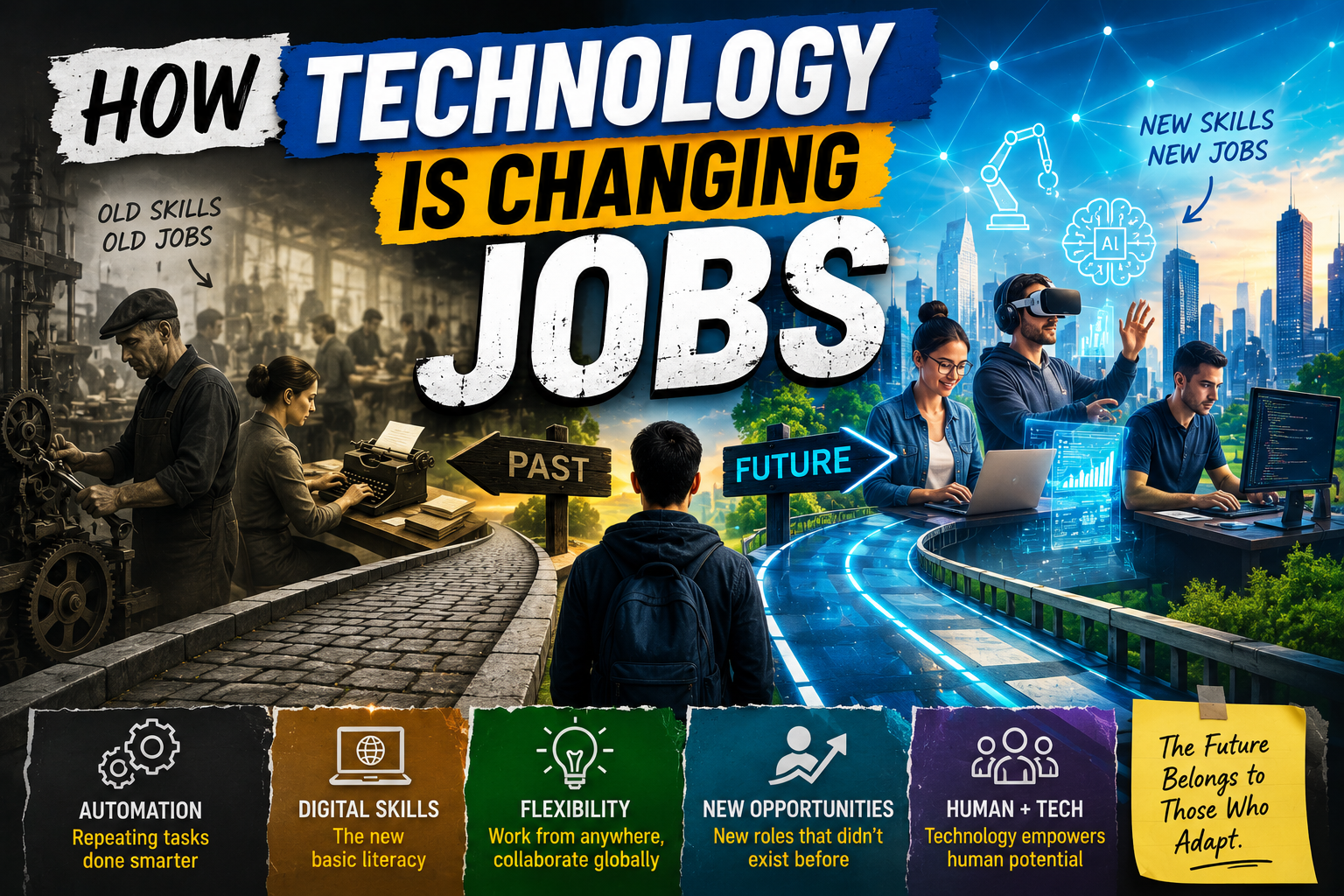
How technology is changing jobs has become an important question for employees, businesses, students, and people planning their careers. Artificial intelligence, automation, robotics, cloud computing, and digital collaboration tools are changing how work is performed and which skills employers value.
Technology is not simply eliminating certain tasks. It is also creating new roles, changing existing responsibilities, improving productivity, and allowing people to work in new ways. Understanding how technology is changing jobs can help workers prepare for evolving career opportunities instead of reacting to changes after they happen.
Key Ways How technology is changing jobs
- Automating repetitive tasks
- Creating new technology-focused roles
- Changing required workplace skills
- Increasing AI-assisted work
- Supporting remote and hybrid work
- Improving workplace productivity
- Changing customer service
- Creating new business models
1. Automation Is Changing Everyday Tasks
One of the clearest examples of how technology is changing jobs is automation. Software and machines can now handle many repetitive activities that previously required manual effort.
Examples include processing invoices, organizing information, scheduling appointments, checking inventory, generating routine reports, and responding to common customer questions.
Automation does not necessarily mean an entire job disappears. In many cases, technology takes over specific tasks while employees focus on activities that require judgment, communication, creativity, and problem-solving.
2. Artificial Intelligence Is Reshaping Knowledge Work
Artificial intelligence is becoming part of many professional workflows. Employees can use AI tools to summarize documents, analyze information, generate drafts, write code, conduct research, and support decision-making.
This is another major example of how technology is changing jobs. Instead of completing every step manually, workers can increasingly use AI as an assistant while remaining responsible for reviewing and improving the final result.
Jobs Where AI Assistance Is Growing
- Software development
- Marketing
- Content creation
- Customer support
- Data analysis
- Research
- Design
- Business administration
The value of AI depends on how effectively people use it. Workers who understand both their professional field and the capabilities and limitations of AI can be better positioned to use these tools productively.
3. Technology Is Creating New Jobs
While automation can reduce demand for some tasks, technological change also creates new occupations and responsibilities. Businesses need people who can develop, implement, manage, secure, and improve digital systems.
Examples include AI specialists, cybersecurity professionals, data analysts, cloud engineers, automation specialists, UX designers, robotics technicians, and technology project managers.
Understanding how technology is changing jobs therefore requires looking at both sides of the transition: some tasks may decline while new forms of work emerge.
4. Digital Skills Are Becoming More Important
Employees in many industries increasingly need basic digital skills. Depending on the role, this may include using productivity software, analyzing data, managing digital platforms, working with AI tools, or understanding cybersecurity practices.
Advanced technical skills are not necessary for every career. However, digital confidence can help employees adapt as their workplaces introduce new software and processes.
5. Remote and Hybrid Work Are Changing the Workplace
Cloud software, video conferencing, digital communication platforms, and online project management tools have made it possible for many employees to work outside traditional offices.
This has changed how companies organize teams, communicate, recruit employees, and manage projects. Workers can collaborate across cities and countries without being physically present in the same location.
Remote work also creates new expectations. Employees often need stronger communication, time management, documentation, and digital collaboration skills.

6. Robotics Is Transforming Physical Work
Robotics is another important part of how technology is changing jobs. Robots can perform repetitive, physically demanding, or highly precise tasks in manufacturing, warehouses, logistics, healthcare, and other industries.
Modern robots are increasingly being combined with computer vision, sensors, and AI. This allows machines to operate in environments that are more complex than traditional automated production lines.
Human workers may increasingly supervise robotic systems, maintain equipment, analyze operational data, and handle tasks that require flexibility or judgment.
7. Technology Is Changing Customer Service
Customer service is being transformed by chatbots, AI assistants, automated ticketing systems, and knowledge bases.
Simple questions can often be answered automatically, allowing human representatives to focus on complex cases that require empathy, negotiation, or problem-solving.
This does not remove the importance of customer service professionals. Instead, their roles can shift toward handling situations where human communication adds greater value.
8. Technology Is Increasing Workplace Productivity
Modern software allows employees to complete many tasks faster. Cloud documents enable real-time collaboration, project management platforms provide visibility into deadlines, and automation tools can connect different business systems.
AI can further reduce time spent on repetitive activities such as drafting, summarizing, searching, and organizing information.
However, increased productivity depends on implementation. Adding more software does not automatically make a workplace more efficient. Businesses need clear processes and training to ensure technology actually reduces unnecessary work.
9. Employers Are Looking for New Skills
As technology changes workplace tasks, employers may place greater emphasis on skills that complement technology rather than compete directly with it.
Important Skills for the Future Workplace
- Problem-solving
- Critical thinking
- Communication
- Creativity
- Adaptability
- Digital literacy
- Data literacy
- AI literacy
- Collaboration
These skills can help workers use new tools effectively while handling responsibilities that require human judgment.
10. Technology Is Changing Career Paths
Career paths are becoming less predictable as industries adopt new technologies. Employees may need to learn new tools, move into different responsibilities, or develop specialized skills during their careers.
This is an important part of how technology is changing jobs: career development is increasingly becoming an ongoing process rather than something that ends after formal education.
Professionals who regularly update their skills can be better prepared when their industry introduces new software, automation, or AI systems.
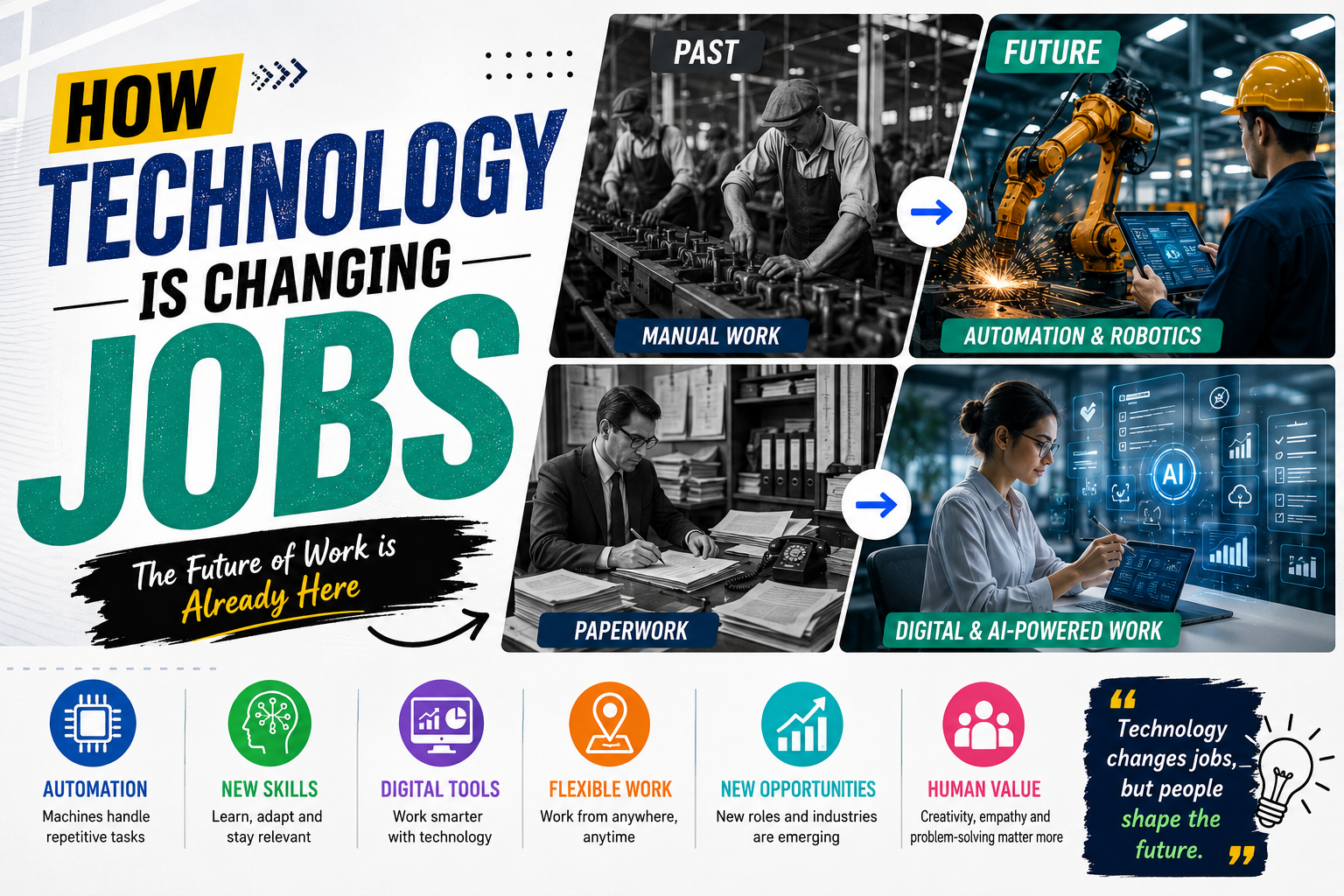
11. Some Jobs May Become More Automated
Technology can reduce demand for certain repetitive tasks, particularly when those tasks follow predictable rules.
Examples may include routine data entry, basic administrative processing, repetitive manufacturing activities, and some standardized customer support interactions.
However, the impact varies by industry and occupation. A job may change significantly without disappearing because employees can be reassigned to tasks that technology cannot easily perform.
12. Human Skills Still Matter
One of the most important lessons from how technology is changing jobs is that technology does not make human skills irrelevant.
Leadership, empathy, negotiation, creativity, strategic thinking, relationship building, and complex decision-making remain important in many workplaces.
The future workplace is likely to involve greater cooperation between people and technology rather than a simple replacement of humans by machines.
How Workers Can Prepare for Technological Change
Workers do not need to become software engineers to prepare for technological change. The most practical approach is to understand how technology affects their specific industry and responsibilities.
- Learn relevant digital tools. Become comfortable with the software used in your industry.
- Develop AI literacy. Learn what AI can and cannot reliably do.
- Strengthen human skills. Improve communication, problem-solving, creativity, and critical thinking.
- Keep learning. Use courses, tutorials, certifications, and practical projects to update your skills.
- Understand your industry. Follow how automation and digital tools are changing your specific field.
- Build adaptable skills. Focus on abilities that can transfer between different roles.
How Businesses Can Adapt
Businesses also have an important role in managing technological change. Simply purchasing new software is not enough. Organizations need to understand which problems technology is solving and how employees will use the new systems.
- Provide employee training.
- Identify repetitive tasks suitable for automation.
- Establish clear AI usage policies.
- Protect employee and customer data.
- Measure productivity improvements.
- Give employees opportunities to develop new skills.
- Maintain human oversight for important decisions.
Technology and the Future of Employment
The future of employment will likely involve a combination of automation, AI assistance, human expertise, and continuous learning. Some occupations will change more rapidly than others, and new roles will continue to emerge as technology creates new products and services.
The biggest advantage may go to people who can work effectively with technology rather than those who simply avoid it.
For employers, the challenge will be balancing efficiency with employee development. For workers, the challenge will be keeping their skills relevant while learning how to use increasingly capable digital tools.

Frequently Asked Questions
How is technology changing jobs?
How technology is changing jobs can be seen through automation, AI-assisted work, remote collaboration, robotics, and new digital roles. Technology is changing tasks within many jobs while also creating new career opportunities.
Will technology replace human workers?
Technology may automate some tasks and reduce demand for certain types of work, but many jobs require communication, creativity, judgment, and human interaction. In many cases, technology changes jobs rather than completely eliminating them.
What skills are important in a technology-driven workplace?
Digital literacy, AI literacy, critical thinking, communication, adaptability, creativity, problem-solving, and collaboration are increasingly valuable across many industries.
Which jobs are most affected by automation?
Jobs involving repetitive and predictable tasks can be more exposed to automation. However, the impact depends on the specific occupation, industry, technology, and how employers implement automation.
How can workers prepare for technology changes?
Workers can learn relevant digital tools, develop AI literacy, strengthen human skills, follow changes in their industry, and continue building transferable skills throughout their careers.
Is technology creating new career opportunities?
Yes. Technological development creates demand for roles related to AI, cybersecurity, data, cloud computing, software, robotics, automation, and digital business operations.
Conclusion
How technology is changing jobs is not simply a story about machines replacing people. It is a broader transformation involving automation, AI, robotics, digital collaboration, new skills, and emerging career paths.
Workers who develop adaptable skills and learn how to use technology effectively can be better prepared for changing workplace demands. Businesses that combine technology with employee training can also create more productive and resilient teams.
The future of work will continue to evolve, but the ability to learn, adapt, and work alongside technology will remain one of the most valuable advantages for professionals.