

The job market is changing quickly, and understanding High-Demand Careers can help students, professionals, and career changers prepare for future opportunities. Technology, artificial intelligence, healthcare, cybersecurity, data, renewable energy, and digital business are creating new career paths across many industries.
Choosing one of the right High-Demand Careers is not only about following current trends. It is also about developing skills that employers are likely to value as technology and business needs continue to change.
In this guide, we explore important future career areas, the skills they require, and practical ways to prepare for them.
Key Takeaways
- High-Demand Careers are growing across technology, healthcare, business, energy, and digital industries.
- AI, data, cybersecurity, software, and cloud computing are important technology-focused career areas.
- Healthcare and renewable energy also offer long-term professional opportunities.
- Technical skills should be combined with communication, creativity, critical thinking, and adaptability.
- Practical experience and continuous learning can help you prepare for changing job requirements.
What Makes a Career High-Demand?
A high-demand career is a profession where employers need skilled workers and where demand may remain strong because of technological, economic, social, or industry changes. High-Demand Careers often develop around problems that businesses and society need to solve.
For example, organizations need cybersecurity professionals to protect digital systems, data professionals to understand business information, and healthcare professionals to provide essential services.
Another important characteristic of High-Demand Careers is the opportunity to keep developing your skills. Fields that change over time can create new roles and specializations for people who continue learning.
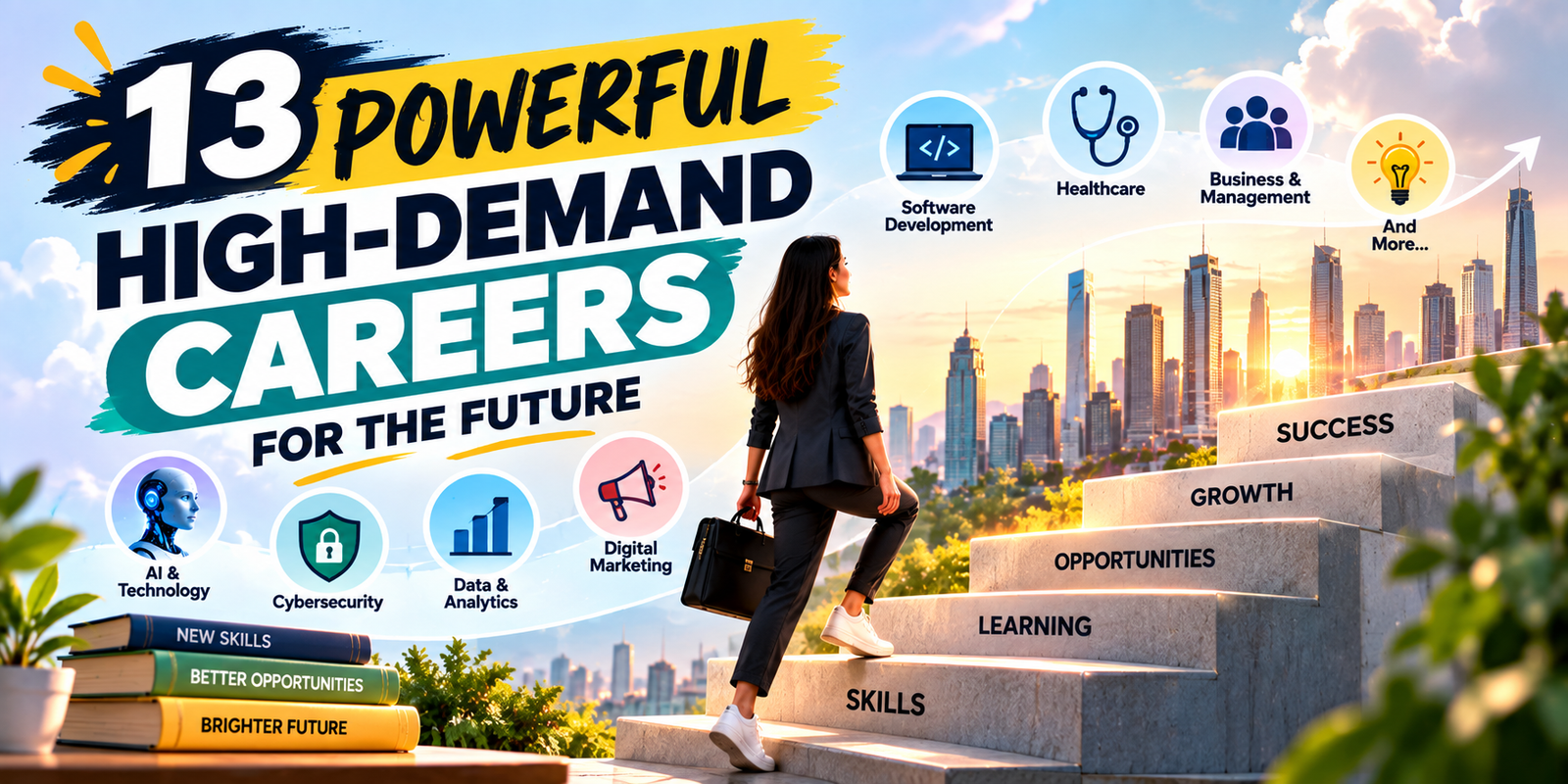
Top High-Demand Careers for the Future
1. Artificial Intelligence and Machine Learning Specialists
Artificial intelligence is being used across software, marketing, healthcare, finance, customer service, manufacturing, and many other industries. As organizations explore practical AI applications, specialists who understand AI systems can find opportunities in different sectors.
AI and machine learning specialists may develop models, analyze data, improve AI applications, or help organizations integrate AI into existing systems. These are among the most technology-focused High-Demand Careers for people interested in programming, mathematics, and problem-solving.

Useful skills include:
- Python and programming fundamentals
- Machine learning concepts
- Statistics and mathematics
- Data analysis
- Generative AI concepts
- Problem-solving
2. Data Analysts and Data Scientists
Businesses generate large amounts of information through websites, applications, sales systems, customer interactions, and digital platforms. Data professionals help organizations turn this information into useful insights.
Data analysts may create reports, identify trends, build dashboards, and support business decisions. Data scientists generally work on more advanced statistical and machine learning problems.
Because organizations in many industries rely on data, data-related roles are important High-Demand Careers for people who enjoy numbers, analysis, and technology.
Important skills include:
- Excel or spreadsheet analysis
- SQL
- Data visualization
- Statistics
- Python or R
- Analytical thinking
3. Cybersecurity Professionals
Organizations are increasingly dependent on digital systems, networks, cloud platforms, and online services. Cybersecurity professionals help protect these systems from security threats and reduce the risks associated with unauthorized access and data breaches.
Career paths include security analysis, security engineering, penetration testing, incident response, cloud security, and security management.
Cybersecurity is one of the important High-Demand Careers for people who enjoy technical investigation and problem-solving.
Useful skills include:
- Networking fundamentals
- Operating systems
- Cybersecurity principles
- Cloud security
- Risk management
- Incident response
4. Software Developers
Software powers websites, mobile applications, e-commerce stores, business platforms, financial systems, and digital services. Developers design, build, test, maintain, and improve these applications.
Although AI-assisted development is changing software workflows, programming fundamentals, software architecture, testing, databases, and problem-solving remain valuable skills.
Software development continues to be one of the major High-Demand Careers for people interested in technology.
Common skills include:
- Programming languages
- Web development
- Mobile development
- APIs
- Databases
- Version control
5. Cloud Computing Specialists
Many organizations use cloud platforms for applications, storage, infrastructure, databases, and remote operations. This has created opportunities for professionals who understand cloud technologies.
Cloud specialists may work with infrastructure, application deployment, cloud security, databases, automation, or architecture.
Cloud computing is another area among High-Demand Careers because organizations continue to depend on digital infrastructure.
Useful areas to learn include:
- Cloud infrastructure
- Networking
- Linux
- Cloud security
- Containers
- Automation
6. Healthcare Professionals
Healthcare remains an essential industry because people need medical care, treatment, prevention, rehabilitation, and support services. Career opportunities extend beyond doctors and nurses.
Healthcare administration, medical research, laboratory work, health information management, medical technology, and specialized healthcare services can also provide professional opportunities.
Healthcare therefore remains an important category of High-Demand Careers, particularly for people interested in science, medicine, and helping others.
7. Renewable Energy and Sustainability Professionals
Energy systems are evolving as organizations invest in renewable energy, efficiency, energy storage, and cleaner technologies. This creates opportunities in engineering, installation, project management, research, operations, and environmental services.
Potential career areas include solar energy, wind energy, battery technology, energy management, and sustainability management.
Renewable energy can become one of the High-Demand Careers areas for professionals interested in engineering and environmental solutions.
8. Digital Marketing Specialists
Businesses depend on digital channels to attract customers, build brands, generate leads, and sell products. Digital marketing includes SEO, content marketing, social media, email marketing, paid advertising, analytics, and conversion optimization.
These roles can be particularly suitable for people who enjoy communication, creativity, research, and technology.
Digital marketing is also included among modern High-Demand Careers because businesses across industries need an effective online presence.
Useful skills include:
- Search engine optimization
- Content strategy
- Social media marketing
- Email marketing
- Analytics
- Copywriting
- Conversion optimization
9. UX and Product Designers
Digital products need to be functional as well as easy to use. UX and product designers research user needs and create experiences that help people interact with websites, applications, and software.
UX design can be a good option for people who enjoy combining creativity, research, technology, and problem-solving.
As digital products continue to expand, UX and product design remain relevant High-Demand Careers for creative professionals.
Important skills include:
- User research
- Wireframing
- Prototyping
- Visual design
- Usability testing
- Communication
10. Robotics and Automation Specialists
Automation is changing manufacturing, logistics, warehouses, agriculture, healthcare, and other industries. Robotics specialists may design, program, operate, maintain, or improve automated systems.
This field can involve mechanical engineering, electrical systems, programming, artificial intelligence, sensors, and industrial automation.
Robotics is another technology-focused area within High-Demand Careers for people interested in both hardware and software.
11. Fintech and Financial Technology Professionals
Financial services are increasingly delivered through digital platforms. Online banking, digital payments, financial applications, automated systems, and data-driven services require professionals who understand both finance and technology.
Career paths can include financial analysis, fintech development, risk management, cybersecurity, compliance technology, and product management.
These roles make financial technology an important area to consider when exploring High-Demand Careers.
12. E-Commerce and Digital Commerce Specialists
E-commerce has created opportunities in online store management, product management, digital marketing, customer experience, marketplace operations, logistics, and conversion optimization.
Professionals in this field need to understand how customers discover products, evaluate options, complete purchases, and interact with brands.
E-commerce skills can therefore support several High-Demand Careers in the growing digital economy.
13. Technical Project Managers
Technology projects often involve developers, designers, business teams, clients, and other stakeholders. Technical project managers help coordinate goals, timelines, resources, risks, and communication.
This career can suit professionals who understand technology but also enjoy organization, planning, communication, and leadership.
Technical project management is another option among High-Demand Careers for people who prefer coordinating teams and projects rather than focusing exclusively on technical development.
High-Demand Careers and the Skills They Require
| Career Area | Important Skills | Potential Work Areas |
|---|---|---|
| AI and Machine Learning | Python, statistics, machine learning | Technology, research, business |
| Data Analysis | SQL, Excel, analytics, visualization | Business, finance, marketing |
| Cybersecurity | Networking, security, risk management | Technology, finance, government |
| Software Development | Programming, databases, APIs | Software, e-commerce, SaaS |
| Cloud Computing | Cloud infrastructure, networking, automation | Technology, enterprise IT |
| Digital Marketing | SEO, content, analytics, advertising | Marketing, e-commerce, agencies |
| UX/Product Design | Research, prototyping, visual design | Software, apps, e-commerce |
| Renewable Energy | Engineering, project management, sustainability | Energy, construction, environmental services |
How to Choose the Right Future Career
Choosing between different High-Demand Careers should involve more than looking at which jobs are currently popular. Consider your interests, strengths, learning style, financial goals, and preferred working environment.
Consider Your Existing Skills
Start by identifying skills you already have. Someone who enjoys numbers may explore data analysis or finance, while someone who enjoys creative work may consider UX design or digital marketing.
Look at Transferable Skills
Communication, project management, analytical thinking, writing, customer service, and problem-solving can support multiple career paths.
Check the Learning Requirements
Different High-Demand Careers require different levels of education and training. Some require university degrees or professional licenses, while others can be entered through certificates, portfolios, apprenticeships, practical projects, or specialized training.
Build Practical Experience
Learning theory is useful, but practical experience makes it easier to demonstrate what you can do. Build projects, create a portfolio, complete internships, freelance, volunteer, or work on real-world assignments whenever possible.
How to Prepare for High-Demand Careers
You do not need to learn everything at once. A focused approach can make preparing for High-Demand Careers more manageable.
- Choose one career direction. Avoid trying to master several unrelated fields at the same time.
- Learn the fundamentals. Build a strong understanding of the core concepts.
- Practice regularly. Use projects and real tasks to develop practical skills.
- Create a portfolio. Show employers what you can actually do.
- Learn modern tools. Understand the software and platforms commonly used in your field.
- Develop communication skills. Technical ability becomes more valuable when you can explain your ideas clearly.
- Keep learning. Technology and workplace requirements change, so professional development should be ongoing.
Why AI Skills Matter Across Different Careers
AI is not only creating specialized technology roles. It is also becoming useful in existing professions. Marketers, designers, developers, customer support professionals, analysts, and business owners can all use AI tools in different ways.
This means professionals can strengthen their position in High-Demand Careers by learning how to use AI responsibly and effectively.
The most useful approach is to combine AI knowledge with strong expertise in a specific profession or industry.

Common Mistakes When Planning a Future Career
Following Trends Without Understanding the Work
A career title may sound exciting, but the actual responsibilities may not match your interests. Research the daily work and required skills before choosing one of the High-Demand Careers you are considering.
Learning Too Many Skills at Once
Trying to learn programming, marketing, design, data science, and cybersecurity simultaneously can make it difficult to develop real expertise. Start with one primary direction.
Ignoring Soft Skills
Technical knowledge is important, but communication, teamwork, organization, critical thinking, and adaptability can also affect career growth.
Only Collecting Certificates
Certificates can demonstrate learning, but practical ability is equally important. Combine training with projects and real examples whenever possible.
Stopping After Getting the First Job
Career development does not end when you get hired. Continuing to learn helps professionals adapt as tools, technologies, and business requirements change.
Future Career Skills to Develop
Regardless of which of the High-Demand Careers you choose, several skills can provide long-term value:
- Critical thinking
- Problem-solving
- Communication
- Digital literacy
- AI literacy
- Data literacy
- Adaptability
- Project management
- Creativity
- Collaboration
The combination of technical and human skills can help professionals remain flexible as the workplace evolves.
Frequently Asked Questions
What are the most high-demand careers for the future?
Important High-Demand Careers include artificial intelligence, data analysis, cybersecurity, software development, cloud computing, healthcare, renewable energy, digital marketing, UX design, robotics, and financial technology.
Do I need a university degree for a future career?
It depends on the profession. Some High-Demand Careers require degrees, licenses, or specialized education, while some technology and digital careers can be entered through skills training, certifications, portfolios, practical projects, or work experience.
Is AI a good career field for the future?
AI is an important technology area with applications across many industries. Careers related to AI can include machine learning, AI engineering, data science, AI product development, and AI implementation.
Which skills will be important in future jobs?
Technical skills such as data analysis, programming, cybersecurity, cloud computing, and AI literacy can be valuable. Communication, critical thinking, creativity, collaboration, and adaptability are also important for many High-Demand Careers.
How can I prepare for a future career?
Choose a career direction, learn its core skills, practice through real projects, build a portfolio, gain practical experience, and continue updating your knowledge as the field changes.
Can digital careers be learned online?
Many digital skills can be learned through online courses, tutorials, documentation, projects, and practical experience. However, regulated professions and some specialized High-Demand Careers may require formal education or professional credentials.
Conclusion
The future job market will continue to evolve, but the need for skilled professionals will remain. High-Demand Careers are emerging across AI, data, cybersecurity, software, cloud computing, healthcare, renewable energy, digital commerce, and other growing fields.
The best approach is not to chase every new trend. Instead, choose a career direction that matches your interests and strengths, develop relevant skills, gain practical experience, and continue learning as technology and industry needs change.
A future-ready professional career is built through relevant expertise, practical experience, adaptability, and a willingness to keep developing. By focusing on skills that solve real problems, you can prepare yourself for changing opportunities and build a stronger long-term career path.