
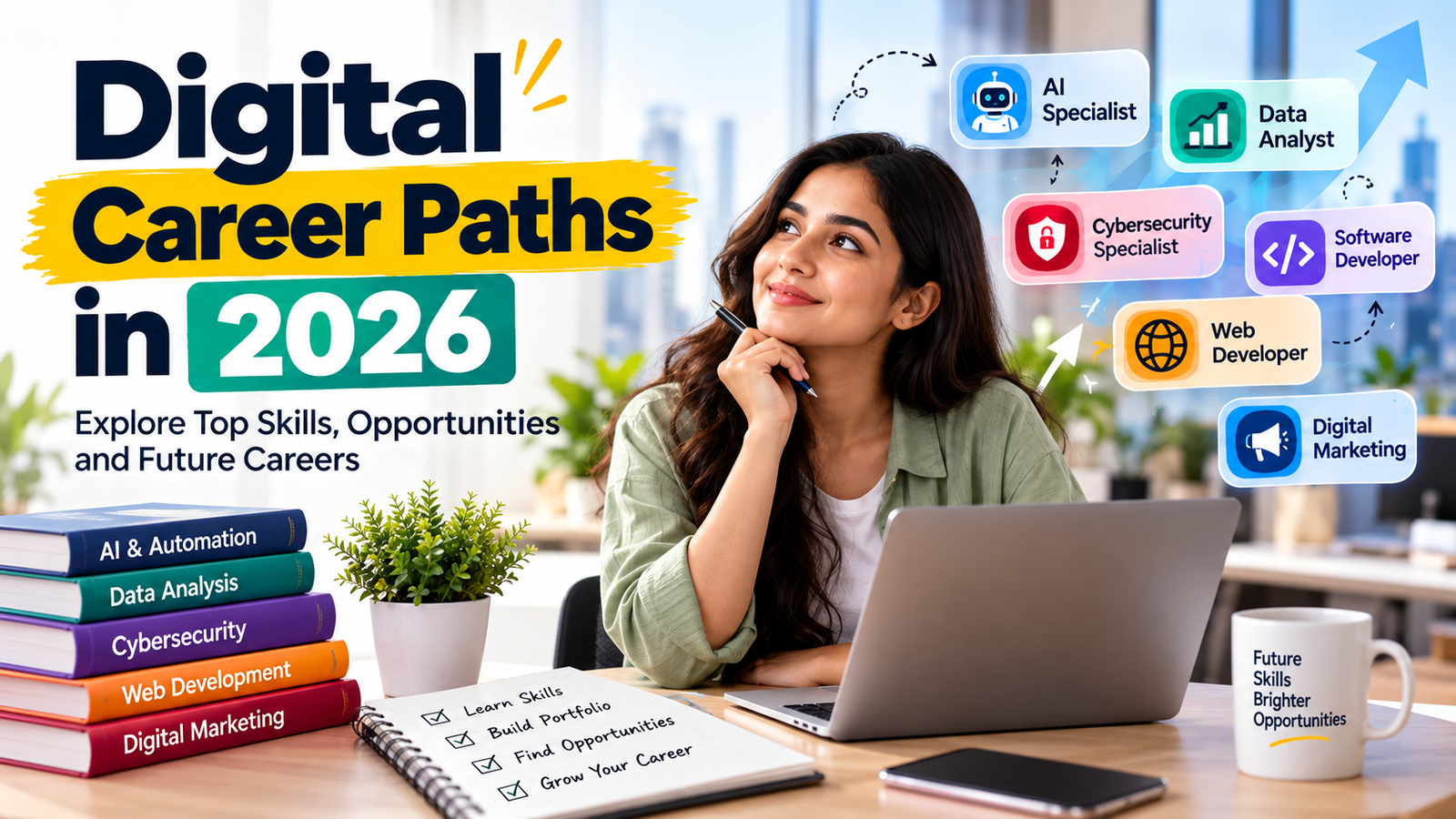
The digital economy continues to create new opportunities for people who want flexible, technology-focused, and skill-based work. From artificial intelligence and cybersecurity to digital marketing and content creation, there are many career paths that can be started with the right combination of learning, practice, and experience. Understanding different Digital Career Paths can help students, career changers, freelancers, and beginners decide which skills are worth developing in 2026.
Not every digital career requires a traditional four-year degree. Many roles can be entered by building practical skills, completing relevant courses, creating projects, and developing a strong portfolio. This guide explores useful Digital Career Paths to consider in 2026 and explains the skills, responsibilities, and preparation involved in each path.
Why Digital Careers Matter in 2026
Businesses of all sizes rely on websites, software, digital communication, online advertising, data, cloud services, and cybersecurity. As companies continue using technology in everyday operations, workers with useful digital skills can find opportunities across many industries.
The growing range of Digital Career Paths means that beginners are not limited to one type of technology job. Someone interested in creativity may explore design or content, while someone who enjoys technical problem solving may prefer software development, cybersecurity, or cloud computing.
Technology also changes quickly. A successful digital career therefore requires continuous learning. Instead of focusing only on one tool, it is useful to understand the underlying skill and learn how different platforms and technologies support that skill.
1. AI Specialist
Artificial intelligence is being used for content creation, automation, customer support, data analysis, software development, research, and business operations. This has increased interest in careers related to AI tools, AI implementation, and machine learning.
AI is therefore becoming an important area among modern Digital Career Paths. Some professionals build machine-learning systems, while others help businesses use existing AI tools effectively. Beginners can start by learning AI concepts, automation, data fundamentals, and responsible AI practices.
Useful skills include:
- Artificial intelligence fundamentals
- Machine learning basics
- Prompt engineering
- Data analysis
- Automation
- Problem solving
2. Data Analyst
Businesses collect large amounts of information, but raw data is not useful unless people can understand it. Data analysts organize information, identify patterns, create reports, and help teams make informed decisions.
Data analysis is one of the practical Digital Career Paths for people who enjoy numbers, research, and problem solving. Beginners can start with spreadsheets before progressing to tools such as SQL, Python, or business intelligence platforms.
Important skills include:
- Excel or spreadsheet analysis
- SQL
- Data visualization
- Statistics
- Research
- Analytical thinking
3. Cybersecurity Specialist
As organizations depend more heavily on digital systems, protecting accounts, networks, applications, and information becomes increasingly important. Cybersecurity professionals help identify vulnerabilities, monitor systems, respond to incidents, and improve security practices.
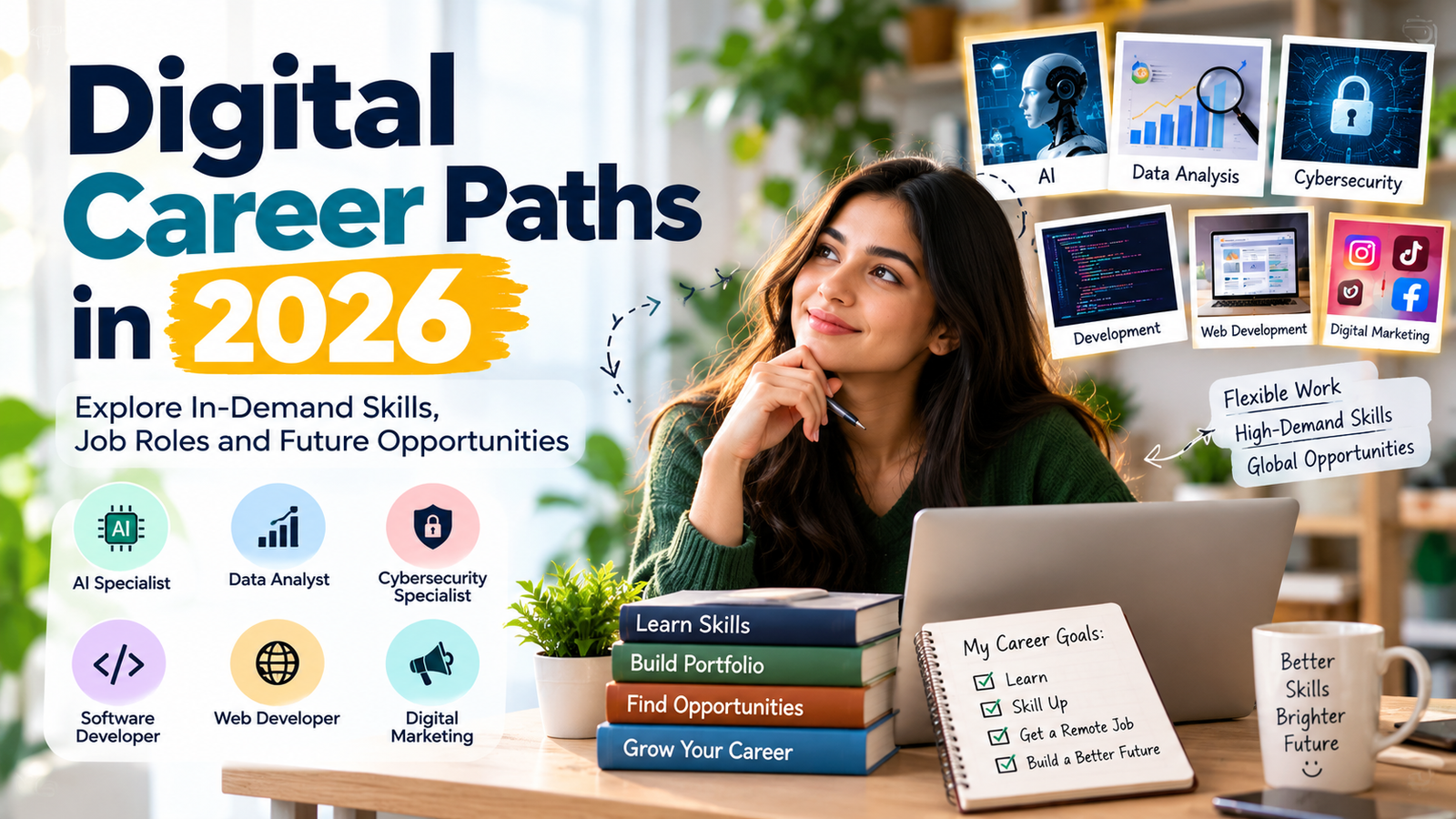
Cybersecurity is another valuable option among Digital Career Paths. Beginners can explore areas such as network security, security operations, identity management, cloud security, and risk management.
Useful starting skills include:
- Networking fundamentals
- Operating systems
- Security principles
- Risk awareness
- Threat detection
- Basic scripting
4. Software Developer
Software development remains an important digital career because businesses depend on websites, mobile applications, internal systems, and online services.
Software development is one of the more technical Digital Career Paths. Beginners do not need to learn every programming language. A better approach is to choose one area and build practical projects.
Someone interested in websites might begin with HTML, CSS, and JavaScript, while another person may choose Python for automation or backend development. Building projects is especially valuable because a portfolio can demonstrate what you can actually create.
5. Web Developer
Web developers create and maintain websites and web applications. This career can include front-end development, back-end development, or full-stack development.
Web development offers flexible Digital Career Paths because professionals can specialize in different areas. Front-end developers work with the visible parts of websites, while back-end developers focus on servers, databases, APIs, and application logic.
Beginners can start by learning:
- HTML
- CSS
- JavaScript
- Responsive design
- Git and version control
- Basic web accessibility
6. UX and UI Designer
User experience and user interface design focus on making digital products useful, understandable, and visually effective. UX designers research user needs and plan experiences, while UI designers focus more closely on visual interfaces.
For creative people, UX and UI design can provide attractive Digital Career Paths. This career can suit people who enjoy solving practical problems while also working with visual design.
Useful skills include:
- Wireframing
- Prototyping
- User research
- Visual design
- Design systems
- Usability testing
7. Digital Marketing Specialist
Digital marketing helps businesses reach customers through online channels. Professionals may work with search engine optimization, social media, email marketing, paid advertising, content, or analytics.
Digital marketing is one of the more accessible Digital Career Paths for beginners because people can practice many skills on personal websites, small projects, or sample campaigns.
Important skills include:
- SEO
- Content marketing
- Social media marketing
- Email marketing
- Analytics
- Paid advertising
8. SEO Specialist
Search engine optimization focuses on improving the visibility and usefulness of websites in search results. SEO specialists research keywords, analyze search intent, improve content, review technical issues, and monitor performance.
SEO provides another option within Digital Career Paths for people who enjoy research, writing, websites, and data. A beginner can start by learning keyword research, on-page SEO, technical basics, internal linking, content structure, and analytics.
SEO also requires patience because search visibility can change over time. Strong SEO work should focus on useful content and a good user experience rather than simply repeating keywords.
9. Content Creator
Content creation has become a broad digital career covering blogs, videos, podcasts, newsletters, social media, educational content, and other online formats.
Content creation can be one of the flexible Digital Career Paths for people who enjoy communication and creativity. Successful creators usually combine creativity with research, audience understanding, and consistency.
Useful skills include:
- Writing
- Video production
- Graphic design
- Storytelling
- Audience research
- Social media strategy
10. Social Media Manager
Businesses use social platforms to communicate with customers, promote products, share educational content, and build communities. Social media managers plan content calendars, publish posts, monitor engagement, and analyze results.
Social media management adds another communication-focused option to modern Digital Career Paths. This career can suit people who understand online communication and enjoy combining creativity with organization.
Helpful skills include content planning, copywriting, visual content, analytics, community management, and platform-specific strategy.
11. Cloud Computing Professional
Cloud computing allows organizations to use remote computing resources, storage, databases, applications, and other infrastructure. Professionals can work in cloud administration, cloud engineering, architecture, security, or support.
Cloud computing is one of the more technical Digital Career Paths and generally requires a stronger computing foundation. Beginners should first understand networking, operating systems, databases, and basic computing concepts.
Learning one major cloud platform and building practical projects can provide a structured starting point.
12. IT Support Specialist
IT support professionals help users solve technical problems involving computers, applications, accounts, networks, and devices. This can be a useful entry point for people who want to build a longer-term technology career.
IT support can also serve as a starting point for several Digital Career Paths, including networking, cloud computing, cybersecurity, and systems administration.
13. E-Commerce Specialist
Online stores require more than simply listing products. E-commerce professionals may work with product pages, customer experience, digital advertising, analytics, inventory systems, email campaigns, and conversion optimization.
E-commerce combines business and technology, making it one of the practical Digital Career Paths for people interested in online business and customer behavior.

14. Automation Specialist
Automation specialists help businesses reduce repetitive manual work by connecting software, workflows, and digital tools. Automation can involve no-code platforms, APIs, AI tools, scripts, or workflow management systems.
Automation is becoming an increasingly useful area among Digital Career Paths because businesses often look for ways to improve efficiency and reduce repetitive tasks.
A beginner can start with simple automation projects such as connecting forms to spreadsheets, organizing customer information, or creating automated notifications.
15. Technical Writer
Technical writers explain complicated products, software, processes, and technical information in a way that users can understand. They may create documentation, help guides, tutorials, knowledge bases, or product instructions.
Technical writing offers communication-focused Digital Career Paths for people who enjoy writing and learning technical subjects. Strong communication skills are especially important because the goal is to make complex information easier to understand.
How to Choose a Digital Career
Choosing between different Digital Career Paths should begin with your interests, existing skills, preferred work style, and willingness to learn.
Ask yourself:
- Do I enjoy technical problem solving?
- Do I prefer creative work?
- Do I enjoy working with numbers and data?
- Do I like writing and communication?
- Do I prefer independent work or teamwork?
- How much time can I spend learning?
- Would I prefer employment, freelancing, or building a business?
There is no single career that fits everyone. Your choice among different Digital Career Paths should depend on the skills you enjoy developing and the type of work you want to perform.
Skills to Build for Digital Careers
Although different Digital Career Paths require different technical abilities, several transferable skills can help across many roles.
- Communication
- Problem solving
- Research
- Time management
- Digital literacy
- Adaptability
- Critical thinking
- Continuous learning
These skills can make it easier to learn new technologies as tools and platforms change.
Build a Digital Career Portfolio
A portfolio can help demonstrate your skills more clearly than a list of courses alone. Create projects that match the type of work you want to do.
For example, an aspiring web developer can create sample websites. A digital marketer can build a sample campaign. A data analyst can create a dashboard using a public dataset. A content creator can publish a series of useful articles or videos.
A strong portfolio can support several Digital Career Paths because it gives employers and clients practical evidence of your abilities.
Learn Through Practical Projects
Courses can provide structure, but practical work helps turn knowledge into usable skills. When exploring Digital Career Paths, try to spend part of your learning time actually creating something.
A simple learning cycle can be:
- Choose one skill.
- Learn the basic concepts.
- Follow a practical tutorial.
- Build a small project independently.
- Review your mistakes.
- Improve the project.
- Add the finished work to your portfolio.
Use AI Tools Responsibly
AI tools can support learning, research, writing, coding, design, and productivity. However, people should not treat AI output as automatically correct.
For many Digital Career Paths, AI can be useful as an assistant rather than a replacement for learning. Verify important information, understand the work you submit, and follow the rules of employers, schools, clients, or platforms.
Freelancing and Digital Careers
Some digital skills can be used in freelance work as well as traditional employment. Freelancers may offer services such as web development, SEO, content writing, graphic design, social media management, data analysis, or automation.
Freelancing can therefore provide another way to explore Digital Career Paths while building practical experience.
Before freelancing, build a few strong examples of your work. Clearly define what you offer, who you want to serve, how you will communicate with clients, and how you will manage deadlines.
How to Start From Zero
If you are completely new to digital work, do not try to learn everything at once. Choose one of the available Digital Career Paths and identify the first few skills it requires.
- Choose one digital career.
- Research its basic skills.
- Select reliable learning resources.
- Create a weekly learning schedule.
- Practice through small projects.
- Build a portfolio.
- Apply for internships, jobs, freelance projects, or entry-level opportunities.
This approach makes the large world of digital careers more manageable and helps you focus on one direction at a time.
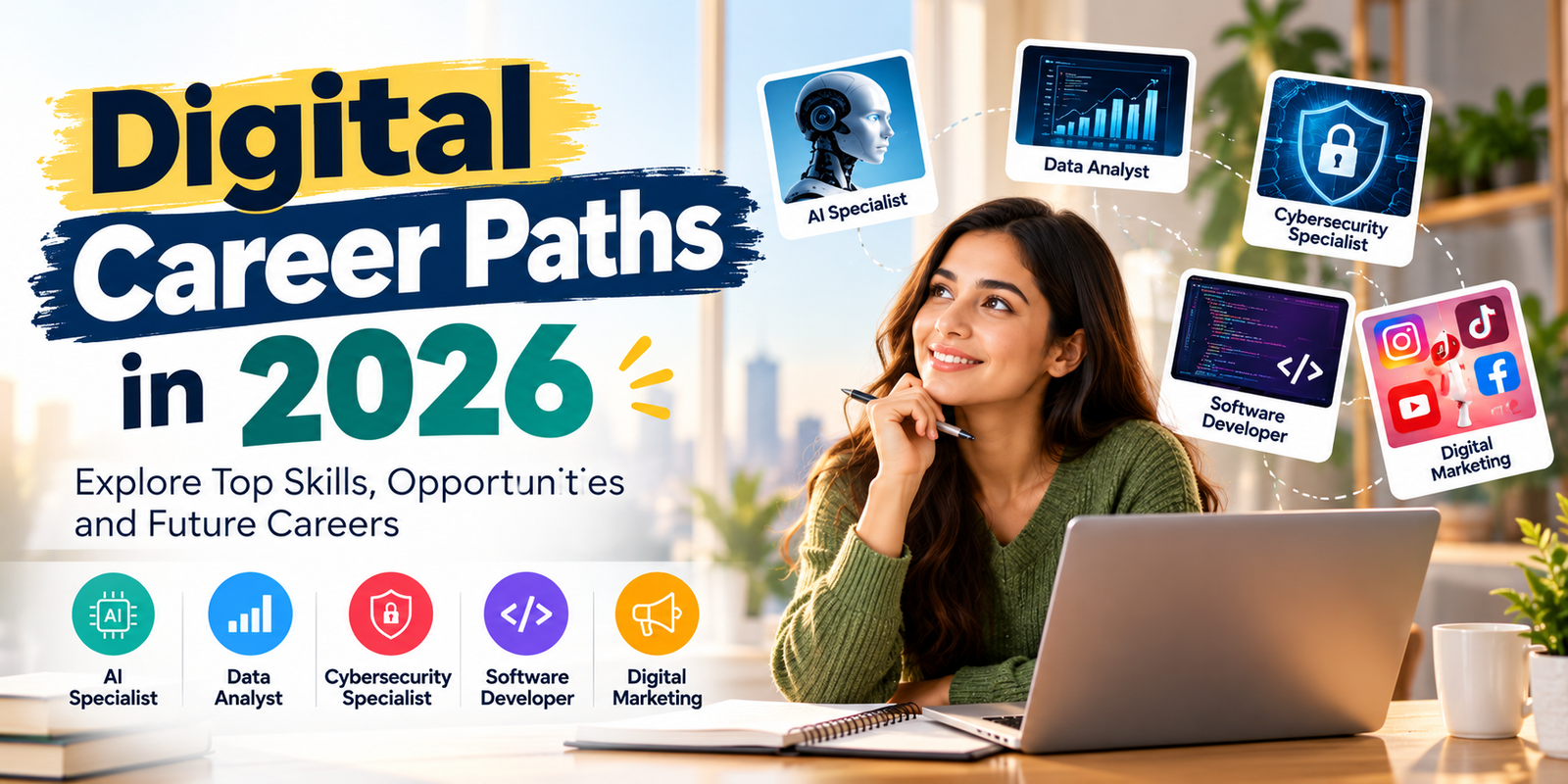
Common Mistakes to Avoid
People starting digital careers sometimes focus too much on collecting certificates and not enough on practical skills. Courses can be useful, but employers and clients also want evidence that you can apply what you have learned.
Other common mistakes include trying to learn too many technologies at once, copying projects without understanding them, ignoring communication skills, and giving up before gaining enough practice.
Frequently Asked Questions
What are the best digital career options to explore in 2026?
There are many options, including AI, data analysis, cybersecurity, software development, web development, digital marketing, SEO, UX/UI design, cloud computing, IT support, content creation, and automation. The most suitable Digital Career Paths depend on your interests, skills, and career goals.
Can I start a digital career without a degree?
Some digital roles can be entered without a traditional degree, particularly when candidates can demonstrate relevant skills through projects, portfolios, certifications, internships, or practical experience. Requirements vary by employer and profession.
Which digital skills should beginners learn first?
Start with skills that match your chosen career. Communication, research, problem solving, digital literacy, and basic technology knowledge are useful across many Digital Career Paths.
How long does it take to learn a digital skill?
The time varies significantly depending on the skill, your previous experience, and how consistently you practice. Basic skills can be learned relatively quickly, while advanced professional ability usually requires sustained practice and real-world experience.
Can digital careers be done remotely?
Many digital roles can be performed remotely, but remote availability depends on the employer, job responsibilities, location, and industry. Some Digital Career Paths may offer remote opportunities, while others may require hybrid or in-person work.
Conclusion
The range of Digital Career Paths in 2026 covers many areas, from artificial intelligence and cybersecurity to marketing, design, development, data, and content. You do not need to master everything. A better strategy is to choose one direction, learn the fundamentals, practice through real projects, and gradually build professional experience.
Digital careers can change as technology evolves, so continuous learning is an important part of long-term development. Focus on useful skills, create evidence of your abilities, and stay open to learning new tools as your career develops.