

Choosing a right career path can feel overwhelming when you have many interests, limited experience, or no clear idea about what you want to do in the future. The right decision is rarely about finding one perfect job. Instead, it is about understanding your strengths, interests, values, skills, lifestyle preferences, and available opportunities before choosing a direction.
Learning how to choose the right career path can help you make a more informed decision and avoid choosing a profession simply because it is popular, well-paid, or recommended by someone else. This guide explains practical ways to evaluate your options, research careers, test your interests, develop useful skills, and create a realistic plan for your professional future.
What Does Choosing a right career path Mean?
Choosing a career path means selecting a general professional direction that matches your abilities, interests, goals, and preferred way of working. It does not mean choosing one job and staying in that position for the rest of your working life.
Your career can change as you gain experience, develop new skills, discover new interests, or encounter opportunities you did not expect. Someone may begin in marketing and later move into communications, business development, project management, or entrepreneurship. Similarly, a person who starts in technology may eventually move into management, consulting, training, or another specialized area.
A career decision should therefore give you a useful starting point while leaving enough room for growth and change.
The goal is not to predict your entire professional life. The goal is to choose a direction that makes sense based on what you know about yourself and the opportunities available to you today.
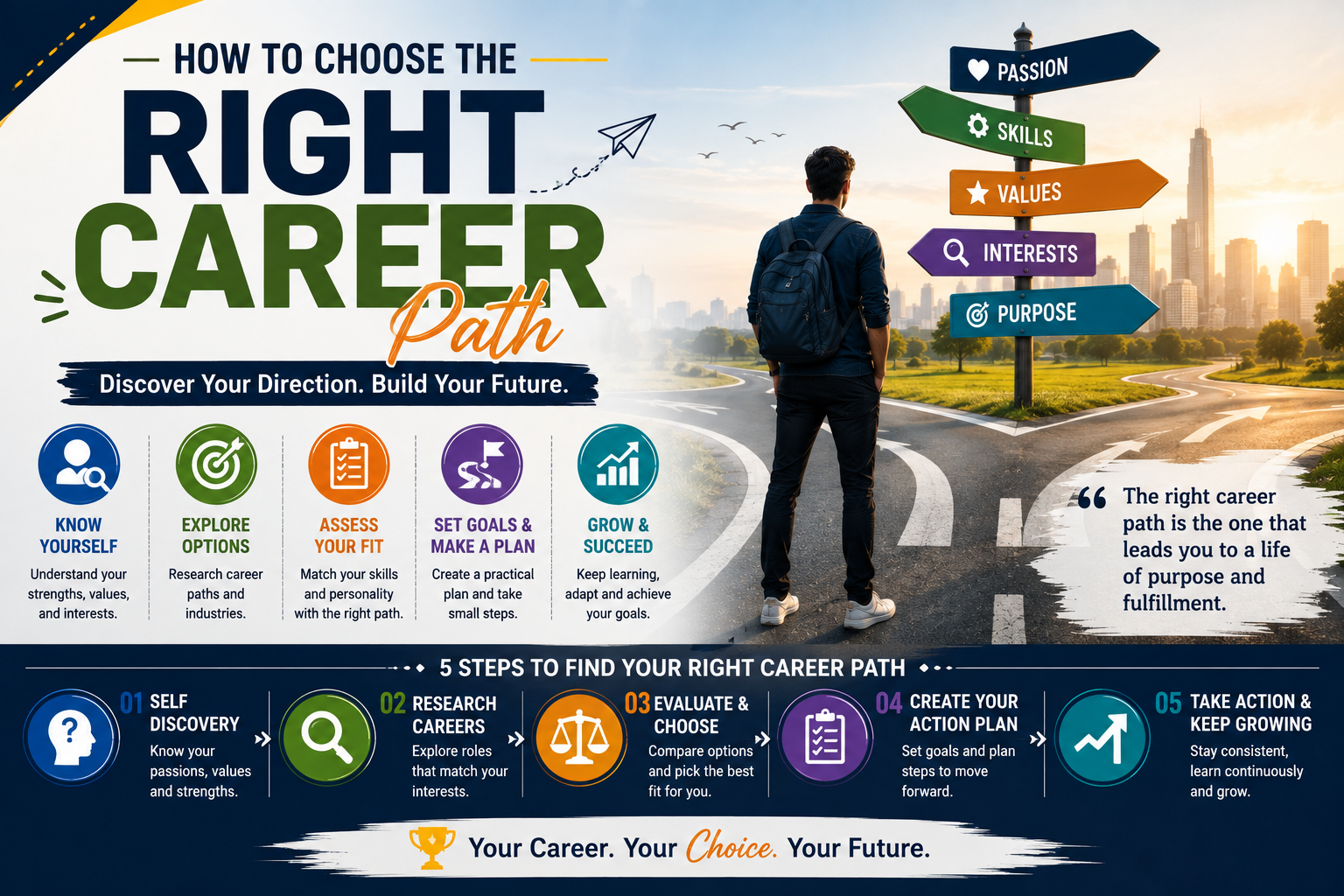
How to Choose the Right Career Path
A practical career decision should combine self-awareness with real-world research. You should understand yourself, investigate different professions, and gain enough experience to make an informed choice.
Follow these steps:
- Understand yourself: Identify your interests, strengths, values, personality traits, and preferred working style.
- Explore career options: Make a list of professions that connect with your abilities and interests.
- Research each option: Study responsibilities, qualifications, work environments, career progression, and employment opportunities.
- Identify skill requirements: Find out which technical and transferable skills employers expect.
- Test your interests: Use internships, projects, volunteering, courses, or job shadowing to experience the field.
- Compare your options: Consider salary, stability, lifestyle, location, training requirements, and growth opportunities.
- Choose a direction: Select the option that provides the strongest overall fit instead of waiting for complete certainty.
- Create an action plan: Decide what education, skills, experience, and networking activities you need to pursue your goal.
- Review your decision: Reassess your progress as you gain new information and professional experience.
This approach makes career planning more practical because you are not relying on one factor alone.
Start With Your Interests and Strengths
Your interests can provide useful clues about careers that may keep you engaged, while your strengths show where you may already have an advantage.
Think about the activities that naturally hold your attention. Perhaps you enjoy explaining ideas, solving technical problems, organizing information, helping people, writing, creating designs, analyzing numbers, building things, or managing projects.
Then consider the skills you have developed through school, work, hobbies, volunteering, or personal projects. These may include:
- Communication
- Writing
- Research
- Leadership
- Creativity
- Organization
- Problem-solving
- Teamwork
- Time management
- Customer service
- Analytical thinking
- Technical skills
Do not assume that an interest automatically makes a suitable career. Someone may enjoy photography but prefer a stable office position rather than working as a professional photographer. Another person may enjoy computers but prefer managing technology projects instead of programming.
The goal is to identify where your interests and strengths can work together in a realistic professional environment.
When considering the right career path, look for the intersection between what you enjoy, what you can become good at, and what employers or clients actually need.
Identify Your right career path Values
Career values are the things that matter most to you in your working life. They can influence job satisfaction even when you have the skills to perform a role successfully.
Common career values include:
- Financial security
- Work-life balance
- Flexible working hours
- Job stability
- Creativity
- Professional growth
- Leadership opportunities
- Meaningful work
- Independence
- Teamwork
- Learning opportunities
- Recognition
- Workplace flexibility
Choose your five most important values and rank them.
For example, suppose flexibility and independence are your highest priorities. A profession requiring strict schedules and limited autonomy may not suit you, even if it offers a competitive salary.
On the other hand, someone who values structure and predictable routines may prefer a career with clear responsibilities and regular working hours.
Understanding your values can make it easier to eliminate career options that do not fit your preferred lifestyle.
Consider Your Skills and Transferable Abilities
You do not need to possess every skill required for a career before entering the field. Many professionals build their abilities gradually through education, work experience, training, and practice.
Technical skills are usually connected to a specific profession. Examples include programming, accounting, graphic design, data analysis, electrical work, laboratory techniques, or operating specialized software.
Transferable skills are different. They can be useful across multiple industries and job roles. Communication, teamwork, critical thinking, organization, problem-solving, customer service, and project coordination are examples.
Create two lists:
Skills I already have
- Writing
- Communication
- Research
- Organization
- Technical abilities
Skills I need to develop
- Industry-specific software
- Advanced technical knowledge
- Professional certifications
- Leadership experience
- Presentation skills
This exercise can help you identify which careers are realistic now and which may require additional preparation.
A strong right career path does not necessarily match all your current abilities. It should also provide a reasonable opportunity for you to develop the skills you need.
Research Careers Before Making a Decision
Career research helps turn assumptions into useful information. A job title alone does not tell you what your daily responsibilities will look like.
For every career you are considering, research:
- Typical daily responsibilities
- Required education
- Certifications or licenses
- Important technical skills
- Transferable skills
- Common entry-level positions
- Work environment
- Typical schedule
- Career progression
- Industries that hire professionals
- Location requirements
- Remote or hybrid possibilities
- Salary expectations
- Common challenges
Job descriptions are especially useful because they show what employers are currently looking for. Review several listings instead of relying on one advertisement.
You should also look beyond salary. A profession might offer attractive compensation but require a schedule or working environment that does not match your priorities.
Reliable sources such as government labor-market information, professional associations, university career services, and established job platforms can help you gather better information.
Match Careers With Your Personality and Work Style
The way you prefer to work can have a major influence on career satisfaction.
Ask yourself whether you prefer:
- Working independently or with a team
- Predictable tasks or varied responsibilities
- Structured environments or flexible settings
- Practical activities or analytical work
- Quiet concentration or frequent interaction
- Office work or field work
- Fixed schedules or flexible hours
For example, someone who enjoys detailed analysis and quiet concentration may prefer accounting, research, data analysis, or technical work. Someone who enjoys frequent interaction may prefer sales, public relations, teaching, recruiting, customer success, or business development.
Personality assessments can help you generate ideas, but they should not make the decision for you. They are best treated as one source of information alongside your actual experiences, skills, interests, and goals.
Think About Education and Training Requirements
Some professions require specific degrees, licenses, certifications, apprenticeships, or supervised training. Others place greater emphasis on portfolios, practical experience, or demonstrated ability.
Before committing to a career, find out what qualifications are actually necessary for the jobs you want.
This can help you avoid spending significant time and money on education that does not directly support your professional goals.
Possible training routes include:
- University degrees
- College programs
- Vocational training
- Professional certifications
- Online courses
- Apprenticeships
- Internships
- Employer training
- Practical projects
- Industry workshops
Consider both the cost and the time required to become employable. If two careers interest you equally but one requires several additional years of expensive training while the other has a more accessible entry route, that difference may influence your decision.

Evaluate the Job Market and Future Opportunities
Personal interest is important, but career planning should also consider employment opportunities.
A profession may sound exciting but have limited openings in the location where you want to work. Another field may offer many opportunities but require skills you currently lack.
Review current job postings and identify recurring requirements. If employers repeatedly request a particular qualification, software skill, language ability, or type of experience, that information can guide your preparation.“You can also use occupation data to compare education requirements, projected growth, and pay across different careers.”
Also think beyond your first position.
Ask:
- Can I specialize in this field?
- Are there senior-level opportunities?
- Can I move into management?
- Can I work in different industries?
- Are freelance or consulting opportunities available?
- Can the skills transfer to another profession?
- Is continued learning important in this field?
The right career path should ideally provide opportunities for professional development rather than limiting you to one narrow role.
Use Real Experience to Test a right career path
One of the most effective ways to evaluate a right career path is to experience part of it before making a major commitment.
You can test a career through:
- Internships
- Work placements
- Volunteer opportunities
- Freelance assignments
- Personal projects
- Portfolio work
- Short courses
- Job shadowing
- Professional networking events
- Informational interviews
Suppose you are interested in digital marketing. Instead of simply reading about the profession, you could create a small marketing project, manage social media for a volunteer organization, or complete a beginner course.
If software development interests you, build a simple application or website. If teaching interests you, volunteer as a tutor. If graphic design interests you, create sample projects for a portfolio.
Real exposure can reveal whether you enjoy the actual work rather than simply liking the idea of the profession.
This type of experimentation can make your career decision more confident and practical.
Compare right career path Options Before Choosing
If you have several possibilities, create a simple comparison instead of relying only on emotions.
| Factor | Career A | Career B | Career C |
|---|---|---|---|
| Interest level | High | Medium | High |
| Current skill fit | Medium | High | Low |
| Training required | Moderate | Low | High |
| Work-life fit | High | Medium | Medium |
| Growth potential | High | Medium | High |
| Job availability | Medium | High | Medium |
You can score each category from 1 to 5 if you want a more structured approach.
For example:
- Interest: 1–5
- Skills: 1–5
- Lifestyle fit: 1–5
- Training requirements: 1–5
- Growth potential: 1–5
- Job opportunities: 1–5
Do not let the final score make the decision automatically. Use it to identify which option deserves more attention and research.
Do Not Choose a right career path Based Only on Salary
Salary is an important part of career planning, particularly if you have financial responsibilities. However, income should be evaluated alongside other factors.
A high-paying career may not be suitable if the working hours, stress level, travel requirements, or work environment conflict with your priorities.
Similarly, a career with moderate starting pay may provide valuable experience, strong advancement opportunities, useful skills, and a better lifestyle.
Consider the complete picture:
- Starting income
- Long-term earning potential
- Job stability
- Work-life balance
- Training costs
- Career progression
- Location
- Working hours
- Job responsibilities
- Personal satisfaction
Money matters, but it should be one part of the decision rather than the entire decision.
Think About Your Preferred Lifestyle
Your career can influence where you live, how much flexibility you have, how often you travel, and how much time you have for family, hobbies, and personal responsibilities.
Ask yourself:
- Do I prefer fixed or flexible hours?
- Would I accept frequent travel?
- Do I want remote, hybrid, or on-site work?
- How important is location flexibility?
- Am I comfortable working under pressure?
- Do I prefer routine or variety?
- Would I rather work indoors or outdoors?
- How much responsibility do I want?
For example, a person who values remote work may prioritize careers where remote positions are commonly available. Someone who enjoys hands-on activities may prefer a practical profession rather than a desk-based role.
Your preferred lifestyle should be part of your right career path decision from the beginning.
Consider right career path Growth and Advancement
A good starting job can lead to several professional opportunities. When evaluating a career, research what typically happens after the entry-level stage.
A professional might start as a junior employee, become a specialist, move into a senior role, take on management responsibilities, or develop expertise in a particular area.
Some careers also allow movement between industries. For example, project management skills can be useful in technology, construction, healthcare, education, finance, and other sectors.
Career growth also depends on continued learning. Industries change, and professionals often need to update their knowledge and skills.
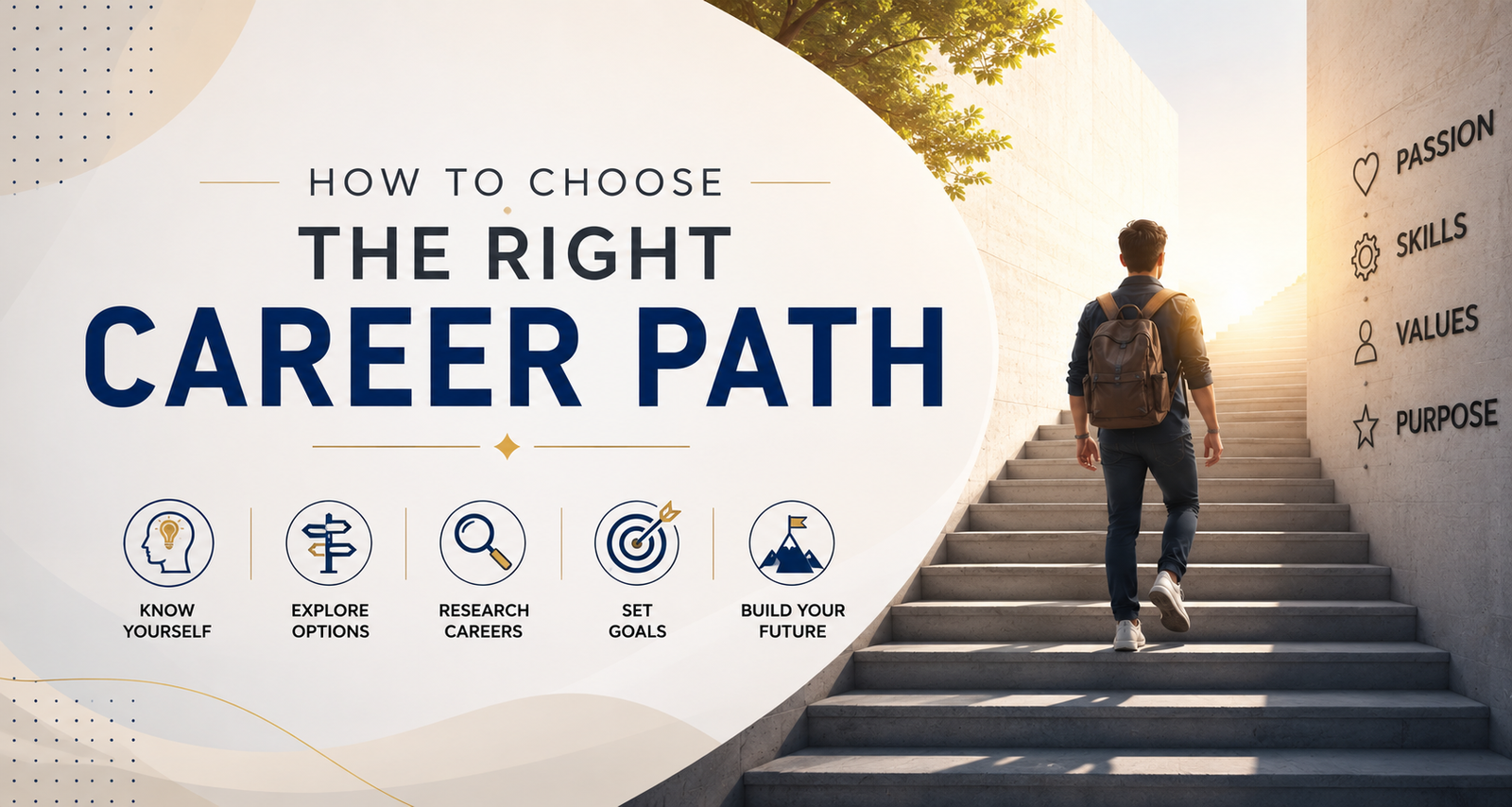
When evaluating the right career path, consider not only your first job but also where the field could take you after three, five, or ten years.
How to Choose the Right Career Path When You Are Unsure
Not knowing what you want to do is common. You do not need to have your entire professional future planned before taking your first step.
Start by choosing a direction rather than demanding a permanent answer.
Look for options that meet three basic conditions:
- You have some genuine interest in the work.
- You can realistically develop the necessary skills.
- The field offers practical employment opportunities.
Then take a small step.
Complete a beginner course. Speak with someone working in the field. Volunteer. Build a small project. Apply for an internship. Read several job descriptions.
Each experience gives you new information.
If you discover that you dislike the work, you have learned something valuable before making a larger commitment. If you enjoy it, you have evidence that the field deserves further investment.The field offers practical employment opportunities, and a career planning guide can help you evaluate your options before making a decision.
Common right career path-Choice Mistakes to Avoid
Career decisions can become harder when people focus on outside pressure or unrealistic expectations.
Following Someone Else’s right career path
Parents, friends, teachers, and colleagues may give useful advice, but their preferences should not determine your professional future.
A career that works well for someone else may not match your personality, strengths, values, or lifestyle.
Listen to advice, but make the final decision based on your own circumstances.
Choosing Only for Money
Income is important, but money alone cannot tell you whether a profession is suitable.
Consider the responsibilities, schedule, work environment, growth opportunities, and training requirements as well.
Ignoring the Actual Work
A job title can sound attractive while the daily responsibilities may not interest you.
Research what professionals actually do during a typical workday. If possible, talk to people already working in the field.
Waiting for Complete Certainty
You rarely have perfect information when choosing a career.
Instead of waiting until you feel completely certain, make the best informed decision you can and remain willing to reassess later.
Ignoring Skill Development
Choosing a right career path without creating a skill-development plan can leave you unprepared.
Study job descriptions and identify the skills employers value. Then build those skills through education, projects, practice, and experience.
Comparing Yourself With Others
Everyone’s right career path develops at a different pace.
Someone else may find a job earlier, earn more money, or advance faster. That does not mean you are making the wrong choices.
Focus on building a career that fits your own goals and circumstances.
Build a Practical Career Action Plan
Once you have chosen a direction, turn the decision into specific actions.
1. Define Your Target Role
Choose one or two realistic job titles that represent your short-term goal.
A specific target is easier to plan for than a vague goal such as “I want a successful career.”
2. Review Job Descriptions
Study multiple job postings for your target roles.
Write down the qualifications, technical skills, soft skills, and experience employers commonly request.
3. Find Your Skill Gaps
Compare employer requirements with your current abilities.
Identify the areas where you need improvement.
4. Build the Missing Skills
Use courses, projects, practice, internships, volunteer work, or workplace opportunities to develop your abilities.
Whenever possible, create evidence of your skills through projects or measurable achievements.
5. Improve Your Resume
Tailor your resume toward your target roles.
Highlight relevant skills, projects, education, certifications, and achievements rather than listing every activity you have completed.
6. Build Professional Connections
Connect with people working in your target field.
Professional conversations can help you understand the industry, learn about opportunities, and discover skills you may need to develop.
7. Apply for Relevant Opportunities
Look for internships, entry-level jobs, freelance assignments, volunteer projects, apprenticeships, or other experiences that can help you move closer to your goal.
8. Review Your Progress
Set a regular time to review your progress.
Ask what you have learned, which skills you have developed, what opportunities have appeared, and whether your career direction still makes sense.
Create a Short-Term Career Experiment
If you are uncertain between several careers, create a 30-day experiment for each option.
For example, if you are considering writing, marketing, and graphic design, spend several weeks exploring each field.
For writing, complete several articles.
For marketing, create a basic campaign or analyze a brand’s online presence.
For graphic design, create several sample designs.
At the end of each experiment, evaluate:
- Did I enjoy the work?
- Was I willing to practice without being forced?
- Did I enjoy learning the required skills?
- Could I imagine doing similar work regularly?
- Did I find the challenges interesting?
- Would I like to improve at this activity?
This approach can provide more useful information than simply asking yourself which career sounds exciting.

Career Planning Questions to Ask Yourself
Before choosing a professional direction, write honest answers to these questions:
- What activities do I naturally enjoy?
- What am I good at today?
- What skills do I want to develop?
- What type of workplace suits me?
- What values are most important to me?
- What lifestyle do I want my career to support?
- What qualifications does my preferred profession require?
- What opportunities exist in my target location?
- What salary range would meet my needs?
- What challenges am I willing to accept?
- What can I do during the next 30 days to test this career?
- What information could change my decision?
Writing your answers down can make your priorities clearer and help you compare career options objectively.
Frequently Asked Questions
How do I choose the right career path?
Start by evaluating your interests, strengths, values, skills, lifestyle preferences, and available job opportunities. Research several careers, test your options through practical experience, and select the direction that provides the strongest overall fit.
What if I have no idea what right career path I want?
Start with exploration instead of trying to find one perfect answer. Identify activities you enjoy, research related professions, take introductory courses, speak with professionals, and gain practical experience through projects or internships.
Should I choose aright career path based on my passion?
Passion can be useful, but it should not be the only factor. Consider your skills, financial needs, job opportunities, working conditions, and long-term goals. A sustainable career often combines genuine interest with practical opportunity.
How important is salary when choosing a right career path?
Salary is an important consideration, but it should be evaluated alongside job stability, growth opportunities, work-life balance, training requirements, location, and personal goals.
Can I change my right career path later?
Yes. Many professionals change careers as they gain experience or discover new interests. Transferable skills, additional education, networking, and relevant experience can make a career transition easier.
How long should I spend deciding on a right career path?
Take enough time to research and test your options, but do not wait for perfect certainty. A practical decision followed by real-world experience can provide more useful information than endless research.
Conclusion
Learning how to choose the right career path is not about discovering one perfect profession that guarantees lifelong success. It is about finding a direction that fits your abilities, interests, values, lifestyle, financial needs, and professional opportunities.
Start by understanding yourself, then research realistic options and test your interests through practical experiences. Compare careers based on more than salary, and pay attention to training requirements, working conditions, job availability, and opportunities for growth.
Once you have selected a direction, focus on the next useful step rather than trying to predict your entire working life. Build relevant skills, gain experience, improve your resume, develop professional connections, and review your goals regularly.
Your first career decision does not have to determine everything that follows. A thoughtful starting point, combined with continuous learning and a willingness to adapt, can help you build a professional life that develops with you.