
Artificial intelligence is becoming a normal part of the devices people use every day. In 2026, smartphones, laptops, smartwatches, earbuds, smart glasses, and connected-home devices are moving beyond simple automation and becoming more capable of understanding context, preferences, voice commands, images, and everyday tasks. This rapid change is making personal AI technology one of the most important developments in consumer technology.
The biggest difference is that AI is no longer limited to a separate chatbot or application. Instead, intelligence is increasingly being built directly into personal devices and connected across an individual’s digital ecosystem. AI can help summarize information, translate conversations, organize tasks, analyze images, assist with writing, answer questions, and provide recommendations based on information the user has chosen to share.
Google, Qualcomm, and other technology companies are increasingly developing AI experiences that connect personal context with everyday computing. Google, for example, has expanded Personal Intelligence features that can connect approved Google services such as Gmail and Google Photos to provide more personalized responses.
At the same time, device manufacturers are investing in on-device AI, where some AI processing can happen directly on smartphones, computers, wearables, and other hardware. Qualcomm’s 2026 announcements show how AI processing is moving into PCs and wearable devices as part of a broader connected personal-device ecosystem.
This article explains how personal AI technology is changing everyday devices, what benefits consumers can expect, what risks they should consider, and how personal technology may evolve throughout the rest of 2026 and beyond.
Quick Overview
- AI is becoming a built-in capability across smartphones, computers, wearables, and home devices.
- On-device AI allows compatible tasks to be processed directly on hardware.
- AI assistants are becoming more contextual and capable of handling multi-step tasks.
- Wearables can provide AI assistance without requiring users to constantly look at a screen.
- Connected devices can share relevant context to create a more seamless experience.
- Personalization is becoming a major part of modern AI assistants.
- Privacy, security, permissions, accuracy, and user control remain important considerations.
What Is Personal AI Technology?
Personal AI technology refers to artificial intelligence designed to provide assistance based on an individual’s needs, preferences, context, and approved information. Traditional software generally waits for a user to open an application and perform a specific action. Personal AI is designed to make interaction more conversational, contextual, and adaptive.
For example, instead of opening several applications to find travel information, a user could ask an AI assistant to organize relevant details from approved email, calendar, photos, or documents. The system may be able to identify the information, summarize it, and present the result in a useful format.
This does not mean AI should automatically access everything on a person’s devices. Permission and privacy controls remain essential. The usefulness of personal AI depends heavily on what information users choose to connect and what actions they allow the system to perform.
The concept is also expanding beyond smartphones. Qualcomm describes an ecosystem in which smartphones, PCs, earbuds, smart glasses, and wearables can contribute different capabilities to a coordinated AI experience.
How Personal AI Technology Is Changing Smartphones
Smartphones are likely to remain one of the most important platforms for personal AI technology. Modern smartphones already contain cameras, microphones, sensors, powerful processors, connectivity, and access to many applications. These capabilities provide a strong foundation for AI-powered assistance.
AI can improve smartphone photography by recognizing scenes, adjusting images, removing unwanted objects, improving low-light results, and helping users organize large photo libraries. AI can also assist with writing messages, summarizing notifications, translating languages, transcribing audio, and finding information.
Another important development is personalized search. Google has been expanding Personal Intelligence in AI Mode and Gemini, allowing users to connect selected applications so responses can be tailored to their personal context. Google says users maintain control over which applications are connected.
This approach changes how people interact with smartphones. Instead of manually searching through multiple applications, users can increasingly describe what they need in natural language and allow AI to help locate relevant information.
AI PCs Are Making Computers More Intelligent
Laptops and desktop computers are also becoming major platforms for personal AI technology. AI PCs are designed with hardware capable of efficiently handling AI workloads, including dedicated neural processing units, or NPUs, in many modern systems.
Local AI processing can be useful for tasks that benefit from low latency. Depending on the software and hardware, a computer may be able to process certain AI functions without sending every piece of information to a remote server.
In August 2026, Qualcomm and HUMAIN announced the Horizon Ultra AI PC, built around CPU, GPU, and NPU computing for on-device AI. The announcement illustrates the broader industry movement toward bringing more AI processing directly to personal computers.
For users, this can create practical benefits. AI features may become available inside productivity applications, file management tools, creative software, communication platforms, and operating-system features.
However, buyers should not purchase a computer simply because it carries an “AI PC” label. The useful question is which AI features are actually supported, whether they work locally or through cloud services, and whether those features solve a real problem.
Wearables Are Becoming AI Companions
One of the most interesting developments in personal AI technology is the expansion of AI into wearable devices.
Smartwatches, rings, earbuds, pins, pendants, and other wearable products can stay close to the user throughout the day. Because of this, they can provide information or interaction without requiring the user to take out a smartphone.
Qualcomm introduced the Snapdragon Wear Elite platform in 2026 with an integrated NPU for on-device AI processing in wearable form factors. The company positions the technology as part of a broader ecosystem where wearables can contribute contextual information to personal AI systems.
This can be useful for voice interaction, notifications, translation, navigation, accessibility, and other hands-free applications.
The long-term direction is important because wearable AI changes the relationship between people and technology. Instead of constantly reaching for a screen, users may increasingly interact with technology through voice, audio, gestures, cameras, and other natural interfaces.
AI Earbuds Are Becoming More Capable
Earbuds may seem like a simple category for personal AI technology, but their position near the user’s ears makes them an interesting interface for AI.
Traditional earbuds focus on music, calls, and noise cancellation. AI-enabled hearables can potentially add translation, voice assistance, contextual information, transcription, personalized audio experiences, and other capabilities.
Qualcomm introduced Snapdragon Sound Elite Gen 2 in September 2026 as an audio platform designed around Personal AI, combining on-device intelligence, connectivity, and audio capabilities. The company describes hearables as an increasingly natural interface for AI when users are away from screens.
This is especially useful when people are walking, exercising, traveling, driving where appropriate, or performing work that makes screen interaction inconvenient.
Smart Glasses Add Visual Context
Smart glasses could become another major category for personal AI technology because they can potentially combine cameras, microphones, speakers, sensors, and displays in a device that users wear naturally.
AI-enabled glasses may assist with recognizing objects, reading signs, translating languages, providing navigation information, answering questions about visible objects, or helping users understand their surroundings.
The major advantage is context. A smartphone requires a user to point a camera at something or type a question. Glasses can potentially make interaction more immediate, although the exact capabilities depend on hardware, software, permissions, connectivity, and privacy controls.
Smart glasses also create significant privacy considerations. A camera or microphone worn in public can affect people who are not using the device. Manufacturers and users therefore need to consider transparency, consent, recording indicators, and responsible use.
On-Device AI and Cloud AI
The growth of personal AI technology is closely connected to the balance between on-device processing and cloud computing.
On-device AI means that compatible AI workloads can be processed directly on the user’s hardware. Cloud AI sends information to remote computing infrastructure where larger models and additional computing resources may be available.
| On-Device AI | Cloud AI |
|---|---|
| Processes compatible workloads locally | Processes workloads on remote servers |
| Can reduce latency for supported tasks | Can provide access to larger models and computing resources |
| Can reduce the need to send some data externally | Usually requires network communication |
| Can support some functions without continuous connectivity | Often depends on an internet connection |
| Limited by device hardware | Can use much larger data-center resources |
The likely future is a hybrid approach. Simple or sensitive tasks can potentially run locally, while more demanding tasks can use cloud resources. Qualcomm describes this type of architecture as combining on-device intelligence, edge computing, and cloud resources.
AI Is Becoming More Context-Aware
One of the biggest changes in personal AI technology is the move from isolated commands toward context-aware assistance.
A traditional assistant might answer, “What is the weather?” A context-aware assistant could potentially understand that the user is preparing for a trip and provide information relevant to the destination, schedule, clothing, or transportation after receiving the necessary permissions and context.
Google’s Personal Intelligence features demonstrate this direction by connecting selected applications such as Gmail and Photos to AI experiences. The goal is to reduce the amount of background information users have to repeat manually.
Context can make AI more useful, but it also makes privacy more important. The more an AI system knows, the greater the responsibility to control how that information is collected, processed, stored, and used.
AI Agents Can Handle Multi-Step Tasks
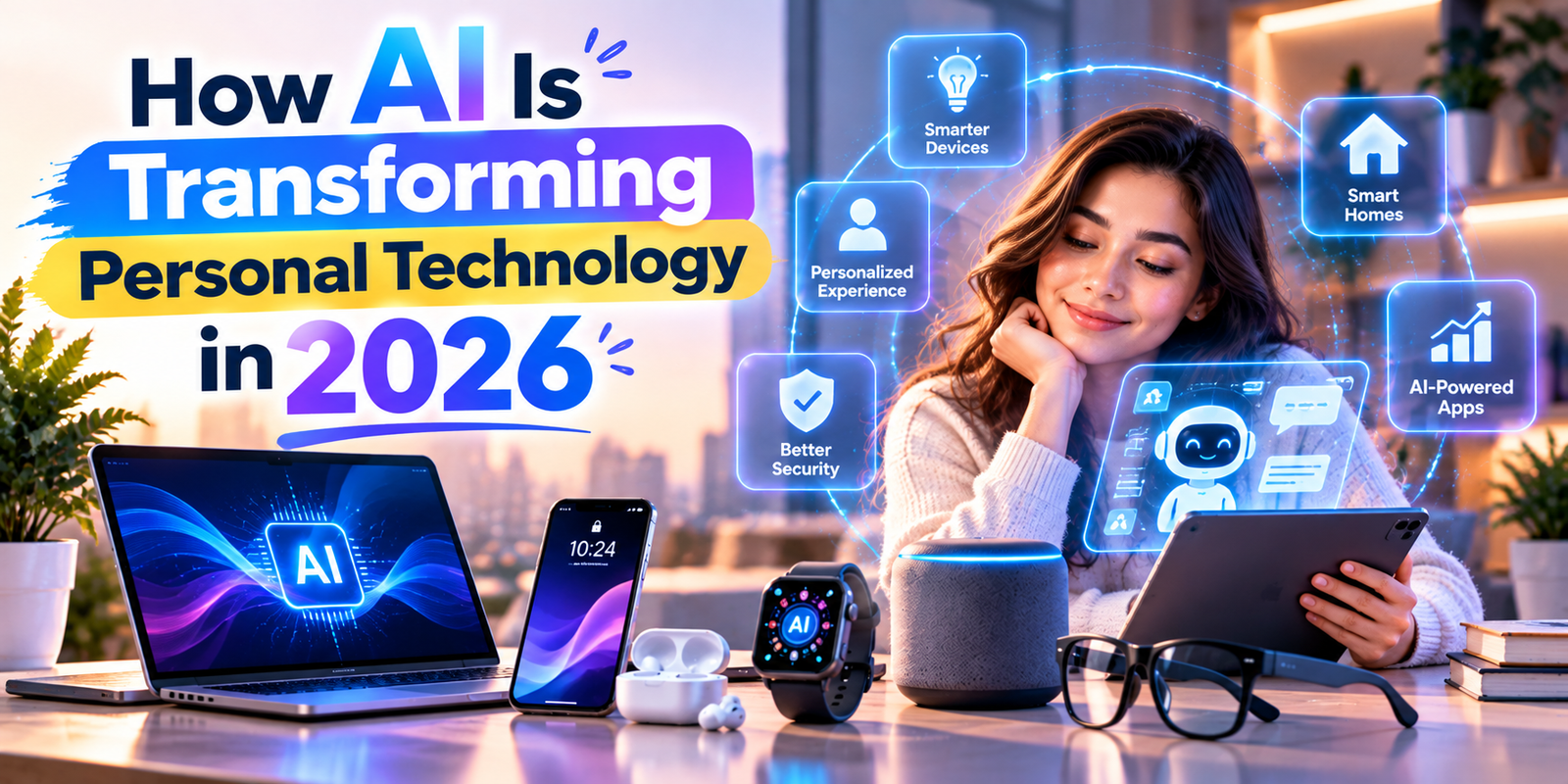
Another major direction for personal AI technology is the development of AI agents.
A basic chatbot primarily responds to questions. An AI agent can be designed to understand an objective, plan multiple steps, use approved tools, and complete parts of a task.
For example, a user might ask an assistant to organize information for an upcoming trip. Depending on the system and permissions, an agent could identify relevant confirmation emails, organize dates, summarize important details, and create a proposed itinerary.
Google has also announced AI features designed to support more agent-like experiences in Search, including custom experiences for ongoing tasks.
However, users should distinguish between an AI that suggests an action and one that actually performs it. Actions involving purchases, messages, accounts, bookings, or sensitive information should have clear permissions and confirmation controls.
Personalization Is Becoming a Core AI Feature
Personalization is one of the defining characteristics of personal AI technology. Instead of giving identical answers to everyone, AI systems can potentially adapt responses based on user preferences and approved context.
Personalization can include writing style, language, frequently used applications, previous purchases, travel information, saved content, or other information that a user intentionally connects.
Google’s 2026 Personal Intelligence features show how AI can connect selected Google services to provide more tailored answers. Google emphasizes that users choose which applications to connect.
Good personalization should make technology easier to use without removing user control. People should be able to understand what information an AI system can access and change permissions when necessary.
How AI Can Improve Everyday Productivity
For many users, the most practical value of personal AI technology will come from saving time.
Writing and Communication
AI can help draft emails, summarize conversations, rewrite text, translate messages, and adjust writing for different audiences. Users can spend less time on repetitive wording and more time reviewing the final result.
Information Management
AI can summarize documents, identify important information, organize notes, and help users find specific details within large collections of content.
Learning
Students and lifelong learners can use AI to explain difficult concepts, generate practice questions, simplify complex subjects, and create study materials.
Creative Work
AI can support image creation, brainstorming, editing, audio processing, video workflows, and other creative tasks. The user’s judgment remains important because generated content can still contain errors or unwanted results.
Accessibility
Voice interaction, transcription, translation, image understanding, and hands-free controls can make digital technology more accessible to people with different abilities and preferences.
AI and Smart Homes
Smart-home systems are another area where personal AI technology can change everyday experiences.
Traditional smart-home systems often require users to control individual devices. AI can potentially make these interactions more natural by allowing people to describe what they want rather than specifying individual commands.
For example, a user could potentially ask a compatible smart-home assistant to prepare the home for bedtime, and the system could coordinate supported lights, thermostats, locks, or entertainment devices according to predefined permissions.
The important point is that AI should not automatically control sensitive devices without appropriate safeguards. Security systems, locks, appliances, and other connected hardware need strong authentication and user controls.
Privacy Challenges
The growth of personal AI technology creates a major privacy question: how much personal information should an AI system know?
An AI assistant becomes more useful when it has context. However, that context might include emails, photos, documents, conversations, location information, schedules, and device activity.
Before enabling a new AI feature, users should review its permissions and privacy settings.
- Check which applications are connected.
- Understand what data the AI can access.
- Review whether processing happens locally or through cloud services.
- Check how long information is retained.
- Disable permissions that are not necessary.
- Review connected applications periodically.
- Use strong account security and multi-factor authentication where available.
- Be careful when allowing AI to take actions on your behalf.
Security and Accuracy Matter
Greater dependence on personal AI technology also means users need to think about accuracy and security.
AI systems can misunderstand instructions, generate incorrect information, misinterpret images, or make unsuitable recommendations. An AI response should therefore not automatically be treated as a fact simply because it sounds confident.
Security is another concern. If an AI system can access multiple accounts, an attacker who gains control of that system could potentially gain access to more information than they could through a single application.
Users should keep devices updated, use strong authentication, review application permissions, and avoid giving unnecessary access to AI tools.
Common Mistakes When Choosing AI Devices
Buying Based Only on the AI Label
Not every device marketed as an AI device provides the same capabilities. Compare actual features rather than relying on marketing terminology.
Ignoring Privacy Settings
Review permissions before connecting email, photos, documents, contacts, calendars, or other personal services.
Assuming Every AI Feature Works Offline
Some features may require cloud processing or an internet connection. Check the manufacturer’s documentation before relying on an AI feature while traveling or in areas with limited connectivity.
Expecting Perfect Accuracy
AI can make mistakes. Important information should be verified, particularly when decisions involve money, legal matters, safety, or sensitive personal information.
Ignoring Compatibility
Some AI features require specific hardware, operating-system versions, subscriptions, regions, or applications. Always check compatibility before purchasing a device for a particular AI function.
What the Future of Personal Technology May Look Like
The future direction of personal AI technology appears to be moving from isolated devices toward coordinated ecosystems.
A smartphone may provide communication and computing. A PC may handle demanding workloads. Earbuds may provide voice interaction. Smart glasses may provide visual context. A smartwatch may provide quick notifications and sensor information. Cloud infrastructure may provide additional computing power when needed.
Qualcomm describes this broader approach as an “Ecosystem of You,” where different personal devices work together around the individual rather than functioning only as separate products.
This does not mean every device will become equally intelligent. Instead, each device can perform tasks suited to its hardware and form factor.
The biggest challenge will be creating an ecosystem that is genuinely useful without becoming intrusive. Users need clear controls over data, permissions, automation, and AI actions.
How Consumers Can Prepare for AI-Powered Technology
Consumers do not need to replace every device immediately to benefit from personal AI technology. A better approach is to identify everyday tasks where AI can provide genuine value.
- Start with one useful AI feature. Choose a feature that solves a real problem, such as writing assistance or transcription.
- Review privacy settings. Understand which information the AI can access before connecting additional services.
- Learn what runs locally. Check whether important features require cloud processing.
- Keep devices updated. Software updates can provide new features and security improvements.
- Use human judgment. Treat AI as an assistant rather than an unquestionable authority.
- Compare ecosystems. Consider how well your phone, computer, wearable devices, and preferred applications work together.personal AI technology
Frequently Asked Questions
What is personal AI technology?
Personal AI technology is artificial intelligence designed to provide individualized assistance using information such as preferences, context, connected applications, and device data that the user has authorized.personal AI technology
How is AI changing personal technology in 2026?
AI is becoming integrated into smartphones, PCs, wearables, earbuds, smart glasses, search tools, and other consumer products. The focus is shifting toward contextual assistance, personalization, on-device processing, and multi-device experiences.personal AI technology
Is on-device AI safer than cloud AI?
On-device AI can offer privacy advantages because compatible information can be processed locally. However, overall privacy depends on the complete product design, software permissions, data retention practices, and security controls.personal AI technology
Will AI replace smartphones?
Current developments do not establish that smartphones will be replaced soon. Instead, AI is increasingly being integrated into smartphones while also expanding into computers, wearables, earbuds, glasses, and other devices.personal AI technology
Are AI wearables useful?
AI wearables can be useful for hands-free interaction, translation, notifications, accessibility, contextual assistance, and other tasks. Their usefulness depends on the specific device, software, battery life, connectivity, and privacy controls.personal AI technology
What should I check before buying an AI device?
Check the actual AI features, supported applications, hardware requirements, privacy settings, battery life, cloud requirements, subscription costs, software support, and whether the device solves a real problem for you.personal AI technology
Conclusion
The growth of personal AI technology is changing the role of everyday technology. AI is moving from standalone applications into smartphones, computers, watches, earbuds, glasses, and connected-home systems.personal AI technology
The most important development is not simply that devices are becoming more powerful. It is that they are becoming more capable of understanding context and working together. Google is expanding personalized AI experiences across selected services, while Qualcomm is developing hardware and platforms for AI across PCs, wearables, hearables, and other devices.personal AI technology
For consumers, the best way to approach this transition is to focus on practical value. A device should not be considered useful simply because it includes AI. The technology should save time, improve accessibility, simplify communication, support creativity, or solve a genuine everyday problem.personal AI technology
Privacy and control should remain equally important. As AI becomes more personal, users need to understand what information they are sharing, which services are connected, and which actions an AI system is allowed to perform.
The future of personal computing is likely to be more conversational, contextual, connected, and adaptive. If these systems continue to improve while maintaining strong privacy, security, transparency, and user control, AI could become a natural layer of everyday technology rather than another application users have to manage.personal AI technology