

Learning how to build multiple income sources can help you reduce dependence on a single paycheck and create greater financial flexibility. Instead of relying entirely on one job or business, you can combine employment income with freelancing, online tutoring, digital products, content creation, a small business, or investments.
The goal is not to start everything at once. A better approach is to build one reliable income stream first and then gradually add other opportunities that match your skills, available time, financial situation, and long-term goals. This guide explains practical ways to create multiple income sources, how to choose the right options, how to manage them, and which mistakes beginners should avoid.
What Are Multiple Income Sources?
Multiple income sources are different channels through which a person earns money. For example, an employee may receive a monthly salary while also earning money from freelance writing, online tutoring, selling digital products, or a small online business.
These income streams can be active, passive, or somewhere in between. Active income usually requires direct time and effort. Freelancing and tutoring are good examples because you generally get paid for completing work or providing a service. Passive or semi-passive income may require significant work or investment initially but can potentially continue generating revenue with less ongoing effort.
It is important to understand that passive income does not mean guaranteed or effortless money. Most income opportunities require some combination of time, skills, money, marketing, maintenance, or risk management.
Why Build Multiple Income Sources?
Building multiple income sources can provide greater financial flexibility. If one source becomes smaller, delayed, or temporarily unavailable, another source may continue to contribute to your overall income.
Additional income can also help you work toward financial goals. You might use extra earnings to build an emergency fund, reduce debt, save for education, invest for the future, or create more financial freedom.
- Greater financial flexibility: Extra income can provide more room in your monthly budget.
- Reduced dependence: Your entire income does not have to come from one employer or client.
- Skill development: Side work can help you develop communication, marketing, technical, and business skills.
- Future opportunities: A small side project may eventually develop into a larger business or career.
- More control: Different income streams can give you more choices about how you spend your time.
- Better financial planning: Additional earnings can support savings and long-term financial goals.
How to Build Multiple Income Sources Step by Step
The best way to create multiple income sources is to build them gradually instead of trying to manage several projects immediately. Start with an opportunity that has a realistic connection to your current skills, experience, and resources.
1. Strengthen Your Main Income First
Your primary income should usually remain the foundation of your financial plan. Before starting several side projects, consider whether you can improve your current earning potential through better skills, additional responsibilities, professional training, or career advancement.
For employees, improving performance and developing valuable skills may create opportunities for promotions or better-paying positions. For business owners, improving customer service, pricing, marketing, or operational efficiency may increase revenue.
A stable primary income can make it easier to experiment with another income stream without placing unnecessary pressure on your finances.
2. Turn Existing Skills Into Extra Income
One of the most practical ways to start multiple income sources is to monetize skills you already have.
Writers can offer article writing, editing, or proofreading. Graphic designers can create logos, social media graphics, or marketing materials. Teachers can provide online tutoring. Programmers can offer website development or software services. People with administrative experience can explore virtual assistance or data management.
Using an existing skill can reduce the learning curve. Instead of spending months learning something completely new, you can focus on improving a skill you already understand and finding people who need it.
3. Start Freelancing
Freelancing is one of the most accessible options for developing multiple income sources because it allows you to sell a service without taking another traditional full-time position.
Popular freelance services include writing, translation, graphic design, web development, video editing, bookkeeping, digital marketing, search engine optimization, virtual assistance, and customer support.
When starting, avoid offering too many unrelated services. A clear freelance profile that focuses on one or two skills can make it easier for potential clients to understand your value.
Start by creating a simple portfolio that demonstrates what you can do. Even if you do not have many professional examples, you can create sample projects that show your ability. As you gain experience, focus on delivering reliable work, communicating clearly, and building a positive professional reputation.
4. Explore Online Teaching and Tutoring
If you have strong knowledge of a particular subject, online teaching can become a useful additional income stream. You may teach academic subjects, languages, software, professional skills, music, or other areas where you have suitable knowledge and experience.
Online tutoring can work well alongside a regular job because lessons can often be scheduled during evenings, weekends, or other available periods.
However, tutoring income usually depends on factors such as your qualifications, subject demand, hourly rate, availability, and ability to attract students. Treat it as a service business rather than assuming that students will automatically find you.
5. Create Digital Products
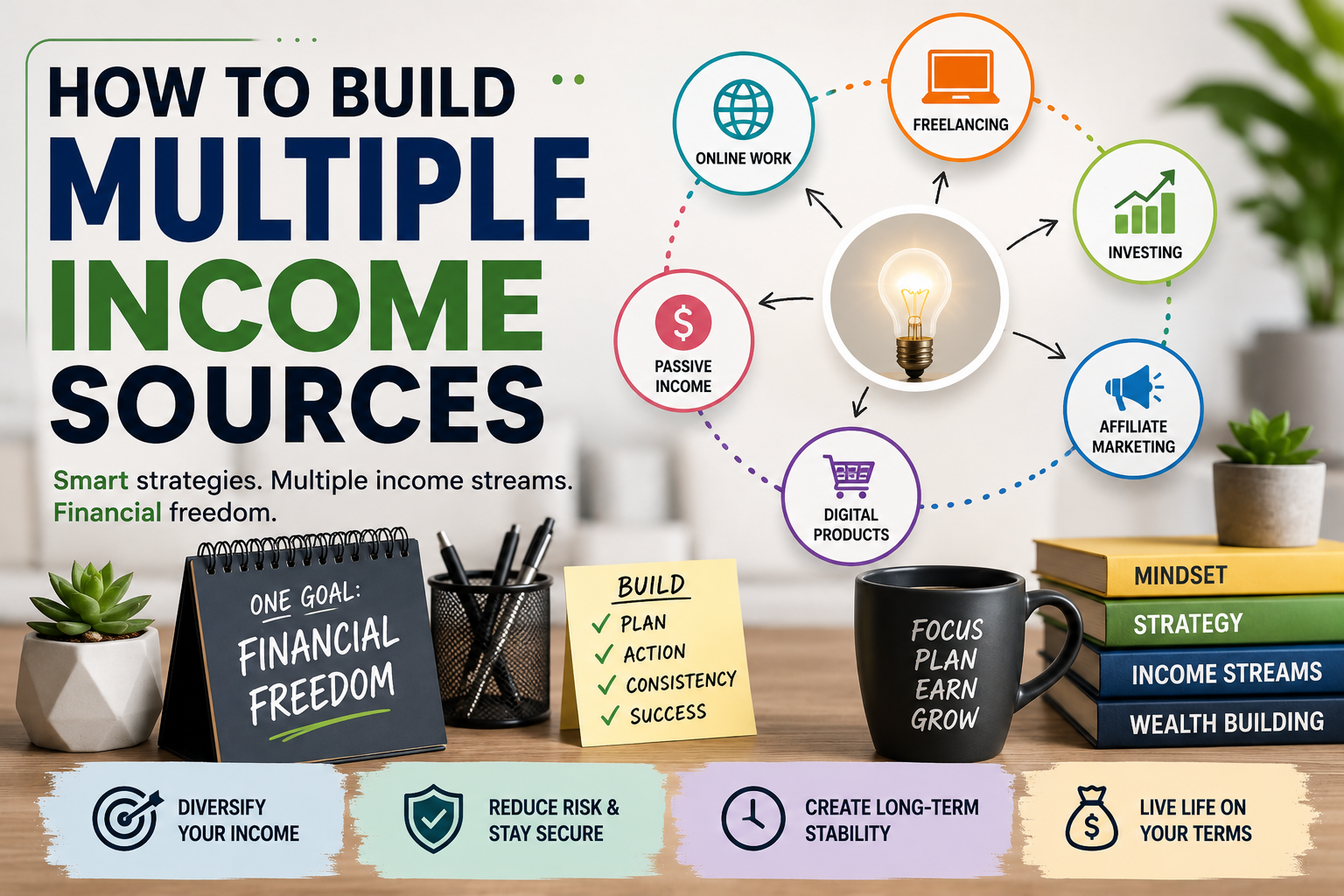
Digital products offer another possible way to expand multiple income sources. Examples include ebooks, templates, checklists, spreadsheets, printable resources, design assets, educational materials, and online courses.
The main attraction of digital products is that you can potentially sell the same product to multiple customers without recreating it from scratch for every transaction.
However, creating a product is only one part of the process. You also need to understand your audience, identify a useful problem, create a quality product, explain its benefits clearly, market it effectively, and provide customer support when necessary.
A useful starting point is to create something based on a problem you already understand. For example, someone experienced in budgeting might create a simple financial planning spreadsheet, while a designer might develop editable social media templates.
6. Start a Small Online Business
An online business can become one of several multiple income sources when it is managed carefully. Depending on your skills and resources, you might sell physical products, provide professional services, operate an online store, or create a specialized digital service.
Starting small is usually more practical than spending heavily before you know whether customers want your product or service. Test your idea with a small audience and collect feedback before expanding.
Pay attention to the difference between revenue and profit. An online store may generate sales while still producing little profit after product costs, shipping, advertising, payment processing, returns, and other expenses.
7. Consider Content Creation
Blogging, video creation, newsletters, podcasts, and educational content can eventually become part of multiple income sources. Depending on the platform and audience, creators may generate revenue through advertising, sponsorships, memberships, affiliate marketing, digital products, or services.
Content creation generally requires patience. A new website, channel, or newsletter may take time to attract an audience. There is no guarantee that creating content will produce significant income.
The strongest approach is to focus on a clear topic and consistently provide useful information. Build trust before concentrating heavily on monetization.
8. Explore Investment Income Carefully
Investments may become another component of multiple income sources, depending on the type of investment, your financial goals, and your tolerance for risk.
Possible investment categories include stocks, bonds, funds, and other financial products. Some investments may generate dividends, interest, or other forms of income, while others may primarily aim for long-term growth.
Investment income is never guaranteed, and investments can lose value. Before putting money into an investment, understand its risks, fees, liquidity, and expected time horizon. Avoid making decisions based only on promises of unusually high or guaranteed returns.
Choose Income Sources That Work Together
Not every opportunity belongs in the same financial plan. The most useful combination of multiple income sources is one that fits your schedule, skills, financial resources, and long-term objectives.
| Income Source | Time Requirement | Startup Cost | Best Suited For |
|---|---|---|---|
| Freelancing | Medium to High | Low | People with marketable skills |
| Online Tutoring | Medium | Low | Teachers and subject experts |
| Digital Products | High initially | Low to Medium | Creators and professionals |
| Online Business | Medium to High | Varies | Entrepreneurs |
| Investments | Low ongoing time | Varies | Long-term investors |
| Content Creation | High initially | Low to Medium | Creators and educators |
The table shows why there is no single best option for everyone. Someone with strong writing skills and limited startup money may prefer freelancing, while someone with specialized knowledge may prefer tutoring. A person with more capital and a long-term horizon may consider investments after understanding the associated risks.
Build Multiple Income Sources Without Getting Overwhelmed
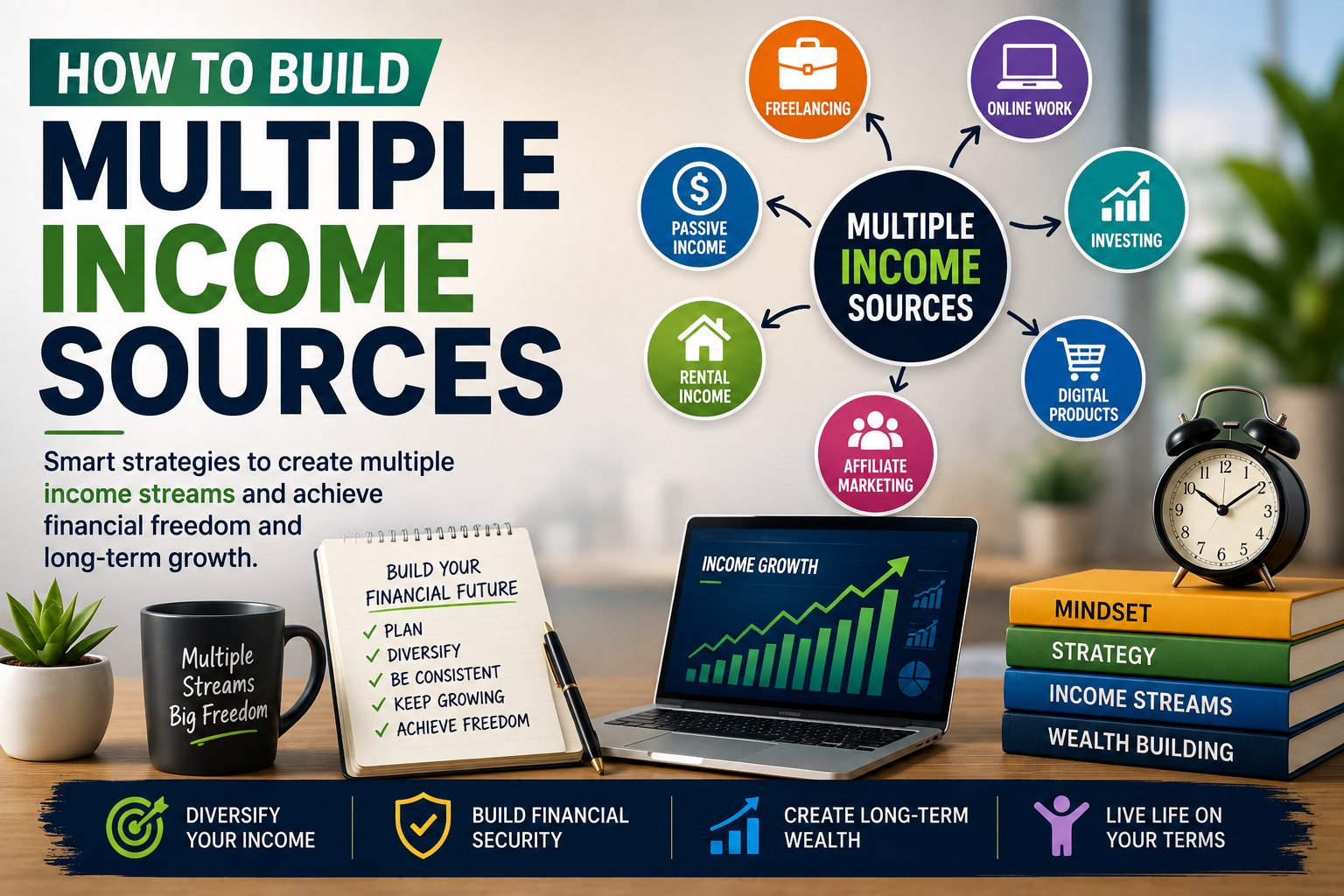
One of the biggest mistakes beginners make when creating multiple income sources is starting too many projects simultaneously.
Managing a full-time job, freelance clients, an online store, a blog, social media accounts, and several other projects can quickly become exhausting. More activities do not automatically produce more profit.
A better approach is to use an income ladder:
- Stabilize your primary income.
- Choose one realistic secondary income stream.
- Build consistent earnings from that source.
- Create systems that reduce unnecessary work.
- Track revenue, expenses, and time.
- Add another source only when you have enough capacity.
This approach gives you time to learn what works before investing heavily in another opportunity. It also reduces the risk of spreading your attention across too many projects.
How to Decide Which Income Stream Is Right for You
Before adding multiple income sources, evaluate each opportunity based on your actual circumstances rather than online trends.
Ask yourself these questions:
- What skills can I use immediately?
- How many hours can I realistically dedicate each week?
- How much money can I afford to invest?
- How quickly do I need additional income?
- Do I prefer working with clients or creating products?
- What level of financial risk am I comfortable taking?
- Can this opportunity support my long-term goals?
If you need additional income relatively soon, a service-based opportunity such as freelancing or tutoring may be more practical than building a content website that could take significant time to grow.
If you have more time than money, skill-based work can also be attractive because it may require relatively little upfront investment.
How to Manage Multiple Income Sources
Once you have established multiple income sources, organization becomes increasingly important. Keep track of income, expenses, invoices, platform fees, customer payments, and other financial transactions.
A simple spreadsheet may be enough when your activities are small. You can create separate sections for each income stream and record monthly revenue, expenses, hours worked, and net earnings.
Review the results regularly. A source that generates good revenue but requires excessive time may not be as attractive as a smaller source with better efficiency.
It is also important to understand the tax requirements that apply to your income. Employment, freelancing, business income, and investments may have different reporting or tax treatment depending on your country.
Measure Profitability, Not Just Revenue
When evaluating multiple income sources, beginners often focus on how much money comes in without considering how much it costs to generate that income.
Suppose a side business generates $1,000 in sales but requires $700 in product costs, advertising, transaction fees, and other expenses. The revenue sounds impressive, but the remaining amount is much smaller.
You should also consider your time. If an activity produces a small profit after requiring many hours, you may want to improve its efficiency or focus on a different opportunity.
Tracking both money and time gives you a clearer picture of which income streams deserve additional attention.
Common Mistakes to Avoid
Trying Too Many Things at Once
More multiple income sources do not automatically mean greater financial success. Too many projects can divide your attention, reduce productivity, and make it harder to maintain quality.
Start with one additional stream and expand only when your current activities are manageable.
Choosing Opportunities Only Because They Are Popular
A method that works for another person may not fit your skills, location, schedule, or financial circumstances.
Online trends can be useful for discovering ideas, but your final decision should be based on practical factors such as demand, costs, competition, skills, and time requirements.
Ignoring Expenses
Revenue is not the same as profit. Consider equipment, software, advertising, transaction fees, transportation, taxes, inventory, and other expenses.
Understanding these costs helps you decide whether an income stream is actually worthwhile.
Expecting Passive Income Immediately
Many supposedly passive opportunities require substantial work before they become relatively low-maintenance. Digital products need creation and marketing. Content requires consistent publishing. Investments require capital and carry financial risk.
Be realistic about the effort involved and avoid opportunities that promise effortless wealth.
Failing to Track Results
If you do not measure earnings, expenses, and time, it becomes difficult to determine which activities deserve more attention.
Review your results regularly and make adjustments based on actual performance rather than assumptions.
How to Increase the Value of Your Income Streams
Once you have multiple income sources, improving existing streams may be more effective than constantly searching for new ones.
For example, a freelancer might increase earnings by specializing in a valuable service, improving their portfolio, raising rates as their experience grows, or developing longer-term client relationships.
A tutor could create structured learning materials, offer group sessions, or develop educational resources. A digital product creator could improve an existing product based on customer feedback.
The objective is to make each income stream more efficient and valuable rather than simply increasing the number of activities you manage.

Expert Tips for Building Sustainable Income
- Start with skills you already have: This can reduce the learning curve and initial costs.
- Protect your primary income: Do not abandon stable employment for an untested project without careful planning.
- Build one stream at a time: Give each new opportunity enough attention to determine whether it works.
- Reinvest selectively: Use some earnings for tools, education, marketing, or savings when there is a clear benefit.
- Separate finances: Keep personal and business transactions organized where appropriate.
- Review your time: Compare income with the number of hours required to generate it.
- Focus on value: Sustainable income usually comes from solving real problems or providing useful products and services.
- Keep learning: Improving your skills can increase the quality and earning potential of your work.
How to Create a Simple Income Plan
If you are new to multiple income sources, create a simple plan instead of trying to change your entire financial life immediately.
First, write down your current income and essential expenses. Then identify how much additional money you would realistically like to earn each month.
Next, list your strongest skills. Think about what people or businesses might be willing to pay for those skills.
Choose one opportunity that requires an acceptable amount of time and money. Set a small initial goal, such as finding your first client, completing your first paid tutoring session, or creating your first digital product.
After a few weeks or months, review the results. If the opportunity shows potential, improve it. If it does not fit your circumstances, consider another option.
Frequently Asked Questions
How many income sources should a beginner have?
There is no ideal number for everyone. A beginner can usually start with a stable primary income and one manageable additional stream. Once that second source becomes organized and sustainable, another can be considered.
What is the easiest way to build multiple income sources?
Using an existing skill is often one of the simplest approaches. Freelancing, tutoring, consulting, writing, virtual assistance, and other service-based work can often be started with relatively low upfront costs.
Can multiple income sources replace a full-time job?
They can potentially become a significant source of income, but there is no guarantee. Before leaving employment, consider income consistency, savings, expenses, taxes, benefits, and the stability of your clients or customers.
Are multiple income sources better than one high-paying job?
Not necessarily. A stable, well-paying job can be valuable. Additional income streams may provide diversification and flexibility, but they also require time, management, and sometimes financial risk.
How can I build multiple income sources with little money?
Start with services based on skills you already have. Freelancing, tutoring, writing, virtual assistance, consulting, and certain creative services can often be started with relatively low upfront costs.
How long does it take to build multiple income sources?
The timeline varies significantly. Service-based work may begin generating income sooner, while businesses, content platforms, digital products, and investments can require more time to develop meaningful results.
Conclusion
Building multiple income sources is less about finding dozens of ways to make money and more about creating a sustainable financial system. Start with a reliable primary income, use your existing skills to develop one additional source, and expand only when you have enough time and capacity.
Choose opportunities based on your skills, financial resources, schedule, and goals rather than online hype. Track both revenue and expenses, understand the risks involved, and avoid promises of effortless or guaranteed income.
The strongest strategy is usually gradual. Build one useful income stream, learn from the results, improve the process, and then decide whether another opportunity makes sense. With patience and careful planning, multiple income sources can provide greater financial flexibility while helping you work toward your longer-term financial goals.