

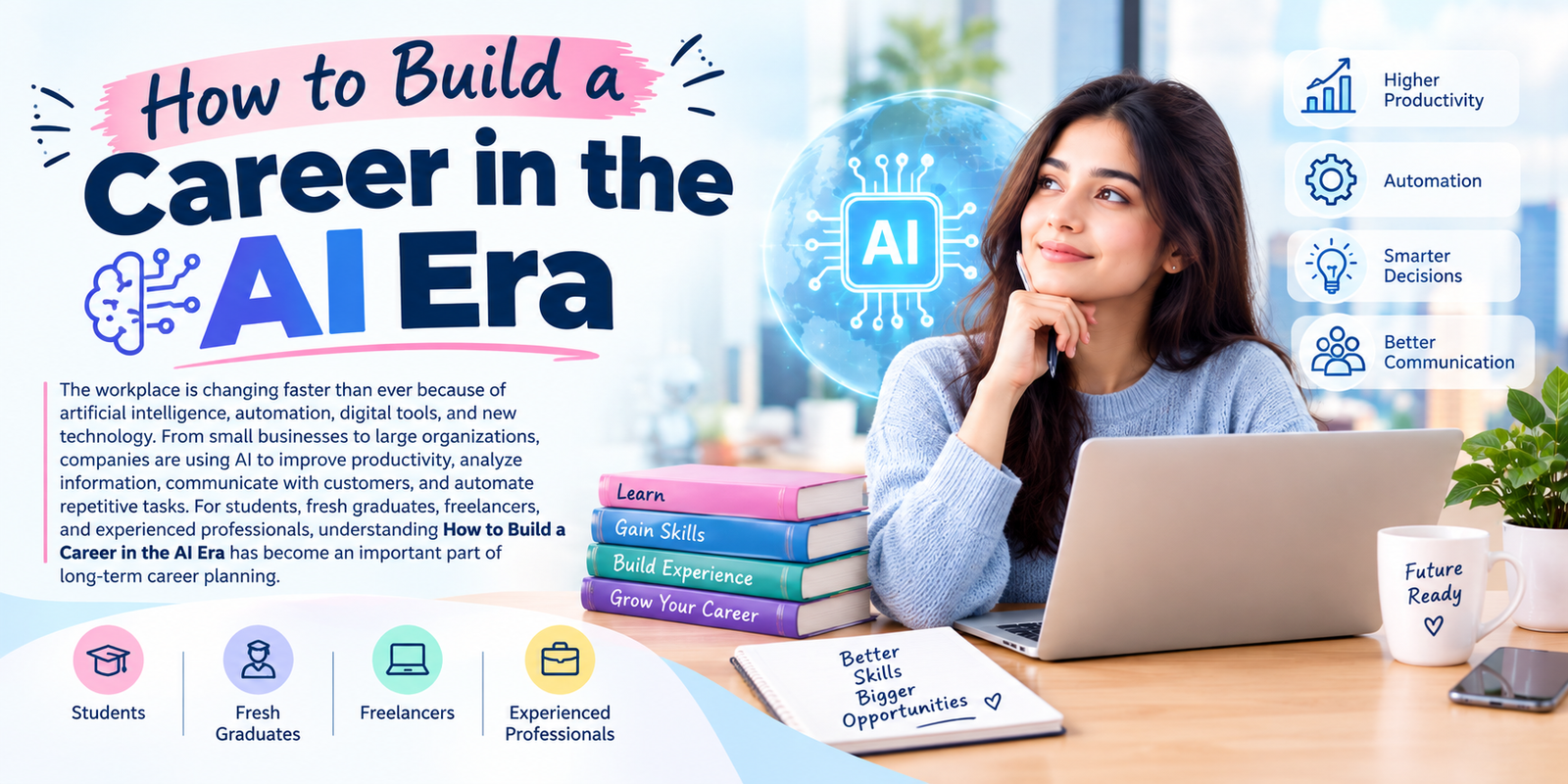
The workplace is changing faster than ever because of artificial intelligence, automation, digital tools, and new technology. From small businesses to large organizations, companies are using AI to improve productivity, analyze information, communicate with customers, and automate repetitive tasks. For students, fresh graduates, freelancers, and experienced professionals, understanding How to Build a Career in the AI Era has become an important part of long-term career planning.
Artificial intelligence is not only creating new technology jobs. It is also changing traditional careers such as marketing, finance, education, healthcare, design, customer service, human resources, and administration. Professionals who learn how to work alongside AI can improve their productivity and develop valuable skills that employers increasingly need.
This guide explains How to Build a Career in the AI Era by focusing on practical skills, continuous learning, AI literacy, communication, adaptability, networking, and real-world experience. Whether you are starting your first career or planning a career change, these strategies can help you prepare for the modern workplace.
Understanding the AI Era
The AI era refers to a period in which artificial intelligence is becoming part of everyday professional and business activities. AI systems can analyze large amounts of information, generate content, assist with research, automate repetitive processes, and support decision-making. However, AI does not remove the need for human skills. Instead, it is changing the combination of skills that professionals need.
Learning How to Build a Career in the AI Era starts with understanding that technology should be viewed as a career tool rather than something that professionals should simply fear. People who know how to use AI responsibly can often complete routine tasks faster and spend more time on creative thinking, problem-solving, communication, strategy, and relationship building.
The goal is not necessarily to become an AI engineer. A person working in marketing can learn AI-assisted content research. A teacher can use AI for lesson planning. A designer can use AI for brainstorming. An accountant can use automation tools to organize information. The best approach depends on the person’s career field and professional goals.
1. Develop Strong Digital Literacy
The first step in How to Build a Career in the AI Era is developing strong digital literacy. Digital literacy means being comfortable with computers, online platforms, cloud applications, collaboration tools, spreadsheets, digital communication, and basic cybersecurity practices.
Many employers expect workers to use digital systems as part of their daily responsibilities. Even jobs that previously required limited technology skills may now involve online databases, project management platforms, digital documents, customer relationship systems, or AI-powered applications.
Start by becoming comfortable with common workplace tools. Learn how to organize files, manage documents, create presentations, work with spreadsheets, communicate through professional platforms, and collaborate online. These basic abilities create a strong foundation for more advanced technology skills.
2. Learn AI Fundamentals
A major part of How to Build a Career in the AI Era is understanding basic AI concepts. You do not need to become a machine-learning researcher to benefit from AI knowledge. However, you should understand what AI can do, what its limitations are, and how it can be used responsibly.
Learn basic concepts such as generative AI, machine learning, natural language processing, automation, AI assistants, and data analysis. You should also understand that AI-generated information can contain errors, outdated information, or misleading conclusions.
AI literacy also includes responsible use. Professionals should know when information needs verification, when confidential information should not be entered into an AI system, and when human judgment is necessary.
3. Choose a Career Direction
Another important step in How to Build a Career in the AI Era is selecting a career direction. AI is influencing many industries, so trying to learn everything at once can become overwhelming.
Begin by identifying the type of work you enjoy. Consider your education, interests, existing abilities, preferred working environment, and long-term goals. You can then identify how AI is changing that particular industry.
For example, someone interested in writing could explore digital marketing, SEO, technical writing, content strategy, or communications. A person interested in technology could explore software development, data analysis, cybersecurity, cloud computing, or AI-related roles.
Choosing a direction allows you to focus your learning instead of collecting random courses and certificates without a clear career purpose.
4. Build AI-Assisted Skills
Professionals should learn how AI can support the skills they already have. This is one of the most practical approaches to How to Build a Career in the AI Era.
A marketer can use AI for brainstorming campaign ideas and analyzing customer information. A researcher can use AI tools to organize notes and summarize documents. A developer can use AI coding assistants for explanations and debugging support. A customer service professional can use AI to organize common questions and draft responses.
The important point is that AI should support professional judgment rather than completely replace it. Workers still need to review outputs, correct errors, understand context, and make final decisions.
5. Improve Your Communication Skills
Communication remains one of the most valuable human abilities in an AI-driven workplace. Anyone researching How to Build a Career in the AI Era should pay attention to written and verbal communication.
Strong communication helps professionals explain ideas, work with teams, negotiate with clients, present information, manage projects, and build professional relationships. AI can generate text, but people still need to understand the audience, purpose, tone, and context.
Practice writing professional emails, reports, presentations, proposals, and short explanations. Also improve listening skills and learn how to communicate complicated ideas in simple language.
6. Develop Critical Thinking
Critical thinking is especially important when using AI because AI-generated information is not automatically correct. Understanding How to Build a Career in the AI Era means learning to question information instead of accepting every AI response without checking it.
Critical thinking involves comparing sources, identifying assumptions, checking evidence, recognizing inconsistencies, and considering alternative explanations. These abilities can help professionals use AI more effectively.
For example, if an AI tool provides statistics for a business report, a professional should verify the numbers before publishing the report. If AI provides a recommendation, the user should consider whether the recommendation fits the specific situation.
7. Learn Problem-Solving
Problem-solving is another essential part of How to Build a Career in the AI Era. Companies need professionals who can identify problems, understand their causes, develop possible solutions, and implement practical improvements.
AI can assist with analysis, but humans often need to define the actual problem. A strong problem solver knows which questions to ask, which information matters, and which solution is realistic.
You can improve problem-solving by working on real projects, analyzing case studies, participating in practical assignments, and learning from mistakes. Do not focus only on memorizing information. Practice applying knowledge to real situations.
8. Create a Personal Learning Plan
A clear learning plan makes How to Build a Career in the AI Era more manageable. Instead of trying to learn every new AI tool, select skills that directly support your career goals.
Create a weekly schedule for learning. You might spend several hours each week studying AI fundamentals, practicing a professional skill, completing a project, and reading about changes in your industry.
Online courses, tutorials, books, professional communities, workshops, and practical projects can all support learning. The most important factor is consistency. Technology changes quickly, so career development should be treated as an ongoing process rather than a one-time activity.
9. Build a Portfolio
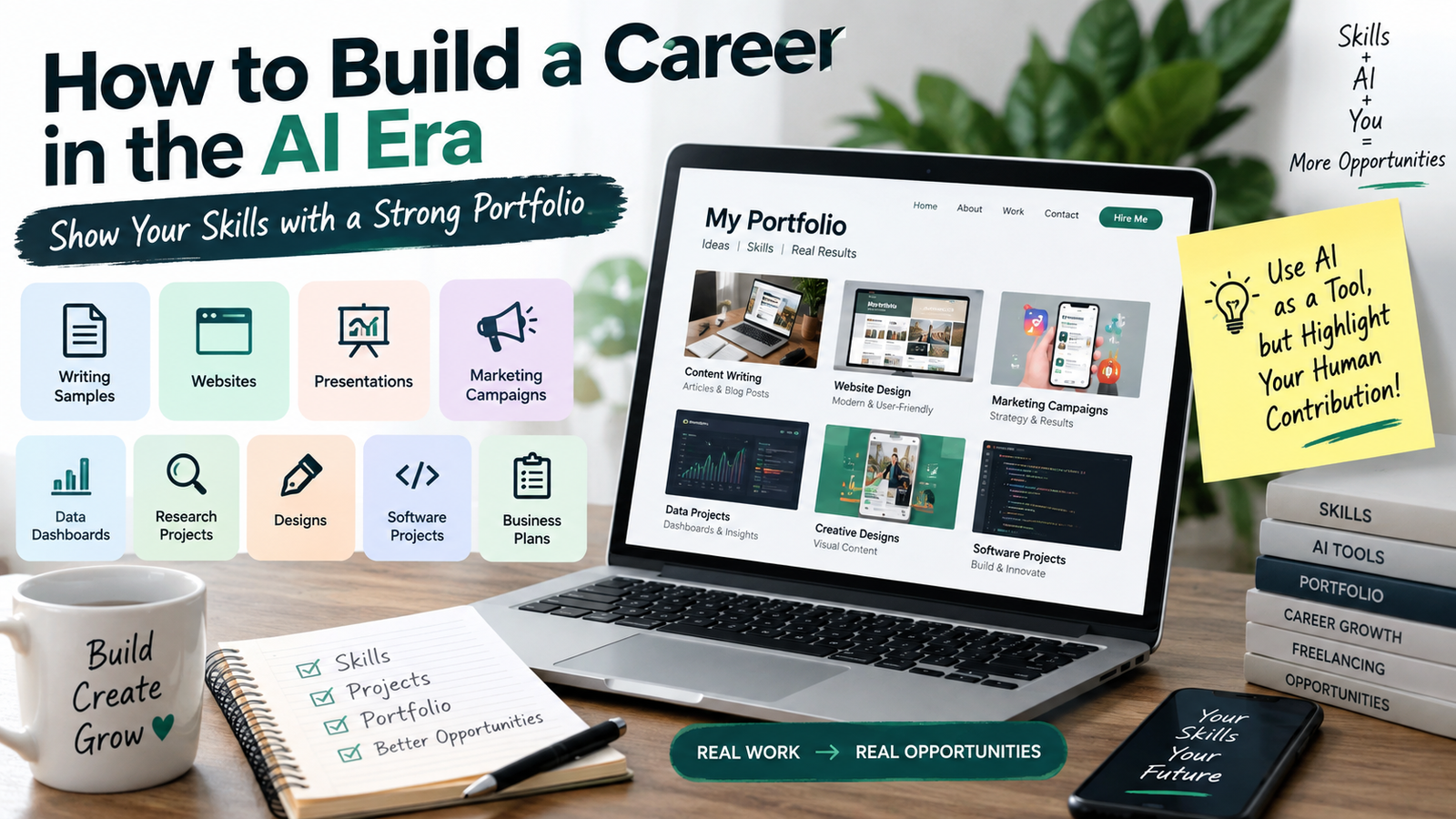
A strong portfolio can demonstrate what you can actually do. When considering How to Build a Career in the AI Era, remember that practical evidence can be valuable when applying for jobs or freelance opportunities.
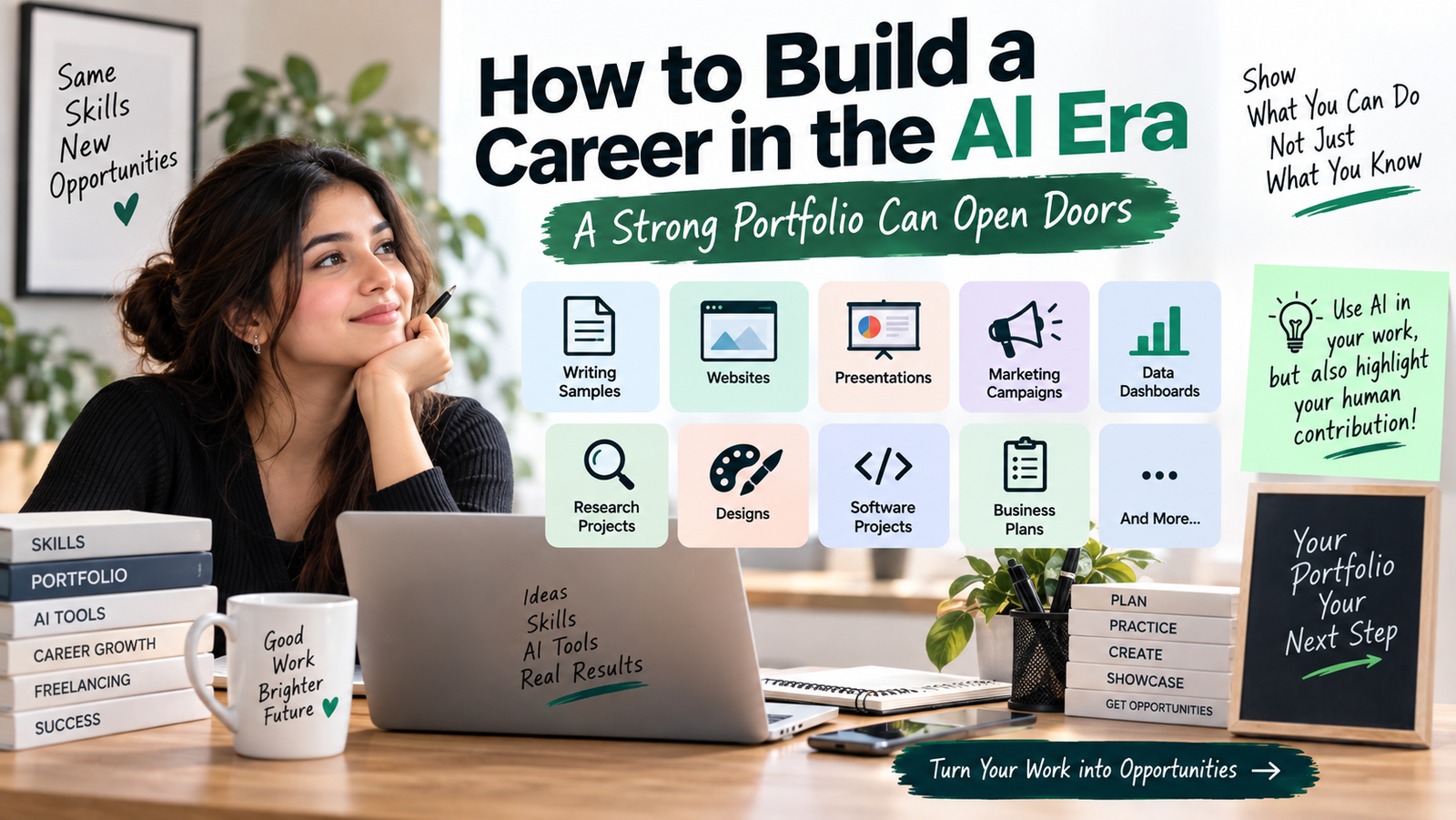
Your portfolio could include writing samples, websites, presentations, marketing campaigns, data dashboards, research projects, designs, software projects, business plans, or other relevant work.
If you use AI in a project, explain how you used it and what human contribution you made. This can demonstrate both technology awareness and professional judgment.
10. Gain Real-World Experience
Another important part of How to Build a Career in the AI Era is gaining practical experience. Experience does not always have to come from a full-time job. Internships, freelance projects, volunteer work, university assignments, personal projects, and small business projects can provide useful experience.
Try to solve actual problems rather than simply completing theoretical exercises. For example, create a sample marketing strategy for a fictional business, build a simple website, analyze a public dataset, or develop a research project related to your chosen field.
Practical work can help you understand what employers expect and can also give you examples to discuss during interviews.
11. Learn Data Skills
Data is becoming increasingly important across industries. Therefore, How to Build a Career in the AI Era should include at least basic data literacy.
You do not necessarily need advanced statistics or programming. Start with spreadsheets, data organization, charts, basic statistics, and data interpretation. Depending on your career path, you can later learn SQL, Python, data visualization, or advanced analytics.
Understanding data can help you make better decisions and communicate business information more effectively.
12. Strengthen Creativity
Creativity remains valuable because organizations need new ideas, solutions, products, campaigns, and experiences. When exploring How to Build a Career in the AI Era, creativity should not be overlooked.
AI can generate many ideas quickly, but humans provide personal experiences, cultural understanding, emotional awareness, strategic context, and original perspectives. Creative professionals can use AI as a brainstorming partner while maintaining their own ideas and professional standards.
Practice creativity through writing, design, problem-solving exercises, brainstorming, experimentation, and personal projects.
13. Develop Adaptability
Technology changes quickly, making adaptability an important career skill. Understanding How to Build a Career in the AI Era means preparing yourself to learn new tools when necessary.
Do not become dependent on a single application or technology. Focus on transferable skills such as communication, research, analytical thinking, project management, creativity, and learning ability.
When a new tool appears, evaluate whether it is genuinely useful for your work. Learn it if it provides meaningful value, but avoid chasing every trend.
14. Build a Professional Network
Networking can support How to Build a Career in the AI Era by connecting you with professionals, mentors, employers, collaborators, and learning opportunities.
Create a professional online presence and participate in relevant communities. Attend webinars, workshops, conferences, career events, and professional discussions. When networking, focus on building genuine professional relationships rather than simply asking people for jobs.
A strong network can expose you to industry trends and opportunities that may not be visible through traditional job searches.
15. Prepare for AI-Related Interviews
Job interviews are also changing. Employers may ask candidates how they use technology, solve problems, learn new tools, or work with AI. Preparing for How to Build a Career in the AI Era should therefore include interview preparation.
Be ready to explain specific examples of technology use. Instead of simply saying that you know AI, describe a project where you used an AI tool, what problem you were trying to solve, how you checked the output, and what result you achieved.
Also prepare examples that demonstrate communication, teamwork, leadership, adaptability, and problem-solving.
16. Understand Responsible AI Use
Responsible technology use is an important element of How to Build a Career in the AI Era. Professionals should understand privacy, security, accuracy, intellectual property, bias, and transparency when using AI systems.
Do not upload confidential company information into tools without understanding the organization’s policies. Verify important information before using it in professional decisions. When appropriate, disclose AI assistance and maintain human oversight.
Responsible AI use can help organizations benefit from technology while reducing avoidable risks.
17. Combine Human Skills with Technology
The future workplace will require a combination of technical and human abilities. A key lesson from How to Build a Career in the AI Era is that professionals should develop both.
Technical skills may include AI tools, data analysis, automation, software, cybersecurity, or digital platforms. Human skills may include communication, empathy, leadership, creativity, critical thinking, negotiation, and teamwork.
The combination can make professionals more versatile because they can understand both the technology and the people who use it.How to Build a Career in the AI Era
18. Keep Your Resume Updated
Your resume should communicate your current skills clearly. When applying the principles of How to Build a Career in the AI Era, update your resume as you develop new skills and complete relevant projects.
Focus on achievements rather than simply listing tools. For example, instead of saying that you used an AI tool, explain how you used technology to improve a workflow, organize research, create a project, or solve a problem.
Keep your resume easy to read and customize it according to the requirements of each position.How to Build a Career in the AI EraHow to Build a Career in the AI Era
19. Consider Freelancing and Remote Work
Digital technology has expanded opportunities for freelancers and remote professionals. Another practical aspect of How to Build a Career in the AI Era is exploring flexible work models.
Depending on your skills, you may be able to provide services such as writing, graphic design, virtual assistance, programming, digital marketing, research, data analysis, customer support, or consulting.
Freelancing requires more than technical ability. You also need communication, time management, client management, pricing knowledge, and the ability to meet deadlines.
20. Measure Your Career Progress
Finally, How to Build a Career in the AI Era should involve regular evaluation. Every few months, review your skills, portfolio, professional network, applications, and learning progress.
Ask yourself which skills have improved, which skills employers are requesting, which projects you have completed, and what you should learn next. This simple review can help you stay focused and make adjustments when the job market changes.How to Build a Career in the AI Era
Career Fields Being Changed by AI
AI is affecting a wide range of professions. Some areas where AI-related skills may be useful include software development, digital marketing, education, finance, healthcare administration, customer service, graphic design, content creation, research, cybersecurity, project management, human resources, and business operations.
The effect is different in every profession. In some jobs, AI may automate certain repetitive tasks. In others, it may become a tool that helps workers perform their responsibilities more efficiently. Therefore, professionals should study the specific changes happening in their industry rather than assuming that every job will be affected in exactly the same way.
Common Mistakes to Avoid
People learning How to Build a Career in the AI Era can make several common mistakes. One mistake is trying to learn dozens of AI tools without developing a strong professional skill. Another is trusting AI-generated information without verification.
Some people also collect certificates without creating practical projects. Certificates can demonstrate learning, but practical evidence can make your skills easier to understand.
Another mistake is ignoring communication and human skills. Technology knowledge alone may not be enough for many professional roles. A balanced approach is generally more useful.How to Build a Career in the AI Era
Conclusion
Learning How to Build a Career in the AI Era is not about predicting exactly which jobs will exist in the future. It is about developing the ability to learn, adapt, use technology responsibly, and solve real problems.
The most useful strategy is to combine AI literacy with strong professional skills. Start by understanding digital tools, learn the AI concepts relevant to your field, improve communication and critical thinking, create practical projects, build a portfolio, and continue learning.
Students and professionals who take a practical approach can gradually prepare themselves for changing workplace expectations. AI can become a powerful career tool when it is combined with human judgment, creativity, responsibility, and continuous learning.
Frequently Asked Questions
What is the first step toward building a career in the AI era?
The first step is to understand your career goal and identify how AI and digital technology are changing that field. Then develop the technical and human skills that support your chosen direction.How to Build a Career in the AI Era
Do I need to become a programmer to work in the AI era?
No. Programming is valuable for certain careers, but many professions can benefit from AI literacy without requiring advanced coding skills. Marketing, education, design, administration, research, finance, and many other fields can use AI-assisted tools.
Which skills are important in an AI-driven workplace?
Important skills can include AI literacy, digital literacy, communication, critical thinking, problem-solving, creativity, adaptability, data literacy, teamwork, and industry-specific expertise.
Can AI help me get a job?
AI can help with tasks such as researching employers, improving resume wording, practicing interview questions, organizing information, and learning new skills. However, applications should remain accurate and reflect your real experience and abilities.How to Build a Career in the AI Era
How can students prepare for AI-related careers?
Students can learn AI fundamentals, practice digital tools, complete practical projects, develop communication skills, participate in internships or volunteer work, and build a portfolio that demonstrates their abilities.
Is AI going to replace every traditional job?
AI affects different occupations and tasks in different ways. Some repetitive activities may become automated, while other roles may change through AI-assisted workflows. The effect depends on the industry, organization, technology, and type of work.
Why is continuous learning important?
AI and digital technology continue to evolve. Continuous learning helps professionals understand new tools, update their skills, and adapt to changing workplace requirements.How to Build a Career in the AI Era
Final Thoughts
The modern career environment rewards people who can combine professional expertise with technology awareness. Instead of focusing only on one AI application, build a foundation of transferable skills and learn how technology can improve your work.
Whether you are a student, graduate, freelancer, career changer, or experienced professional, the journey begins with small practical steps. Learn, practice, create, review your progress, and continue adapting as technology develops.