
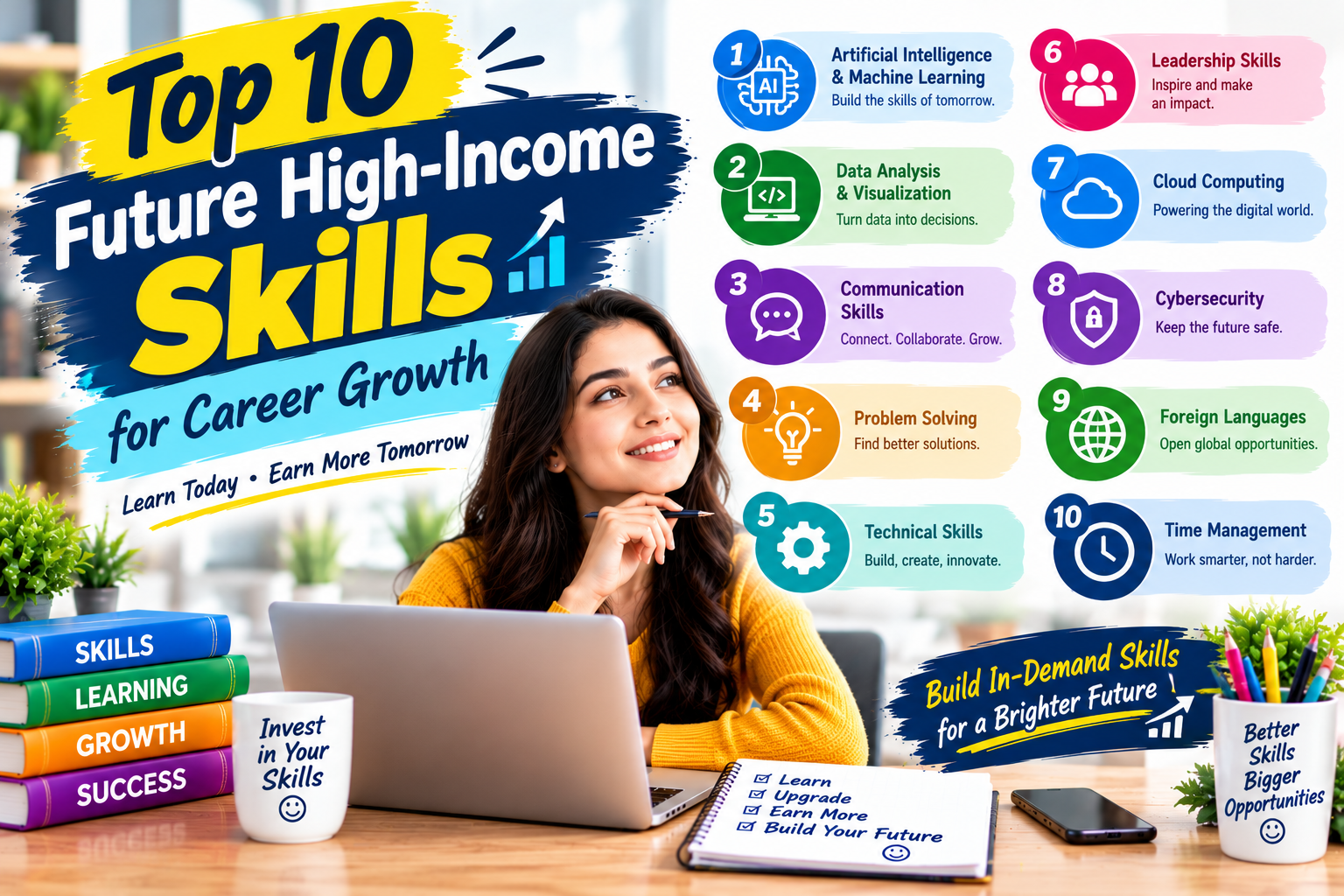
The job market is changing quickly, and earning potential increasingly depends on what you can do rather than only the title printed on your degree. Learning Future High-Income Skills can help professionals prepare for careers that require technical ability, business judgment, creativity, communication, and continuous learning. The most valuable skills are not limited to programming or artificial intelligence. They also include data analysis, cybersecurity, digital marketing, sales, financial knowledge, leadership, problem-solving, and specialized professional expertise.
This guide explains the high-income skills that can remain valuable as technology, businesses, and workplaces evolve. It also shows how Future High-Income Skills can benefit different professionals, how to start learning, how to turn a skill into income, and which common mistakes can slow career growth.
What Are High-Income Skills?
High-income skills are abilities that can create significant economic value for employers, clients, customers, or businesses. Future High-Income Skills are particularly useful when they help professionals solve valuable problems, improve efficiency, increase revenue, protect information, or support better decisions.
Examples include software development, data analysis, cybersecurity, artificial intelligence, sales, digital marketing, financial analysis, project management, and specialized consulting. A skill itself does not guarantee a high salary. Income usually depends on proficiency, experience, industry, location, communication ability, business demand, and the value a professional can consistently deliver.
The strongest career strategy is therefore not simply to collect certificates. It is to develop a useful skill, practice it through realistic projects, demonstrate measurable results, and continue improving as market requirements change.
Why Future High-Income Skills Matter
Technology is changing how organizations create products, communicate with customers, analyze information, and manage operations. Future High-Income Skills can help professionals adapt to these changes by combining technical knowledge with practical workplace abilities. As digital tools become more common, understanding these skills can help workers respond to changing job requirements.
That does not mean every traditional job will disappear. Instead, many roles are changing. Employees who understand new technologies and can combine them with industry knowledge may be able to perform higher-value work. Developing Future High-Income Skills can help professionals strengthen their existing expertise while preparing for new responsibilities.
For example, a marketing professional who understands analytics, customer behavior, automation, and AI-assisted workflows can offer more than someone who only knows how to publish basic social media posts. Similarly, an accountant who can use spreadsheets, data tools, automation, and financial analysis can contribute to broader business decisions. These examples show how Future High-Income Skills can complement existing professional knowledge rather than requiring someone to completely change careers.
The important lesson is that technology skills and human skills should not be treated as separate worlds. Professionals who combine both can build a stronger career profile and make better use of Future High-Income Skills. Communication, critical thinking, creativity, and problem solving can make technical abilities more useful in real workplace situations.
For this reason, learning Future High-Income Skills should be viewed as an ongoing career-development process. Instead of trying to master every new technology, professionals can identify the skills most relevant to their field, practice them through realistic projects, and gradually build a combination of technical and human abilities.
1. Artificial Intelligence and AI Literacy
Artificial intelligence is one of the most important areas for professionals preparing for the future. Learning Future High-Income Skills increasingly includes understanding how AI systems work, where they are useful, how to evaluate their output, and how to integrate them into everyday workflows. You do not necessarily need to become a machine learning engineer to benefit from AI.
AI literacy can include understanding generative AI, prompt design, automation, AI-assisted research, document analysis, workflow design, data interpretation, and responsible AI use.
Who Can Benefit?
- Business professionals
- Marketers and content creators
- Teachers and trainers
- Software developers
- Researchers
- Entrepreneurs
- Administrative professionals
- Data and technology specialists
A beginner can start with practical AI tools, learn effective prompting, verify AI-generated information, and build small workflows. More advanced learners can move into machine learning, AI engineering, model evaluation, automation, or specialized AI applications.
2. Data Analysis and Business Intelligence
Organizations generate large amounts of information, but raw data has limited value until someone can interpret it. Data analysis is among the most practical Future High-Income Skills because it helps businesses identify patterns, measure performance, understand customers, control costs, and make informed decisions.
Useful skills include Microsoft Excel, SQL, statistics, data visualization, Power BI, Tableau, Python, data cleaning, dashboard creation, and business reporting.
Beginners do not need to master every tool at once. A practical progression is to learn spreadsheets first, followed by SQL and a visualization platform. Python can then be added when deeper analysis or automation becomes relevant. The official Python Tutorial provides a useful starting point for learners who want to develop their programming skills. Python Tutorial
A strong portfolio might include a sales dashboard, customer analysis report, financial model, inventory analysis, or marketing performance dashboard. These projects demonstrate practical ability better than a list of course certificates alone.

3. Cybersecurity
As businesses depend more heavily on digital systems, protecting accounts, networks, applications, and data remains an important business requirement. Future High-Income Skills increasingly include cybersecurity because the field combines technical knowledge with risk management and business responsibility.
Cybersecurity includes many specialties, ranging from security operations and network protection to penetration testing, identity management, cloud security, governance, and risk management. These areas make cybersecurity an important part of Future High-Income Skills for professionals interested in technology-focused careers.
People entering this field can begin with networking fundamentals, operating systems, authentication, access control, basic security principles, and security monitoring. Certifications can be useful, but hands-on practice is equally important for developing practical Future High-Income Skills that employers can apply to real-world security challenges.
Cybersecurity also rewards continuous learning because threats, technologies, and defensive practices change over time. Professionals who regularly improve their technical abilities, understand emerging risks, and practice security techniques can strengthen their position within the Future High-Income Skills landscape.
As organizations continue adopting cloud platforms, remote work systems, automation, and connected applications, the demand for cybersecurity knowledge can remain relevant across many industries. Developing cybersecurity expertise alongside communication, problem-solving, and analytical abilities can therefore make it a valuable component of Future High-Income Skills for long-term professional development.
4. Software Development
Software development remains a broad field because businesses across industries depend on websites, mobile applications, internal systems, APIs, databases, and digital services. It continues to be one of the major Future High-Income Skills for people interested in technical careers.
Beginners can start with one programming language instead of trying to learn several at the same time. JavaScript, Python, Java, C#, and other languages can lead to different career paths.
Beyond syntax, developers need to understand problem solving, version control, databases, testing, APIs, debugging, software architecture, and collaboration. AI-assisted development tools can support coding, but developers still need enough knowledge to review, test, secure, and maintain the resulting software.
5. Cloud Computing
Cloud computing skills can be valuable for professionals working with modern IT infrastructure. Among Future High-Income Skills, cloud knowledge can support careers involving application deployment, infrastructure, databases, security, networking, and technology operations.
Major cloud ecosystems provide services for computing, storage, databases, networking, security, analytics, and application deployment.
Important concepts include virtual machines, containers, networking, identity and access management, storage, databases, monitoring, backup, and cloud security.
Someone starting from the beginning can first learn general cloud concepts and then explore one major cloud platform. Practical labs and small deployment projects can help turn theoretical knowledge into usable experience.
6. Digital Marketing
Businesses need customers, and digital marketing helps organizations reach, engage, and retain audiences through online channels. Digital marketing is among the Future High-Income Skills that can be developed without requiring every learner to become a programmer.
The field includes search engine optimization, paid advertising, email marketing, social media, content marketing, conversion optimization, analytics, and marketing automation.
The highest-value marketing professionals typically understand more than one channel. They can connect audience research with content, campaigns, analytics, and business goals.
For example, an SEO specialist can become more valuable by understanding keyword research, technical SEO, content strategy, search intent, conversion optimization, analytics, and basic web technology.
7. Sales and Negotiation
Sales is sometimes overlooked when people discuss technical careers, but the ability to generate revenue is directly relevant to business performance. Sales and negotiation are therefore important Future High-Income Skills for professionals who enjoy communication and relationship building.
Skilled sales professionals identify customer problems, communicate value, handle objections, build relationships, and negotiate agreements.
Negotiation is useful beyond traditional sales. It can help professionals manage vendors, discuss compensation, handle partnerships, close contracts, and resolve business disagreements.
Strong sales ability combines communication, listening, research, emotional awareness, product knowledge, and commercial judgment.
8. Financial Analysis and Financial Literacy
Financial knowledge can strengthen careers across business, management, entrepreneurship, banking, accounting, and investment-related fields. Financial analysis is another area where Future High-Income Skills can create value by helping organizations understand money, risk, costs, and performance.
Professionals who understand revenue, expenses, cash flow, profitability, budgeting, and financial statements can participate more effectively in business decisions.
Advanced learners can explore financial modeling, corporate finance, valuation, risk analysis, accounting systems, and specialized financial technologies.
Even professionals outside finance can benefit from basic financial literacy because business decisions often involve costs, returns, budgets, and resource allocation.
9. Project Management
Organizations need people who can turn objectives into organized plans and coordinate resources, deadlines, risks, and stakeholders. Project management is therefore one of the practical Future High-Income Skills for professionals who prefer organized, collaborative work.
Project management is useful in technology, construction, marketing, healthcare, education, finance, manufacturing, and many other industries.
Important abilities include planning, scheduling, communication, risk management, documentation, stakeholder management, budgeting, and performance tracking.
Knowledge of Agile, Scrum, Kanban, traditional project management, and digital project management platforms can broaden a professional’s capabilities. The best approach depends on the organization and type of work.
10. Business Strategy and Consulting
Business strategy focuses on questions such as where a company should compete, how it can create value, what customers need, and how resources should be allocated. Strategy is therefore an important part of Future High-Income Skills for professionals interested in decision-making and business leadership. Learning about Strategic Management can help professionals understand how organizations evaluate markets, allocate resources, and develop long-term business plans.
Strategy-related work requires research, analytical thinking, financial understanding, communication, presentation skills, and the ability to turn complex information into practical decisions.
Professionals can develop these abilities by studying business cases, analyzing companies, learning financial concepts, practicing presentations, and working on structured problem-solving exercises.
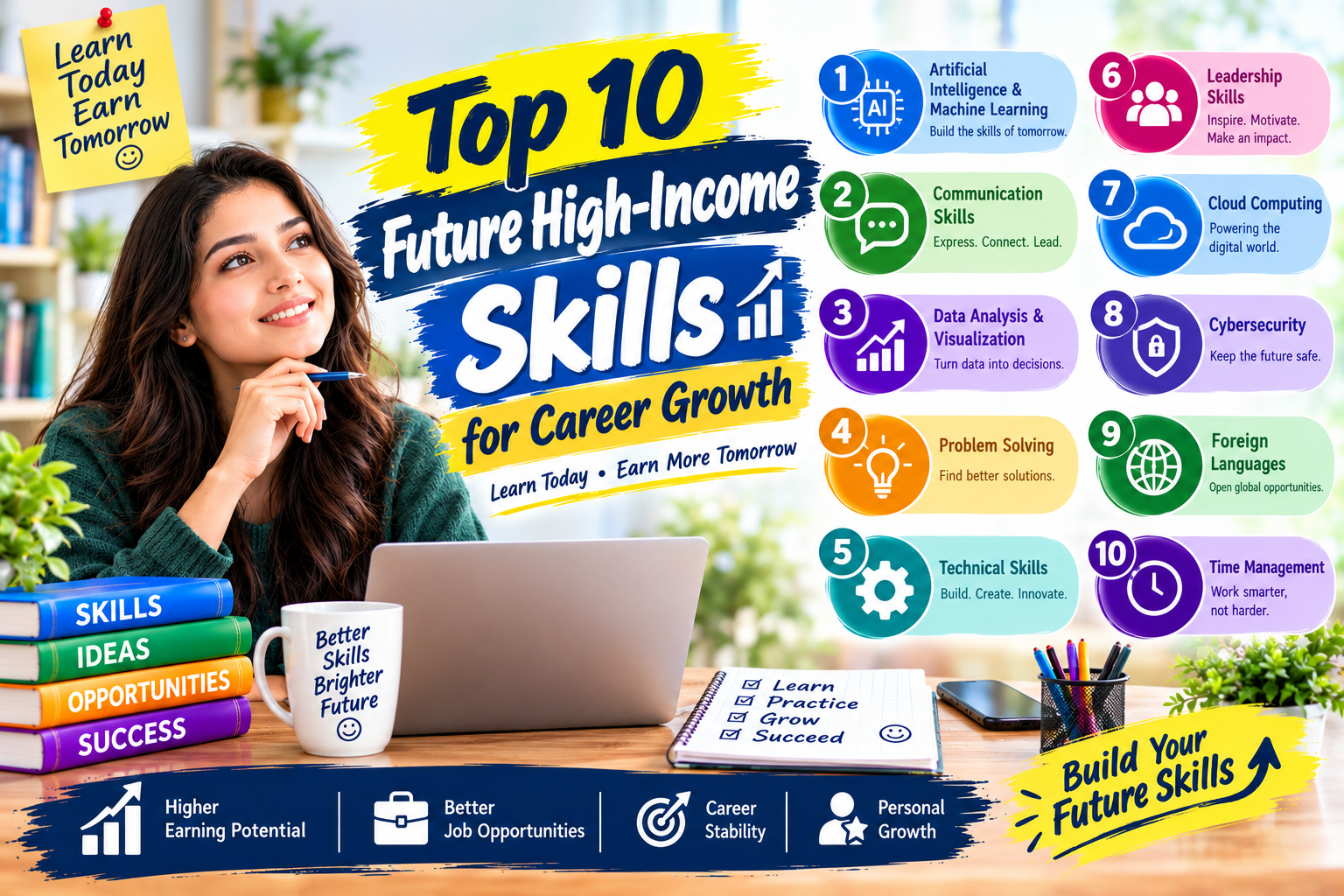
11. UX and Product Design
Good products need to be functional and understandable. User experience design focuses on how people interact with websites, applications, products, and digital services. UX is therefore another valuable area within Future High-Income Skills.
UX skills can include user research, information architecture, wireframing, prototyping, usability testing, interaction design, and accessibility.
Product design can combine UX with business objectives, technology constraints, and customer needs. Designers who understand research, analytics, product strategy, and collaboration can contribute beyond visual design.
12. Communication and Public Speaking
Communication remains valuable even as technology becomes more advanced. Strong communication is one of the most transferable Future High-Income Skills because professionals must still explain ideas, write clearly, present information, negotiate priorities, and collaborate with people. These abilities can also support efforts to turn hobbies into income by helping individuals communicate their skills and services effectively.
Written communication is particularly important for emails, proposals, reports, documentation, marketing material, presentations, and executive summaries.
Public speaking can also increase professional effectiveness. A technically strong person who can explain complicated ideas clearly may be able to communicate their expertise more effectively in meetings, interviews, presentations, and client discussions.
13. Critical Thinking and Problem Solving
Critical thinking helps professionals evaluate information, identify assumptions, compare alternatives, and reach conclusions based on evidence. Problem solving is another important component of Future High-Income Skills because organizations need people who can address complex challenges.
These abilities are increasingly useful because modern workers often have access to more information than they can process manually. The challenge is not simply finding information. It is determining whether the information is relevant, reliable, complete, and appropriate for the decision.
Professionals can improve these skills by breaking complex problems into smaller parts, identifying root causes, testing assumptions, comparing evidence, and reviewing outcomes after decisions are made.
14. Sales Copywriting and Content Strategy
Businesses need content for websites, email campaigns, product pages, advertisements, social media, and educational resources. Copywriting can become part of Future High-Income Skills when it connects communication with measurable business objectives. Developing strong Copywriting Skills can help professionals create persuasive content that supports marketing, customer engagement, and business growth.
Strong copywriters understand audience research, positioning, customer pain points, benefits, calls to action, search intent, and conversion principles.
AI tools can assist with drafting and research, but human judgment remains important for accuracy, originality, brand voice, audience understanding, and final editing.
15. Specialized Industry Knowledge
One of the most overlooked high-income opportunities is combining a general skill with specialized industry knowledge. Combining expertise with Future High-Income Skills can help professionals create a more specialized career profile.
A person who understands data analysis and healthcare operations, for example, may have a different career path from someone who applies the same analytical skills in retail or manufacturing.
This combination can create a professional niche. Examples include technology and finance, AI and healthcare, cybersecurity and banking, digital marketing and education, or data analysis and supply chain management.
The broader lesson is simple: specialized knowledge can make a common skill more valuable when it solves a specific industry problem.
Future High-Income Skills Compared
| Skill Area | Useful Starting Skills | Potential Career Applications |
|---|---|---|
| Artificial Intelligence | AI literacy, prompting, automation | AI operations, automation, product support |
| Data Analysis | Excel, SQL, statistics, dashboards | Data analyst, BI analyst, reporting |
| Cybersecurity | Networking, security fundamentals | Security operations, risk, cloud security |
| Software Development | Programming, databases, APIs | Web, mobile, backend, software engineering |
| Digital Marketing | SEO, analytics, content, advertising | SEO, performance marketing, content strategy |
| Project ManagemenUX Designt |
Planning, communication, risk management | Project coordinator, project manager, operations |
| Sales | Prospecting, communication, negotiation | Business development, account management, sales |
| Research, wireframes, usability | UX design, product design, research |
How to Choose the Right Skill
Choosing a skill should begin with your existing strengths, career goals, available time, and the type of work you actually want to perform. Future High-Income Skills should be selected based on personal fit and practical career goals rather than popularity alone.
Consider Your Existing Background
Look for skills that build on what you already know. An accountant may find financial analysis, business intelligence, automation, or data visualization easier to connect with than starting an unrelated technical field from zero.
Consider the Type of Work You Prefer
If you enjoy analytical work, data and finance may be suitable areas to explore. If you prefer communication and relationship building, sales or digital marketing may fit better. People who enjoy technical problem solving may prefer software, cloud computing, cybersecurity, or AI.
Consider How the Skill Creates Value
Ask what problem the skill solves. Does it help a company increase revenue, reduce costs, protect information, improve customer experience, automate repetitive work, make better decisions, or develop new products?
Understanding the value proposition can help you choose a skill with a clearer path toward professional application.
How to Learn Future High-Income Skills
Learning Future High-Income Skills becomes more effective when it follows a structured process rather than an endless cycle of watching tutorials.
- Choose one skill: Start with a specific skill instead of trying to master an entire industry.
- Learn the fundamentals: Understand the core concepts before moving into advanced tools.
- Practice regularly: Use exercises and realistic tasks rather than passive learning alone.
- Build projects: Create work that demonstrates how you can use the skill.
- Get feedback: Ask experienced people, teachers, colleagues, or professional communities to review your work.
- Document your results: Build a portfolio, case study, GitHub profile, professional profile, or other evidence where appropriate.
- Apply the skill: Use it in freelance projects, internships, volunteer work, workplace assignments, or personal projects.
- Continue updating: Refresh your knowledge as tools, standards, and business requirements change.
How to Turn a Skill Into Income
Learning a skill is only the first step. Income usually comes from applying that skill to a real problem, and Future High-Income Skills become commercially useful when they can be connected to clear outcomes.
Employees can use new capabilities to qualify for different responsibilities, contribute to projects, or move into specialized roles. Freelancers can package their abilities into services such as SEO, dashboard development, web development, design, automation, consulting, or content strategy.
Entrepreneurs can use professional skills to build products or services. For example, someone with web development and business knowledge might create a specialized software service, while a marketing professional could build a niche agency.
A useful approach is to create a simple offer: identify a specific customer, define the problem, explain the service, show evidence of your ability, and make the expected outcome clear.
Skills That Work Well Together
Combining complementary abilities can create a stronger professional profile. Future High-Income Skills often become more useful when paired with another skill that allows professionals to solve broader problems.
- AI + Data Analysis: Useful for automated reporting, research, and decision support.
- SEO + Content Writing: Useful for search-focused websites and digital publishing.
- Programming + Cloud Computing: Useful for developing and deploying modern applications.
- Cybersecurity + Cloud: Useful for protecting cloud-based infrastructure.
- Marketing + Analytics: Useful for measuring campaign performance and customer behavior.
- Sales + Communication: Useful for business development and client relationships.
- Finance + Data: Useful for financial reporting, forecasting, and business intelligence.
- Design + Product Strategy: Useful for developing customer-focused digital products.
Common Mistakes When Learning High-Income Skills
Trying to Learn Everything
Learning several unrelated technologies simultaneously can create shallow knowledge. Start with one core capability and build depth before expanding.
Collecting Certificates Without Practice
Certificates can document learning, but they do not automatically demonstrate practical ability. Build projects and solve realistic problems alongside formal learning.
Ignoring Communication
Technical ability alone may not be enough. Professionals must often explain findings, write reports, work with teams, and communicate with customers or managers.
Following Every New Trend
Not every new tool deserves your attention. Focus on durable principles first and then learn specific tools that support your work.
Failing to Build Evidence
A portfolio can help employers or clients understand what you can actually do. Document selected projects, your role, the problem, the process, and the outcome where measurable results are available.
Expert Tips for Building a High-Income Career
Developing Future High-Income Skills is easier when learning is connected to practical outcomes rather than certificates alone.
- Choose depth before collecting dozens of unrelated skills.
- Learn tools together with the principles behind them.
- Use real projects to test your knowledge.
- Study business problems, not only technical features.
- Practice explaining your work in simple language.
- Track measurable outcomes when your work produces them.
- Build relationships with professionals in your target field.
- Review your skill set every few months and identify gaps.
- Develop one complementary skill that increases the value of your main specialty.
- Keep a portfolio of your strongest work and update it regularly.
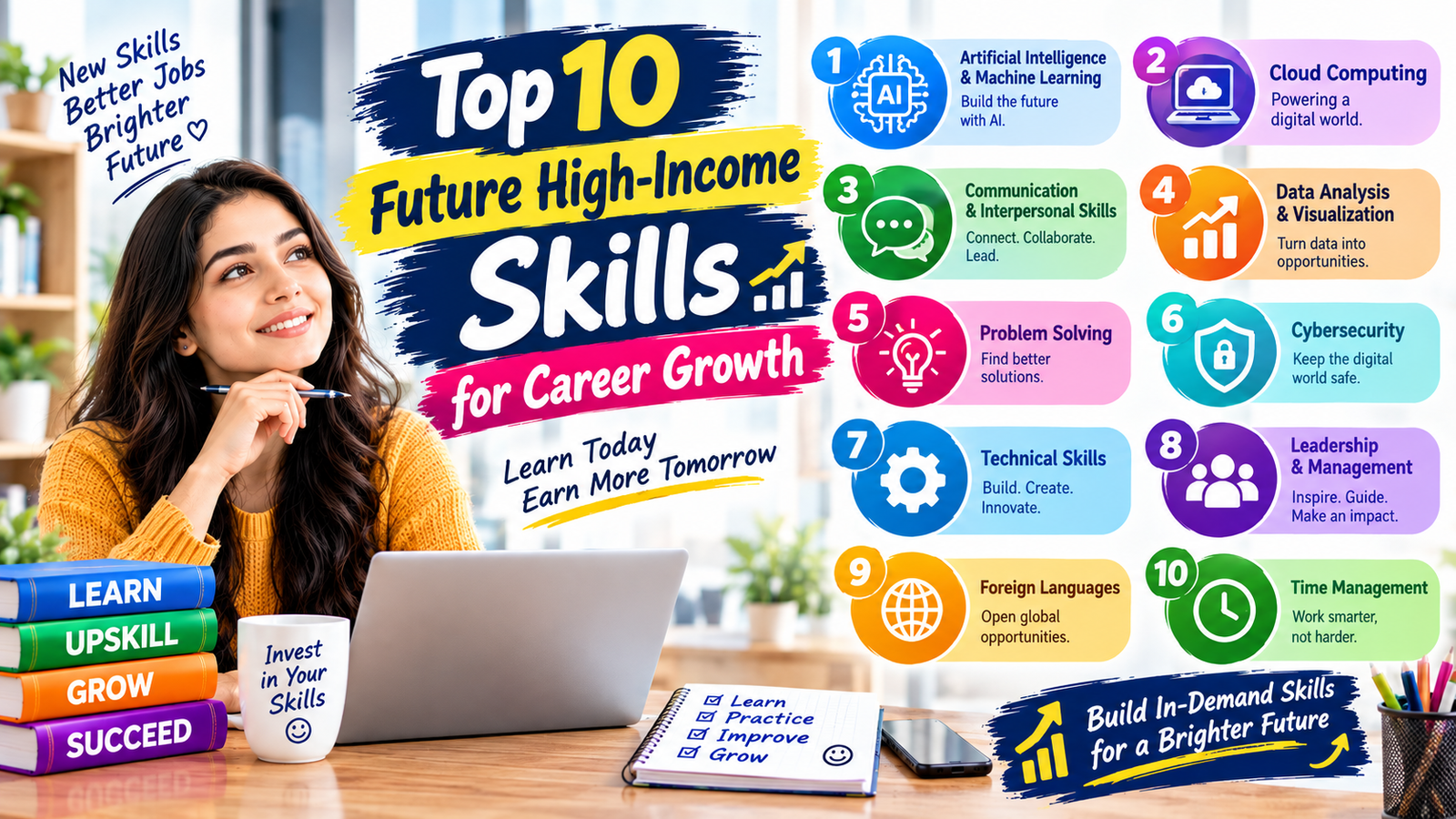
Frequently Asked Questions
What are the best Future High-Income Skills to learn?
Important areas include artificial intelligence, data analysis, cybersecurity, software development, cloud computing, digital marketing, sales, financial analysis, project management, UX design, and specialized industry knowledge. The right choice depends on your background and career goals.
Can beginners learn high-income skills?
Yes. Beginners can start with foundational concepts and gradually move toward practical projects. Choosing one skill and following a structured learning path is usually more manageable than trying to learn many advanced subjects at once.
Do I need a university degree to develop high-income skills?
Not every skill requires a traditional degree. Some technology, marketing, design, sales, and freelance career paths can be developed through structured self-learning and practical experience. However, certain professions and regulated occupations have formal education or licensing requirements.
How long does it take to learn a high-income skill?
The time varies by skill, previous experience, study schedule, and the level of proficiency required. Basic familiarity may take weeks or months, while professional-level expertise can require years of practice and continuous learning.
Which skills should I combine with AI?
AI can complement data analysis, marketing, programming, finance, design, research, customer service, project management, and many other fields. Combining AI literacy with a real domain specialty can help professionals apply technology to specific business problems.
How can I prove that I have a valuable skill?
Use practical evidence such as projects, portfolios, case studies, work samples, measurable results, professional references, or relevant certifications. The strongest evidence depends on the profession and the type of work you want to perform.
Conclusion
The most useful Future High-Income Skills are not limited to one technology or profession. Artificial intelligence, data analysis, cybersecurity, software development, cloud computing, digital marketing, sales, finance, project management, design, communication, and critical thinking can all contribute to long-term career development when they are applied effectively.
The key is to avoid chasing skills simply because they appear popular. Start with a field that matches your interests and existing experience, learn its fundamentals, practice through realistic projects, and build evidence that shows what you can accomplish. Then add complementary skills that increase your ability to solve valuable problems.
A strong career is built through continuous improvement rather than one course or certificate. By developing relevant technical abilities alongside communication, business judgment, and problem-solving skills, professionals can remain better prepared as workplaces and technology continue to evolve.