
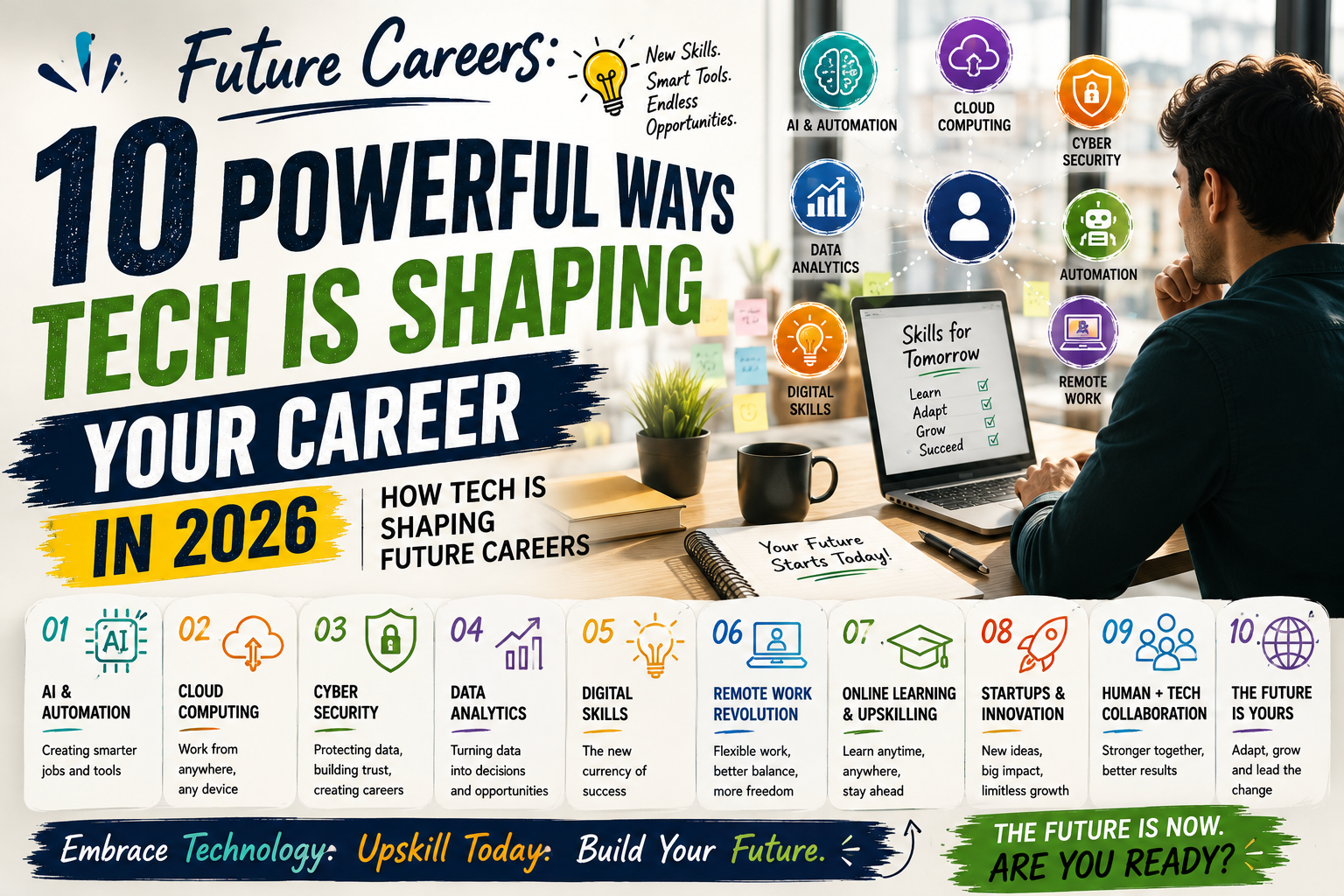
Technology is changing how people work, which skills employers value, and how new career opportunities are created. From artificial intelligence and automation to cloud computing and cybersecurity, digital tools are influencing almost every industry.
Understanding future careers can help students, job seekers, and professionals make better decisions about what to learn next. Technology is not simply replacing certain tasks; it is also creating new roles, changing existing jobs, and increasing the value of skills such as problem-solving, adaptability, digital literacy, and critical thinking.
This guide explains how technology is influencing future careers, which skills are becoming more valuable, which technology-driven roles are emerging, and how beginners can prepare for changes in the job market.
Quick Summary
- Artificial intelligence is changing tasks across many professions.
- Automation is reducing repetitive work while creating demand for new technical and analytical skills.
- Digital literacy is becoming useful across technical and non-technical careers.
- Cybersecurity and data-related roles are becoming increasingly important.
- Human skills such as communication, creativity, and critical thinking remain valuable.
- Continuous learning is becoming an important part of long-term career development.
- The most resilient future careers will often combine technology skills with human judgment.
How Technology Is Changing Future Careers
Technology affects future careers in several ways. It can automate repetitive tasks, improve productivity, create new services, and change how teams communicate and operate.
For example, accounting software can automate parts of bookkeeping, while analysts may spend more time interpreting financial information. In marketing, automation can handle repetitive campaign tasks while professionals focus more on strategy and creative decisions.
This means the impact of technology is often more complicated than simply saying that a job will disappear. In many cases, the tasks within a job change before the job itself changes significantly.
1. Artificial Intelligence Is Reshaping Work
Artificial intelligence is one of the most important technologies influencing modern workplaces. AI systems can assist with writing, research, customer support, data analysis, coding, image generation, and other knowledge-based tasks.
For workers preparing for future careers, the practical question is not only whether AI can perform a particular task. It is also how effectively a professional can use AI while checking its output and applying human judgment.
AI Skills Worth Learning
- Writing effective AI prompts
- Evaluating AI-generated information
- Using AI for research and brainstorming
- Understanding basic AI limitations
- Automating repetitive workflows
- Protecting confidential information when using AI tools
AI literacy can become a useful supporting skill even for people who never work as AI engineers or machine learning specialists.
2. Automation Is Changing Everyday Tasks
Automation allows software and machines to perform repetitive processes with limited human intervention. Businesses use automation for activities such as data entry, scheduling, reporting, inventory management, customer communication, and workflow processing.
As repetitive tasks become automated, workers may spend more time on activities that require judgment, communication, creativity, problem-solving, and decision-making. These abilities can become especially valuable across many future careers.
This makes it useful for professionals to understand which parts of their work can be automated and which parts require human expertise.
3. New Technology Careers Are Emerging
Technological change does not only modify existing careers. It also creates new areas of work and expands the demand for specialized skills.
Examples include roles connected to artificial intelligence, machine learning, cybersecurity, cloud infrastructure, data engineering, automation, and technology implementation.
Examples of Technology-Driven Careers
- AI and machine learning specialists
- Data analysts and data scientists
- Cybersecurity professionals
- Cloud engineers
- Software developers
- Automation specialists
- UX and product designers
- AI governance and risk professionals
Not every role requires the same education. Some technology careers require advanced degrees, while others can be approached through practical training, certifications, portfolios, or entry-level experience.
4. Data Skills Are Becoming More Valuable
Modern businesses generate large amounts of information from websites, applications, transactions, customers, devices, and internal systems. The ability to understand and use this information can support better decisions.
Data-related skills can be useful in technology, marketing, finance, healthcare, retail, logistics, and many other industries. This makes data literacy relevant to a wide range of future careers.
Beginner Data Skills
- Spreadsheet analysis
- Basic statistics
- Data visualization
- SQL fundamentals
- Data interpretation
- Clear reporting
You do not need to become a data scientist to benefit from data skills. Even basic data literacy can help professionals understand reports, identify patterns, and make evidence-based decisions.
5. Cybersecurity Is Becoming More Important
As organizations store more information and operate more services online, protecting digital systems becomes increasingly important.
Cybersecurity professionals help organizations identify vulnerabilities, protect networks and applications, monitor threats, manage access, and respond to security incidents.
Cybersecurity is also relevant outside dedicated security roles. Developers, managers, administrators, and other employees may need basic knowledge of secure passwords, access controls, phishing, data protection, and safe digital practices.
For people considering future careers in technology, cybersecurity can be an important area to explore because digital systems continue to require protection.
6. Remote and Hybrid Work Are Changing Career Opportunities
Digital communication and collaboration tools have made it possible for many professionals to work with organizations without being physically present in the same office.
Remote and hybrid work can expand access to opportunities, but they also require strong communication, time management, documentation, and self-management.
Skills for Digital Workplaces
- Written communication
- Video conferencing
- Digital collaboration
- Time management
- Independent problem-solving
- Online project management
These skills can be valuable whether you work remotely, in a hybrid environment, or in a traditional workplace. They can also support professionals as workplace expectations evolve.
7. Technology Is Changing Traditional Careers
Technology is not limited to technology companies. Traditional professions are also being transformed.
Healthcare professionals use digital records and diagnostic technologies. Financial professionals use advanced analytics and automation. Teachers use digital learning platforms. Retail businesses use e-commerce and customer data. Manufacturers increasingly rely on robotics, sensors, and connected systems.
As a result, professionals in almost every industry can benefit from understanding the digital tools used in their field. This means future careers will not necessarily be limited to traditional technology positions.
Future Careers Will Combine Technical and Human Skills
One of the most important trends is the combination of technical knowledge with human capabilities.
A professional who understands technology but cannot communicate clearly may struggle to turn technical knowledge into business value. Likewise, someone with strong communication skills can become more effective when they understand the tools used in their industry.
Important Human Skills
- Critical thinking
- Creative thinking
- Communication
- Collaboration
- Leadership
- Adaptability
- Problem-solving
- Emotional awareness
The World Economic Forum’s Future of Jobs research highlights technology-related skills alongside human capabilities such as analytical thinking, creative thinking, resilience, flexibility, and agility as important areas for the changing labor market.
Which Skills Should You Learn for Future Careers?
You do not need to learn every new technology. Instead, choose skills that support your target career and can transfer across different roles.
For Technology Careers
- Programming
- Cloud computing
- Cybersecurity
- Data analysis
- AI fundamentals
For Business Careers
- Data literacy
- Digital marketing
- Project management
- AI-assisted productivity
- Business communication
For Creative Careers
- UX/UI design
- Digital content creation
- Visual communication
- Creative software
- AI-assisted creative workflows
Combining technical and transferable skills can make professionals more adaptable as future careers continue to evolve.
How Beginners Can Prepare for Future Careers
- Choose a career direction. Start with an industry or role rather than trying to learn everything.
- Identify the core skills. Review current job descriptions to understand what employers commonly request.
- Learn through practical work. Build projects, complete realistic exercises, or gain supervised experience.
- Create a portfolio. Show what you can actually produce instead of listing skills without evidence.
- Learn digital tools. Become comfortable with software commonly used in your target industry.
- Develop human skills. Communication, critical thinking, and adaptability remain valuable.
- Keep updating your knowledge. Technology changes quickly, so career development should be an ongoing process.
This approach can help beginners prepare for future careers without trying to predict exactly which technology will dominate several years from now.
Common Mistakes to Avoid
Chasing Every New Technology
New tools appear constantly. Learning every new platform can create shallow knowledge. Focus on technologies that are relevant to your career goals.
Ignoring Fundamental Skills
Technology does not eliminate the importance of communication, mathematics, writing, research, or problem-solving. Strong fundamentals make it easier to adapt to new tools.
Relying Completely on AI
AI can produce useful results, but it can also generate inaccurate or incomplete information. Professionals should review important outputs and remain responsible for final decisions.
Learning Without Practice
Watching tutorials is only the beginning. Build projects, solve practical problems, and create evidence that demonstrates your ability.
How Employers May Evaluate Technology Skills
Employers do not always evaluate technology knowledge through certificates alone. Depending on the role, they may look at practical projects, portfolios, technical assessments, previous experience, communication skills, and the ability to solve realistic problems.
For beginners, this makes a portfolio particularly useful. A small number of well-explained projects can demonstrate initiative, technical ability, and problem-solving more clearly than a long list of unfinished courses.
Building demonstrable skills can therefore be more useful than simply collecting information about future careers.
Frequently Asked Questions About Future Careers
How is technology changing future careers?
Technology is automating repetitive tasks, creating new occupations, changing existing roles, and increasing the value of digital, analytical, and human skills. The effect differs by industry and occupation.
Will AI replace future careers?
AI is more likely to change many tasks within jobs than eliminate every job in a particular profession. Some roles may shrink while new responsibilities and occupations emerge around AI, automation, oversight, and implementation.
What skills are important for future careers?
Useful skills include digital literacy, AI literacy, data analysis, cybersecurity awareness, critical thinking, communication, creativity, adaptability, and problem-solving. The right combination depends on the career.
Are technology careers only for programmers?
No. Technology careers include design, cybersecurity, data, project management, cloud infrastructure, technical sales, AI operations, product management, and other areas. Many non-technical careers also require digital skills.
How can students prepare for future careers?
Students can explore different industries, develop digital and communication skills, complete practical projects, build portfolios, learn modern workplace tools, and gain experience through internships or other relevant opportunities.
Should professionals learn AI?
Basic AI literacy can be useful for many professionals. Learning how to use AI responsibly for research, productivity, analysis, and routine tasks can complement existing professional skills.
Conclusion
Technology is reshaping future careers by changing workplace tasks, creating new roles, and increasing the importance of digital skills. Artificial intelligence, automation, data, cloud computing, and cybersecurity are influencing industries far beyond traditional technology companies.
The best way to prepare for future careers is not to chase every new tool. Build strong fundamentals, learn technology relevant to your field, develop practical experience, and strengthen human skills such as communication, creativity, critical thinking, and adaptability.
Future careers will continue to evolve, but professionals who can learn new tools, solve problems, and adapt to changing work environments will be better positioned to take advantage of new opportunities.