
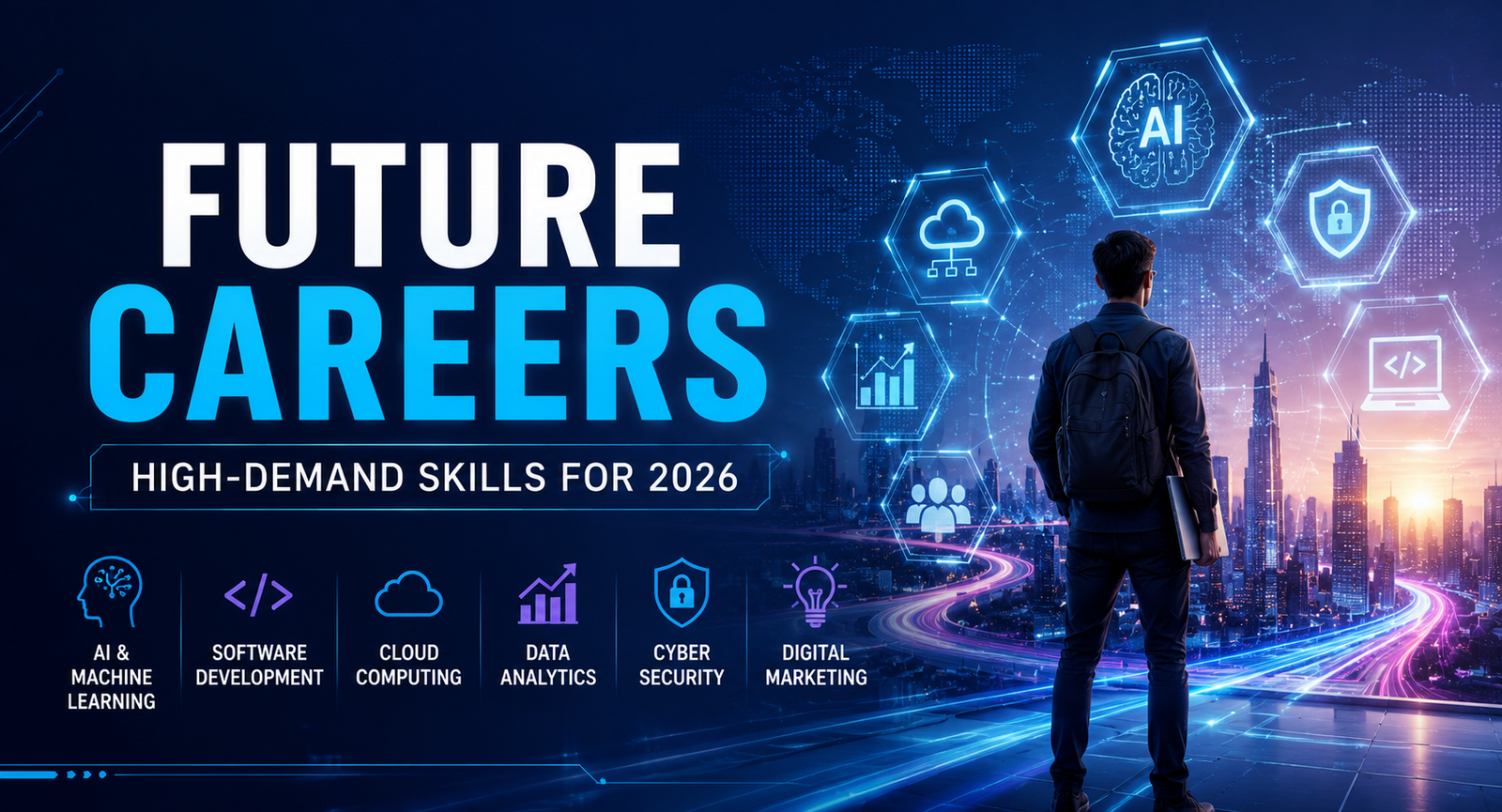
The job market is changing quickly, and choosing the right abilities can make a major difference in your career prospects. Future Career Skills for 2026 include a mix of technical abilities, digital knowledge, communication, problem-solving, and adaptability. You do not need to master every emerging technology to stay competitive. The better approach is to identify skills that match your career goals and build them consistently.
This guide explains which Future Career Skills are becoming more valuable, why employers look for them, how to develop them, and how to choose the right combination for your career.
Key Takeaways for Building a Future-Ready Career
- AI literacy and digital skills are becoming useful across many industries.
- Data analysis can help professionals make better decisions and solve business problems.
- Cybersecurity awareness is increasingly important as organizations depend on digital systems.
- Communication, critical thinking, and problem-solving remain valuable even as technology advances.
- Adaptability and continuous learning can help workers respond to changing job requirements.
- The best skill strategy combines technical knowledge with strong human skills.
What Are the Most In-Demand Skills for 2026?
The most valuable Future Career Skills in 2026 are not limited to one profession. Employers across technology, finance, healthcare, education, marketing, business, and other fields need people who can work effectively with technology while also making sound decisions and communicating clearly.
Some of the strongest areas to consider include artificial intelligence, data analysis, cybersecurity, digital literacy, cloud technologies, communication, critical thinking, project management, and adaptability.The World Economic Forum’s [Future of Jobs Report 2025](official source) also highlights AI and big data, networks and cybersecurity, technological literacy, creative thinking, and analytical thinking among important skills shaping the future of work.
1. Artificial Intelligence and AI Literacy
Artificial intelligence is becoming part of everyday work rather than remaining limited to specialist technology teams. Professionals in marketing, customer service, finance, administration, software development, research, and other fields may increasingly interact with AI-powered tools.
AI literacy does not necessarily mean becoming a machine learning engineer. For many professionals, it means understanding what AI can do, where it can help, how to write effective instructions, how to evaluate outputs, and when human judgment is still necessary.
How to Build AI Skills
- Learn the basic concepts behind generative AI and machine learning.
- Practice using AI tools relevant to your profession.
- Learn how to evaluate AI-generated information instead of accepting every output automatically.
- Understand basic data privacy and responsible AI practices.
- Use AI to improve routine tasks while keeping human oversight.
AI skills can be especially useful when combined with an existing professional specialty. A marketer who understands AI-assisted research, for example, may have a different advantage from someone who knows AI but has no practical business knowledge.
2. Data Analysis and Data Literacy
Organizations collect large amounts of information, but data only becomes useful when people can understand and apply it. Data literacy is therefore one of the important Future Career Skills for 2026.
Professionals do not always need advanced statistics. Many roles benefit from the ability to read charts, identify trends, work with spreadsheets, understand basic metrics, and turn information into practical recommendations.
Useful Data Skills to Learn
- Microsoft Excel or Google Sheets
- Basic statistics
- Data visualization
- SQL fundamentals
- Dashboard interpretation
- Data cleaning and organization
- Business reporting
If your career involves business decisions, operations, sales, finance, marketing, or research, improving your ability to work with data can strengthen your professional value.
3. Cybersecurity Awareness
Digital work creates new opportunities but also creates security risks. Cybersecurity is not only the responsibility of dedicated security teams. Employees who understand phishing, password security, access controls, data protection, and safe digital practices can help reduce everyday risks.
For people pursuing technology careers, deeper cybersecurity knowledge can lead toward roles such as security analyst, security engineer, penetration tester, or security administrator. For other professionals, basic cybersecurity awareness can still be an important workplace skill.

4. Digital and Technology Skills
Digital literacy is becoming a foundation for many modern jobs. The exact tools vary by profession, but employers generally value people who can learn new software and use digital systems efficiently.
Depending on your career path, useful areas may include cloud computing, collaboration platforms, content management systems, automation, customer relationship management software, or basic programming.
These Future Career Skills can be especially useful when they are connected to a specific industry or job function rather than learned in isolation.
You do not need to learn every platform. Focus on technologies that are connected to the type of work you want to perform.
5. Critical Thinking and Problem-Solving
Technology can process information quickly, but professionals still need to decide what information matters and what action makes sense. Critical thinking helps you evaluate evidence, recognize weak assumptions, identify risks, and choose practical solutions.
Strong problem-solving skills are useful in almost every career. An employee who can identify the cause of a problem, compare possible solutions, and explain the reasoning behind a decision can contribute beyond simply completing assigned tasks.
6. Communication Skills
Communication remains one of the most transferable career skills. Technical knowledge has limited value if you cannot explain your ideas, write clearly, listen carefully, or work effectively with colleagues and customers.
Focus on both written and verbal communication. Learn to write concise emails, explain complex information in simple language, give useful presentations, and adapt your communication style to different audiences.
For managers and future leaders, communication becomes even more important because responsibilities often involve coordination, feedback, negotiation, and decision-making.
7. Adaptability and Continuous Learning
Job requirements can change as businesses adopt new technologies, processes, and customer expectations. Adaptability helps professionals respond without becoming dependent on one fixed set of tasks.
Continuous learning does not mean taking courses constantly. A practical learning routine might involve completing one focused course, reading industry material, practicing a new tool, or applying a new skill to a real project.
The goal is to create a habit of updating your abilities before your current skills become outdated. The OECD also emphasizes lifelong learning and adaptable problem-solving as important parts of building skills for changing labor markets. This makes continuous learning an important part of building Future Career Skills over time.
8. Project Management
Project management skills are useful far beyond formal project manager positions. Employees often need to organize tasks, manage deadlines, communicate progress, identify risks, and coordinate with other people.
Learning basic project management can help you manage both individual assignments and larger team projects. Familiarity with concepts such as scope, priorities, milestones, dependencies, and risk management can improve workplace performance.
9. Creativity and Strategic Thinking
Automation can handle many repetitive activities, but organizations still need people who can generate ideas, understand customers, identify opportunities, and make thoughtful strategic choices.
Creativity is not limited to artistic careers. It can appear in product development, marketing campaigns, business processes, customer experience, engineering, education, and problem-solving.
Strategic thinking takes this further by connecting individual decisions to broader goals. Instead of asking only, “What should I do next?” consider, “What outcome are we trying to achieve, and which action will contribute most to it?”

10. Leadership and Collaboration
Leadership is another valuable skill for professionals who want long-term career growth. Effective leadership involves more than managing people. It includes setting priorities, making decisions, handling disagreements, giving feedback, supporting colleagues, and taking responsibility for results.
Collaboration is equally important because many modern workplaces depend on cross-functional teams. Being able to work with people from different backgrounds and specialties can make you more effective in complex projects.
Leadership and collaboration can also turn individual Future Career Skills into stronger workplace performance because they help professionals apply their knowledge within teams.
Technical Skills vs. Human Skills: What Should You Learn?
The strongest career strategy is usually not choosing between technical and human skills. Instead, combine them.
| Skill Area | Examples | Why It Matters |
|---|---|---|
| AI and technology | AI literacy, automation, cloud tools | Helps professionals work effectively with modern technology |
| Data | Excel, SQL, visualization, analytics | Supports evidence-based decisions |
| Cybersecurity | Security awareness, risk management | Helps protect digital systems and information |
| Human skills | Communication, teamwork, empathy | Improves collaboration and workplace relationships |
| Thinking skills | Critical thinking, problem-solving, strategy | Supports better decisions and complex work |
| Management | Planning, leadership, project management | Helps professionals coordinate people and resources |
How to Choose the Right Skills for Your Career
Learning every popular skill is neither practical nor necessary. The better approach is to select Future Career Skills that support the type of career you want.
Start With Your Target Role
Look at several job descriptions for the position you want. Identify skills that appear repeatedly. Separate them into technical skills, communication skills, industry knowledge, and preferred qualifications.You can also compare occupations, education requirements, job outlook, and typical duties through the U.S. Bureau of Labor Statistics’ [Occupational Outlook Handbook](official source).
Build a Core Skill Plus a Complementary Skill
Choose one skill that directly supports your profession and another that makes it more valuable.
For example, a digital marketer might combine marketing knowledge with data analytics. An accountant might add advanced spreadsheet and data skills. A software developer might strengthen communication and project management abilities.
This combination approach makes your Future Career Skills more relevant because you are developing abilities that work together rather than collecting unrelated qualifications.
Practice Through Real Projects
Courses can provide useful foundations, but practical work helps turn knowledge into ability. Build a small portfolio project, improve a workplace process, analyze a public dataset, create a sample campaign, or complete a realistic practice assignment.
Whenever possible, document what you did and what the result was. A clear example of your work can communicate your capabilities more effectively than a long list of course certificates.
How to Develop Future Career Skills for 2026
- Choose one priority skill. Avoid trying to learn everything at once.
- Study the fundamentals. Understand the basic concepts before moving to advanced topics.
- Practice regularly. Short, consistent sessions are easier to maintain than occasional intensive study.
- Apply the skill to a real problem. Practical application improves understanding.
- Create evidence of your work. Keep projects, reports, presentations, or other examples in a portfolio where appropriate.
- Ask for feedback. Feedback can reveal gaps that self-study may not identify.
- Review your progress. Adjust your learning plan as your career goals or industry requirements change.
A focused learning plan makes it easier to turn Future Career Skills from theoretical knowledge into practical workplace abilities.
Common Mistakes When Learning Future Career Skills
Trying to Learn Too Many Skills
Collecting courses without developing practical ability can leave you with broad but shallow knowledge. Choose a smaller number of skills and develop them deeply enough to use them confidently.
Following Trends Without a Career Goal
A skill may be popular but still have limited value for your specific career. Always connect learning decisions to a target role, industry, or professional objective.
Ignoring Communication
Technical skills can attract attention, but communication often determines how effectively you can use those skills within a team or organization.
Learning Without Practice
Watching tutorials is not the same as being able to perform the task independently. Include practical exercises and real-world projects in your learning process.
How Skills Can Support Career Growth
Developing valuable skills can also support progression within your current job. When you become more capable of solving problems, handling complex responsibilities, using technology, or supporting team goals, you have stronger evidence to discuss during performance reviews and career conversations.
However, skill development alone does not guarantee a promotion. You also need to communicate your achievements, take ownership of meaningful work, and understand what your organization expects from the next level.
Building relevant Future Career Skills can strengthen your professional profile, especially when you can demonstrate how those abilities have improved your work or helped solve real problems.
If you are unsure which direction to take, learning more about how to choose the right career path can help you connect your interests, abilities, and employment opportunities before investing heavily in a particular skill.

Which Skills Are Best for Different Career Goals?
| Career Goal | Useful Skills to Consider |
| Technology | Programming, AI, cloud computing, cybersecurity, data |
| Marketing | Analytics, content strategy, AI tools, communication, customer research |
| Finance | Data analysis, spreadsheets, financial modeling, communication |
| Management | Leadership, project management, communication, strategic thinking |
| Healthcare | Digital literacy, communication, data awareness, specialized professional skills |
| Business | Problem-solving, analytics, negotiation, technology, leadership |
The right combination of Future Career Skills depends on your industry, current experience, desired role, and the gaps you need to close.
Frequently Asked Questions
What are the most valuable Future Career Skills to learn in 2026?
AI literacy, data analysis, cybersecurity awareness, digital skills, critical thinking, communication, adaptability, project management, and leadership are useful areas to consider. The best choices depend on your target career.
Are technical skills more important than soft skills in 2026?
Neither category is universally more important. Technical skills can help you perform specialized work, while communication, critical thinking, teamwork, and adaptability help you apply those skills effectively.
How can I learn high-demand skills for 2026?
Start with one skill connected to your career goal, learn the fundamentals, practice through real projects, seek feedback, and gradually expand into complementary skills. This approach can help you build Future Career Skills without becoming overwhelmed.
Do I need AI skills for every career?
Not every career requires advanced AI expertise. However, basic AI literacy can be useful in many fields because professionals may encounter AI-powered software, workflows, or decision-support systems.
How do I know which career skills are right for me?
Compare your career goal with current job descriptions, identify frequently requested abilities, assess your existing strengths, and choose Future Career Skills that close the most important gaps.
Can learning new skills help me get promoted?
Yes, new skills can strengthen your contribution, but promotion decisions usually involve more than training. Demonstrating measurable results, reliability, initiative, communication, and readiness for greater responsibility also matters.
Conclusion
The best Future Career Skills for 2026 are not simply the newest technologies. They are skills that help professionals solve problems, use modern tools, communicate effectively, make decisions, and adapt to changing work requirements.
Rather than chasing every trend, choose a career direction and build a focused combination of technical and human skills around it. Start with one valuable capability, practice it through real work, and gradually add complementary skills. This approach can make your professional development more focused and help you prepare for changing opportunities in the years ahead.