
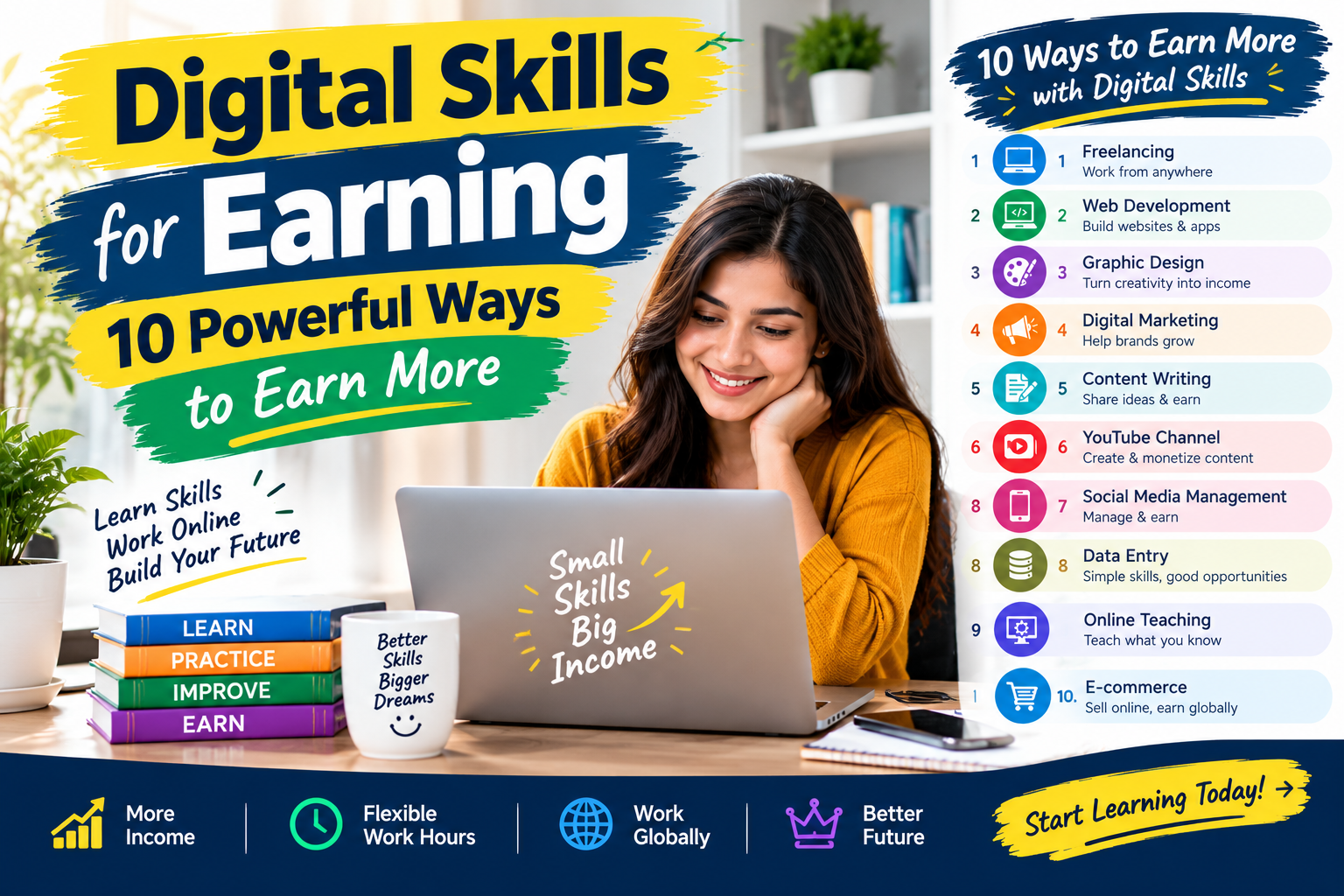
Building the right Digital Skills for Earning can help you become more competitive in today’s job market. Employers increasingly rely on digital platforms, software, online communication, data systems, automation, and technology-based workflows. At the same time, freelancers and independent professionals can use digital abilities to serve clients locally and internationally.
The good news is that you do not need to master every technology available. A better approach is to choose one useful skill, develop practical ability, create evidence of your work, and then add related skills that increase your professional value. Whether you are a student, job seeker, employee, freelancer, or career changer, the right digital skill can create opportunities that were difficult to access through traditional qualifications alone.
This guide explores practical Digital Skills for Earning, explains where they are used, and shows how you can turn learning into a stronger career profile. It also covers freelancing, remote work, artificial intelligence, portfolios, common mistakes, and a practical learning roadmap.
What Are Digital Skills?
Digital skills are abilities that allow people to use computers, software, online services, digital platforms, and technology effectively. They include basic workplace abilities as well as advanced professional capabilities.
Basic digital literacy may involve using email, word processors, spreadsheets, cloud storage, online meetings, and collaboration platforms. More advanced skills include programming, web development, data analysis, cybersecurity, cloud computing, search engine optimization, digital marketing, graphic design, video editing, and artificial intelligence applications.
The value of a digital skill depends on how effectively it solves a real problem. Simply knowing how a software application works does not necessarily create professional value. Employers and clients want people who can use technology to produce accurate, useful, and measurable work.
For example, knowing basic spreadsheet functions can help with administrative duties. Learning advanced formulas, pivot tables, dashboards, data cleaning, and reporting can open a path toward more analytical responsibilities. This difference between basic familiarity and practical competence is important when developing Digital Skills for Earning.
Why Digital Skills Matter for Career Growth
Modern organizations use technology across finance, marketing, administration, education, healthcare, retail, manufacturing, communication, and professional services. As a result, digital competence can support many different career paths.
One advantage of Digital Skills for Earning is that they can be applied in more than one employment model. A person may use the same skill in a full-time position, freelance service, remote job, consulting project, or small online business.
- Employment: Digital abilities can help candidates qualify for positions that require software or technology knowledge.
- Freelancing: Specialized skills can be offered as services to individual clients and businesses.
- Remote work: Many digital tasks can be completed using internet-based collaboration systems.
- Business: Digital marketing, websites, e-commerce, content, and automation can support independent businesses.
- Career progression: Additional digital capabilities can help employees take on more specialized responsibilities.
- Productivity: Technology knowledge can help professionals automate repetitive work and organize information efficiently.
Digital competence does not guarantee a particular salary or income level. Earnings vary according to experience, industry, location, specialization, demand, employer, client base, and professional performance. The purpose of learning these skills is to expand your capabilities and create more opportunities to demonstrate value.

Digital Skills for Earning That Are Worth Learning
1. Digital Marketing
Digital marketing is one of the broadest technology-related career areas. It covers online promotion through search engines, social networks, email, websites, content, advertising platforms, and analytics.
Someone beginning with Digital Skills for Earning can choose one part of digital marketing instead of trying to learn everything simultaneously. Search engine optimization, social media management, content marketing, email marketing, and paid advertising each require different knowledge.
Digital marketing professionals may work as marketing assistants, SEO specialists, content marketers, social media managers, campaign coordinators, or marketing analysts. Freelancers can also offer individual services such as content planning, keyword research, social media calendars, or website optimization.
Practical experience matters. A beginner could create a sample marketing campaign for a fictional business, develop a content calendar, prepare a keyword research report, or analyze a public website. These projects provide stronger evidence than simply listing marketing software on a resume.
2. Search Engine Optimization
SEO helps websites and digital content become more useful and discoverable through search engines. It involves understanding search intent, keywords, content quality, website structure, internal links, technical factors, and search performance.
SEO is a particularly useful option for people who enjoy writing, research, websites, marketing, and analytics. A learner can start with on-page optimization and content structure before exploring technical SEO, local SEO, ecommerce SEO, or larger content strategies.
People developing Digital Skills for Earning can demonstrate SEO ability through sample audits, optimized articles, keyword maps, content briefs, internal-linking plans, and technical checklists.
A strong SEO professional also needs judgment. Search optimization should not be reduced to repeating keywords. Good work considers user intent, helpful information, website usability, accessibility, and the overall page quality.
3. Graphic Design
Graphic design is useful for companies that need visual content for websites, social media, advertisements, presentations, brochures, branding, and marketing materials.
Designers may use applications such as Adobe Photoshop, Illustrator, InDesign, or other design platforms. However, learning software is only one part of becoming a capable designer. Typography, layout, spacing, hierarchy, contrast, consistency, and visual communication are equally important.
For Digital Skills for Earning, graphic design can be attractive because the work can often be displayed through a portfolio. A beginner can create sample social media graphics, promotional banners, presentation slides, brand concepts, or website layouts.
A focused portfolio with several strong examples is generally more useful than dozens of unrelated designs. Each project should show a clear purpose and demonstrate deliberate design choices.
4. Video Editing
Video content is widely used for marketing, education, entertainment, product promotion, social media, training, and business communication. This creates opportunities for people who can transform raw footage into clear and engaging videos.
Basic video editing includes cutting clips, arranging sequences, improving audio, adding captions, using transitions, and exporting content for different platforms. More advanced work may include motion graphics, color correction, sound design, and visual effects.
Video editing is another practical category of Digital Skills for Earning because the results can be demonstrated visually. A beginner can create short promotional videos, tutorials, social media clips, interview edits, or product demonstrations for a portfolio.
The most valuable skill is not the ability to add effects. It is the ability to communicate a message clearly and keep the viewer focused on the purpose of the video.
5. Web Development
Web development involves creating and maintaining websites and web applications. Front-end development commonly includes HTML, CSS, JavaScript, responsive layouts, accessibility, and browser-based development. Learning these areas can create valuable Digital Skills for Earning for beginners interested in online work.
Back-end development can include programming languages, databases, APIs, authentication, servers, and application logic. Beginners should select a manageable path rather than attempting to learn every programming technology at the same time. Building practical Digital Skills for Earning through one focused development path can make the learning process easier to manage.
Web development is one of the more technical Digital Skills for Earning because it can support employment, freelance projects, and independent website services.
Useful beginner projects include a responsive business website, personal portfolio, landing page, online catalog, or simple interactive application. These projects can demonstrate practical knowledge more effectively than theoretical explanations alone and help turn Digital Skills for Earning into visible portfolio evidence.
As experience grows, developers can expand their Digital Skills for Earning by learning frameworks, improving website performance, understanding APIs, working with databases, and developing more advanced web applications.
6. Data Analysis
Data analysis helps organizations organize information, identify patterns, prepare reports, and support decisions. It can be useful in business, finance, operations, marketing, research, education, and many other fields.
Common tools include Microsoft Excel, Google Sheets, SQL, Power BI, Tableau, and Python. The right combination depends on the intended role.
Beginners can start with spreadsheet formulas, sorting, filtering, data cleaning, pivot tables, charts, and basic dashboards. After gaining confidence, they can learn SQL and specialized visualization platforms.
Data analysis is a valuable part of Digital Skills for Earning because it combines technology with business reasoning. A person who can explain what the numbers mean may provide more value than someone who can simply generate a chart.
7. Programming
Programming is the process of creating instructions that computers can execute. It supports websites, mobile applications, automation, business systems, data processing, artificial intelligence, games, and other software products. Learning programming can develop practical Digital Skills for Earning for people interested in technology-based careers.
Python, JavaScript, Java, C#, and other programming languages are used for different purposes. Beginners should select a language according to their desired direction and build relevant Digital Skills for Earning through consistent practice.
Important concepts include variables, conditions, loops, functions, data structures, debugging, version control, and software design. These concepts are more important than memorizing large amounts of syntax and provide a strong foundation for Digital Skills for Earning.
Programming can become one of the most technically demanding Digital Skills for Earning, so consistent practice is important. Small projects such as calculators, task managers, automation scripts, websites, and simple applications can gradually build confidence.
With continued learning and project development, programming can strengthen Digital Skills for Earning by helping learners create useful software, demonstrate their abilities through portfolios, and explore different technology-related opportunities.
8. Cybersecurity
Cybersecurity focuses on protecting computers, networks, applications, devices, and information from unauthorized access and other security risks.
Beginners can start with networking fundamentals, operating systems, authentication, access control, secure configuration, basic risk management, and security awareness.
More specialized areas include security operations, application security, incident response, penetration testing, cloud security, and governance, risk, and compliance.
Cybersecurity should always be practiced legally and ethically. Learners should use authorized laboratories, training environments, or systems where they have explicit permission to perform testing.
9. Cloud Computing
Cloud computing provides access to computing resources such as storage, databases, networking, and applications through internet-based infrastructure. Amazon Web Services, Microsoft Azure, and Google Cloud are major cloud ecosystems.
Cloud knowledge can complement software development, cybersecurity, data analysis, and system administration. Beginners should first understand virtual machines, storage, networking, databases, identity management, scalability, and basic cloud service models.
Hands-on practice can make cloud concepts easier to understand. Instead of only reading definitions, learners can work through suitable training environments and document what they build.
10. Artificial Intelligence Skills
Artificial intelligence and generative AI are increasingly being incorporated into workflows involving writing, coding, research, marketing, design, customer support, and data-related tasks. Learning these technologies can strengthen Digital Skills for Earning for professionals working across different industries.
Useful AI capabilities include writing effective instructions, reviewing generated responses, organizing information, checking accuracy, identifying limitations, and integrating AI into existing workflows. These abilities can become practical Digital Skills for Earning when applied to real workplace tasks.
AI can become more valuable when combined with another discipline. For example, a marketer can learn AI-assisted research, a developer can use coding assistance, and a data analyst can use AI to help organize information. Combining AI knowledge with professional expertise can create stronger Digital Skills for Earning.
For people building Digital Skills for Earning, the key is to understand the underlying professional task instead of depending entirely on an AI system. Human judgment remains important for accuracy, context, quality, privacy, and accountability.
As AI tools continue to develop, professionals can expand their Digital Skills for Earning by learning how to evaluate outputs, improve workflows, protect sensitive information, and use AI as a productivity tool rather than treating it as a complete replacement for professional knowledge.
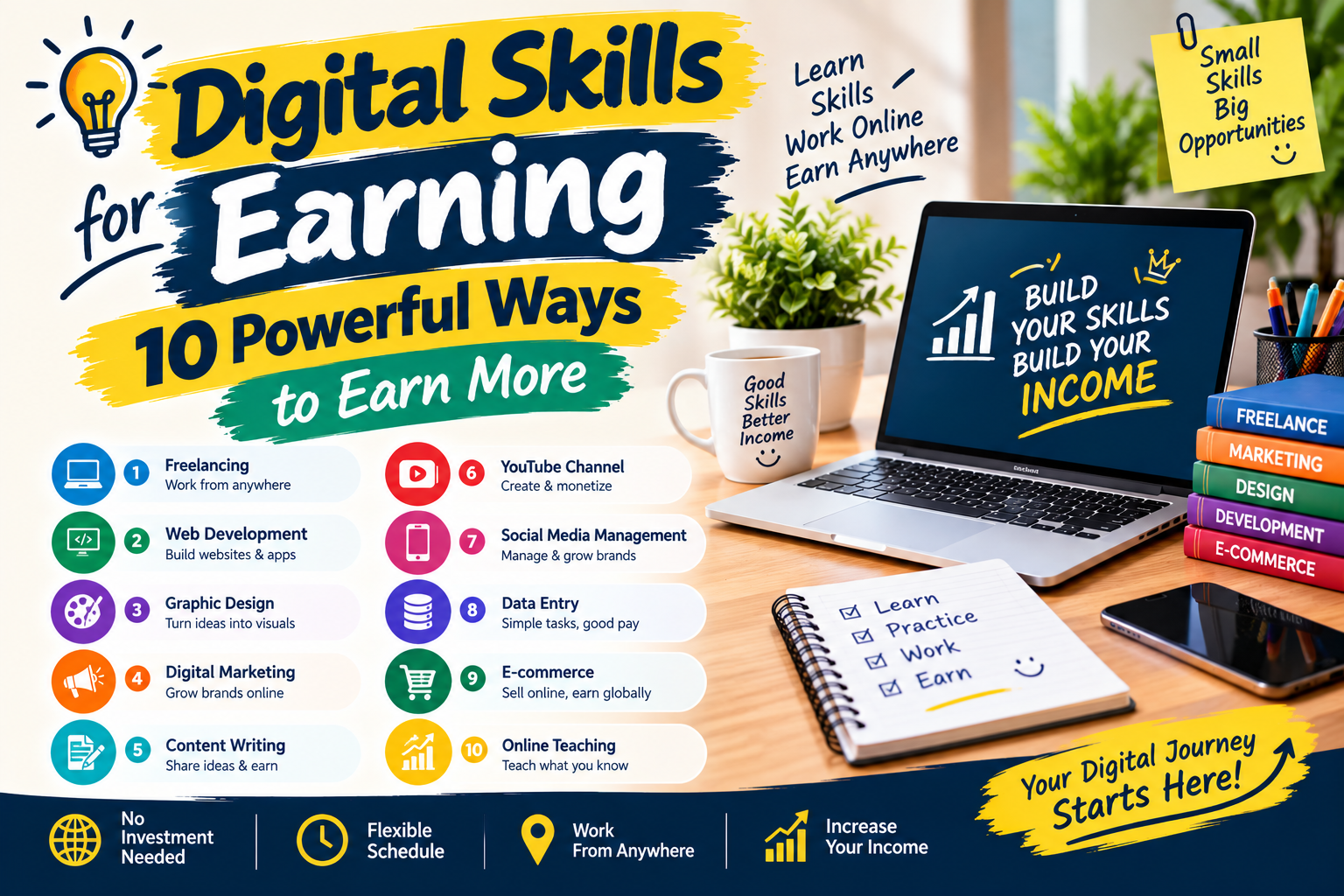
How to Choose the Right Digital Skill
Choosing a digital skill should begin with your career goal. The skill that suits a freelance designer may not suit someone interested in data analysis or software development.
Consider Your Existing Strengths
If you enjoy writing, research, and communication, SEO, content marketing, and digital publishing may be natural options. If you enjoy visual creativity, graphic design or video editing may be more suitable. If you prefer logic and structured problem-solving, programming, data analysis, or cybersecurity may be worth exploring.
Think About Your Preferred Work Style
Some people prefer working with clients, while others prefer structured employment. Some enjoy creative assignments, while others prefer analytical or technical work.
Understanding your preferred work environment can help you choose Digital Skills for Earning that are more likely to fit your long-term goals.
Review Real Job Descriptions
Before spending significant time on a skill, review actual job postings in that field. Look at required tools, qualifications, responsibilities, experience levels, and supporting skills.
This approach can prevent you from spending months learning a tool that is not relevant to the type of work you want.
How to Build a Portfolio
A portfolio is one of the strongest ways to demonstrate practical ability. It gives an employer or client something concrete to review.
For design, the portfolio may contain visual projects. For development, it can include websites or code repositories. For SEO, it can contain audits and content examples. For data analysis, it can show dashboards and reports. For video editing, it can contain finished video samples.
Every project should have a clear purpose. Explain the problem, your approach, the tools used, and the final deliverable. If you use fictional companies or practice data, identify the work honestly.
A portfolio can make Digital Skills for Earning more credible because it demonstrates application rather than simply making a claim about your abilities.
Certificates and Practical Experience
Certificates can demonstrate that you completed a course or training program. However, a certificate does not automatically prove that you can perform professional tasks independently.
Practical projects can complement certificates. A credential may demonstrate structured learning, while a portfolio can demonstrate application.
When selecting a course, review the curriculum, practical assignments, instructor information, assessment process, and relevance to your career objective. Be careful with courses that promise guaranteed income or unrealistic results from very short training programs.
How to Turn Digital Skills Into Freelance Work
Freelancing requires more than learning a technical skill. You also need to understand client communication, project scope, deadlines, revisions, file management, and professional delivery.
Start with projects that match your current ability. Taking work that is far beyond your experience can create quality problems and damage your professional reputation.
Once you have several useful examples, create a clear service description. Explain exactly what you provide, who it is for, and what the client receives.
People using Digital Skills for Earning in freelance markets should also learn how to communicate professionally. Clear proposals, realistic deadlines, organized files, and timely updates can be as important as technical knowledge.
Digital Skills for Remote Careers
Remote work has created opportunities for professionals who can complete tasks through online systems. However, remote work requires more than technical knowledge.
Important supporting abilities include time management, written communication, digital organization, online collaboration, documentation, and cybersecurity awareness.
Common remote workflows may use video conferencing, cloud storage, collaborative documents, project management platforms, and team communication tools. The exact tools vary between organizations.
Remote employees should also protect confidential information, use appropriate authentication, secure their devices, and follow their employer’s technology policies.
Digital Skills for Students
Students can start building professional digital abilities before graduation. Even basic experience with spreadsheets, presentations, research, online collaboration, and digital communication can be useful across many careers.
Students interested in Digital Skills for Earning should focus on creating projects that connect with their academic field.
A business student might build a marketing analysis. A computer science student could create a small application. A media student might develop a video portfolio. A finance student could create an analytical dashboard using sample data.
These projects can provide evidence of initiative and practical ability when applying for internships or entry-level opportunities.
Digital Skills for Career Changers
Career changers often have valuable transferable skills. Communication, customer service, teaching, sales, project coordination, administration, research, and industry knowledge can support a transition into digital work.
For example, an administrative professional who develops advanced spreadsheet and reporting abilities may move toward data-focused responsibilities. A teacher who learns video production and instructional design may explore digital learning content.
This is an important part of Digital Skills for Earning because a career change does not always require starting completely from zero. Existing experience can be combined with new technology skills.
How to Learn Digital Skills on a Limited Budget
You do not always need an expensive course to begin. Official documentation, educational platforms, tutorials, public datasets, open-source projects, and practice environments can provide useful learning opportunities.
- Use official documentation to understand software and technical concepts.
- Practice with public datasets when learning data analysis.
- Create small projects instead of only watching tutorials.
- Study open-source projects to understand real development workflows.
- Use recognized educational resources from technology organizations.
- Keep notes about errors and the methods you use to solve them.
A structured learning path is usually more effective than collecting dozens of unrelated courses. Select one skill, establish a foundation, practice regularly, and gradually increase project difficulty.
A Practical Roadmap for Digital Skills for Earning
- Choose one core skill. Select an area that matches your interests and career target.
- Learn the fundamentals. Understand the terminology, tools, concepts, and common workflows.
- Practice consistently. Apply each new concept through exercises.
- Create realistic projects. Build work that demonstrates how you solve problems.
- Review your weaknesses. Identify gaps in accuracy, quality, speed, or communication.
- Build a portfolio. Present your strongest projects clearly and honestly.
- Seek opportunities. Apply for internships, jobs, freelance assignments, or small projects.
- Add supporting skills. Expand your profile after developing a strong foundation.
This step-by-step process makes Digital Skills for Earning easier to approach because you are not trying to become an expert overnight.
Common Mistakes to Avoid
Learning Too Many Skills at Once
Trying to learn programming, design, SEO, video editing, cybersecurity, and data analysis simultaneously can make progress difficult to measure. Start with one core area.
Watching Tutorials Without Practicing
Passive learning can create familiarity without competence. Build projects as soon as you understand the basic concepts.
Focusing Only on Software
Professional work requires problem-solving and judgment. Knowing where a button is located in an application is not the same as knowing how to use the tool effectively.
Ignoring Communication
Technical professionals still need to explain their work, understand requirements, manage deadlines, and respond to feedback.
Relying Completely on AI
AI tools can accelerate some tasks, but generated information may contain errors. Review important outputs and maintain responsibility for the final result.
Expecting Instant Income
Learning a skill is the beginning of a career process, not a guarantee of immediate earnings. Experience, portfolio quality, professional reputation, market demand, and client or employer relationships all influence income.
How to Make Your Digital Skills More Valuable
The strongest Digital Skills for Earning are often combined with business understanding and communication.
- Understand the problem: Know what the employer or client actually needs.
- Focus on outcomes: Show what your work achieves instead of only listing tools.
- Improve quality: Review your work for accuracy, usability, consistency, and clarity.
- Document projects: Explain your process and decisions.
- Build specialization: Develop a recognizable area of expertise.
- Keep learning: Update your knowledge when important tools or workflows change.
- Develop business awareness: Understand scope, deadlines, pricing, customer expectations, and professional conduct.
How AI Can Support Your Digital Career
Artificial intelligence can support many professional workflows, but it should be treated as a tool rather than a substitute for expertise.
A content professional may use AI to brainstorm ideas or organize research. A developer may use coding assistance while reviewing the generated code. A marketer can use AI to structure campaign ideas. A data professional can use it to assist with explanations or repetitive analytical tasks.
The professional still needs to verify important information and understand the underlying work. This combination of human expertise and technology can make Digital Skills for Earning more adaptable as workplace tools change.
How to Measure Your Progress
Do not measure your progress only by the number of courses completed. Measure what you can actually do.
- Can you complete a basic project independently?
- Can you identify common mistakes?
- Can you explain your work clearly?
- Can you solve a problem without following a tutorial step by step?
- Can you create a portfolio project?
- Can you improve your work after receiving feedback?
If the answer gradually becomes yes, your learning is moving toward practical competence. That competence is more useful for career development than simply collecting course completion badges.
Choosing Between Creative, Technical, and Analytical Skills
Creative skills can suit people who enjoy visual communication, storytelling, writing, design, and media. Graphic design, video editing, content creation, and digital marketing can fit this category.
Technical skills are generally more focused on systems, software, infrastructure, and technology. Web development, programming, cloud computing, and cybersecurity are examples.
Analytical skills focus on information, patterns, reporting, and decision support. Data analysis, business intelligence, research, and performance analytics can fit this direction.
There is no requirement to stay inside one category. Many professionals combine them. For example, an SEO specialist may use analytical skills, while a web developer may combine technical knowledge with UX principles.

Frequently Asked Questions
What are the most useful Digital Skills for Earning?
Useful areas include digital marketing, SEO, graphic design, video editing, web development, programming, data analysis, cybersecurity, cloud computing, and AI-assisted workflows. The right choice depends on your goals, interests, and current abilities.
Can Digital Skills for Earning help without a university degree?
Some digital careers and freelance services can be entered without a traditional university degree, although requirements differ by employer and profession. Practical ability, relevant experience, training, and a strong portfolio can help demonstrate competence.
How long does it take to develop Digital Skills for Earning?
The timeline depends on the skill, learning schedule, prior experience, and level of competence required. Basic software skills may develop relatively quickly, while advanced programming, cybersecurity, cloud, and data careers can require extended practice.
Which Digital Skills for Earning are useful for freelancing?
Freelance opportunities can exist in SEO, writing, graphic design, video editing, web development, programming, digital marketing, virtual assistance, and data services. Choose a service that you can deliver reliably and demonstrate through practical work.
Are certificates necessary for Digital Skills for Earning?
Certificates can demonstrate structured learning, but they are not always required. Their usefulness depends on the employer, profession, and certification. Practical projects and relevant experience can provide additional evidence of your ability.
How can beginners start using Digital Skills for Earning?
Choose one skill, learn the fundamentals, practice through small projects, create a portfolio, and look for suitable entry-level opportunities. Once your foundation is strong, add a complementary skill that increases your usefulness.
Conclusion
Developing Digital Skills for Earning is about building capabilities that can solve real problems and create professional opportunities. Digital marketing, SEO, graphic design, video editing, web development, programming, data analysis, cybersecurity, cloud computing, and AI-assisted workflows offer different directions for people with different interests.
The most practical approach is to start with one skill, learn its foundations, practice through realistic projects, build a portfolio, and gradually add related abilities. Do not focus only on certificates or software names. Focus on what you can actually create, improve, explain, and deliver.
Whether you want a full-time career, freelance work, remote employment, or an online business, strong Digital Skills for Earning can support your professional development when they are combined with communication, reliability, problem-solving, and continuous learning. Technology will continue to change, but the ability to learn, adapt, and use digital tools to produce useful results can remain valuable across many career paths.