
Done. Aapke uploaded article ki original structure aur topic coverage ko maintain karte hue focus keyword placement optimize ki gayi hai. Pasted markdown
**Exact Focus Keyword:** `Digital Economy Careers`
**Exact usage:** **30 times**
**Placement:** Introduction + H2/H3 headings + career sections + skills + remote work + freelancing + FAQ + conclusion.
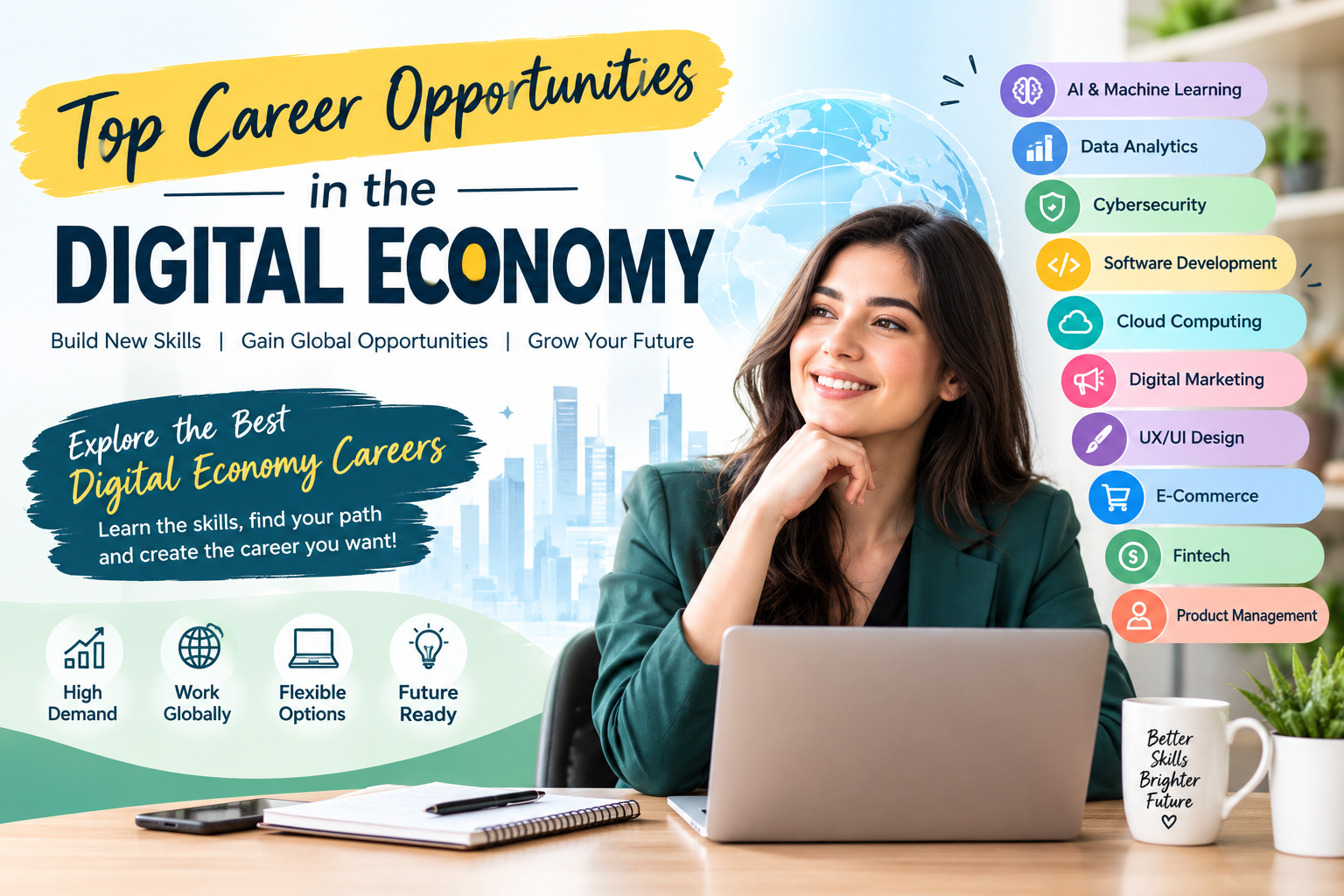
Top Career Opportunities in the Digital Economy
The digital economy is creating new ways to build a career, earn income, work internationally, and develop skills that can transfer across industries. Some of the strongest Digital Economy Careers combine technical knowledge with problem-solving, communication, business understanding, creativity, and data skills.
You do not need to become a programmer to participate in this environment. Digital Economy Careers now exist in artificial intelligence, cybersecurity, software development, data analytics, digital marketing, cloud computing, e-commerce, financial technology, user experience, and product management.
This guide explains the most important Digital Economy Careers, the skills they require, who they may suit, and practical ways to start building experience.
What Is the Digital Economy?
The digital economy includes economic activity that depends heavily on digital technologies, online platforms, data, software, connected systems, and internet-based services. It includes technology companies as well as businesses in banking, retail, education, healthcare, manufacturing, logistics, media, and professional services.
Because almost every major industry now uses digital systems, Digital Economy Careers are no longer limited to technology companies. A cybersecurity analyst may work for a bank, a data professional may work for a retailer, and a digital marketer may work for a healthcare company.
Why Digital Economy Careers Matter
Organizations increasingly need people who can build, manage, secure, analyze, market, improve, and operate digital products and services. This demand makes Digital Economy Careers relevant to people with technical, creative, analytical, and business-focused strengths.
Artificial intelligence and automation are also changing how many tasks are completed. Professionals do not always need advanced AI expertise, but people pursuing Digital Economy Careers can benefit from understanding how technology affects their field and how to use new tools responsibly.
Strong careers in this space usually reward a combination of specialist knowledge and adaptable skills such as communication, analytical thinking, creativity, collaboration, and continuous learning.
Top Career Opportunities in the Digital Economy
| Career Area | Core Skills | Suitable For | Typical Entry Route |
|---|---|---|---|
| Artificial Intelligence and Machine Learning | Python, data, mathematics, AI tools | Analytical and technical learners | Courses, projects, degree programs, internships |
| Data Analytics and Data Science | Excel, SQL, statistics, visualization | People who enjoy working with information | Portfolio projects, certificates, junior analyst roles |
| Cybersecurity | Networks, security, risk, systems | Detail-oriented problem solvers | Labs, certifications, IT support, internships |
| Software Development | Programming, databases, testing | Logical and creative problem solvers | Projects, computer science, bootcamps, internships |
| Cloud Computing | Cloud platforms, networking, Linux, automation | Technical infrastructure learners | Cloud training, labs, IT experience |
| Digital Marketing | SEO, content, analytics, advertising | Creative and commercially minded people | Personal projects, internships, freelance work |
| UX and UI Design | User research, wireframing, design systems | Creative problem solvers | Design portfolio, courses, practical projects |
| E-Commerce | Online retail, analytics, merchandising, marketing | Business-focused digital professionals | Store projects, marketing, operations experience |
| Fintech | Finance, technology, data, compliance | People interested in finance and technology | Finance, technology, analytics, or business training |
| Digital Product Management | Strategy, communication, analytics, product development | Organized cross-functional thinkers | Business, technology, design, or project experience |
These career paths differ in technical depth, entry requirements, and daily responsibilities, so choosing the right path should depend on your strengths and long-term goals.
1. Artificial Intelligence and Machine Learning
Artificial intelligence is becoming part of software development, customer service, analytics, marketing, research, operations, and finance. Within the digital job market, AI and machine learning can suit people who enjoy technical problem-solving, data, experimentation, and continuous learning.
Career opportunities can include AI engineer, machine learning engineer, AI product specialist, automation specialist, data scientist, AI researcher, and AI implementation consultant.
Skills That Can Help
- Python programming
- Statistics and probability
- Data preparation
- Machine learning concepts
- Generative AI tools
- Prompt design and evaluation
- Model testing
- Problem-solving
Not every AI-related role requires advanced mathematics or model development. Businesses also need people who understand how to apply AI responsibly to real workflows while checking accuracy, privacy, data protection, and appropriate human oversight.

2. Data Analytics and Data Science
Organizations generate large amounts of information through sales, websites, operations, customer interactions, finance, and logistics. Data-focused roles help turn that information into useful business decisions.
Data analytics can be an accessible technical path because beginners can gradually build skills using spreadsheets, SQL, visualization tools, and practical datasets. A strong portfolio can include dashboards, business reports, SQL projects, data-cleaning exercises, and clearly explained recommendations.
3. Cybersecurity
As companies depend more heavily on digital systems, cybersecurity has become an important part of the digital workforce. Professionals in this field help protect networks, applications, devices, identities, and business information.
Potential Cybersecurity Careers
- Security analyst
- Security operations center analyst
- Penetration tester
- Cloud security specialist
- Identity and access management specialist
- Governance, risk, and compliance professional
- Security engineer
Beginners can start with networking, operating systems, security fundamentals, access control, common cyber threats, and basic incident response. Hands-on practice in authorized labs can provide useful evidence of technical ability.
4. Software Development
Software development remains one of the most established technology career paths. Businesses need websites, applications, mobile products, internal systems, integrations, APIs, automation, and enterprise software.
Popular development paths include front-end, back-end, full-stack, mobile development, software testing, DevOps, and application integration. Beginners should usually choose one practical path and build complete projects instead of trying to learn every programming language at once.
5. Cloud Computing
Many organizations use cloud infrastructure to host applications, store information, run business systems, manage databases, and scale services. Cloud-focused roles can include cloud support, administration, engineering, architecture, DevOps, site reliability, and cloud security.
Useful foundations include networking, Linux, infrastructure concepts, automation, security, and hands-on experience with major cloud platforms. Practical labs are valuable because employers often want evidence that candidates understand how cloud services work in real environments.
6. Digital Marketing
Digital marketing combines communication, technology, data, creativity, psychology, and business strategy. It is a career area that can suit people who prefer commercial and creative work rather than deeply technical roles.
Specializations include search engine optimization, content marketing, paid advertising, email marketing, social media marketing, conversion optimization, marketing analytics, and marketing automation.
Practical experience can be developed through personal websites, sample campaigns, content optimization, analytics projects, or work for small organizations. Strong marketers increasingly combine creativity with measurable business results.
7. UX and UI Design
UX and UI design are creative digital career paths focused on making websites, software, applications, and digital products easier and more useful for people.
Useful skills include user research, wireframing, prototyping, visual hierarchy, accessibility awareness, design systems, usability testing, and communication with developers. A portfolio should explain the problem, the design process, important decisions, and the intended outcome rather than showing attractive screens alone.
8. E-Commerce
E-commerce is another area where digital career paths combine business and technology. Potential roles include e-commerce specialist, marketplace manager, store manager, online merchandising specialist, conversion specialist, operations coordinator, and e-commerce analyst.
Important skills include online store management, product listing optimization, customer experience, digital advertising, conversion analysis, inventory coordination, marketplace management, and retention marketing.
9. Financial Technology
Financial technology, or fintech, combines finance with software, digital payments, data, mobile applications, automation, cybersecurity, and online banking technologies. Fintech-related Digital Economy Careers can appear in banks, payment companies, insurance technology, investment services, lending platforms, and financial software businesses.
Career areas include product management, financial data analysis, software development, risk analysis, compliance technology, payment operations, cybersecurity, and fraud prevention.
10. Digital Product Management
Product management is one of the cross-functional Digital Economy Careers because product managers often work with engineers, designers, marketers, analysts, customers, and business leaders.
The role can involve understanding customer problems, defining priorities, coordinating product development, measuring performance, and communicating product strategy. Experience in business analysis, software, design, marketing, or project management can provide a useful route into product work.
11. Digital Sales and Business Development
Not all Digital Economy Careers require coding. Technology sales and digital business development can suit people with strong communication, relationship-building, presentation, negotiation, and commercial skills.
Professionals in these roles help companies find customers, understand business problems, explain digital solutions, negotiate agreements, and manage accounts. Product understanding is especially important in business-to-business technology sales.
12. Digital Content and Creative Careers
Writers, editors, video professionals, designers, creative strategists, content producers, and technical writers can also build Digital Economy Careers. However, professionals can strengthen their position by moving beyond basic content production into strategy, audience research, storytelling, creative direction, analytics, and subject-matter expertise.
The goal is to understand not only how to create content but also why it is being created and how it contributes to a business or audience objective.

13. Automation and No-Code Technology
Automation and low-code tools are expanding the range of Digital Economy Careers available to people who enjoy technology and process improvement but may not want to become traditional software developers.
Potential roles include automation specialist, workflow consultant, operations analyst, CRM specialist, process improvement professional, and business systems administrator. These roles often require the ability to understand business processes and connect different tools efficiently.
Which Digital Economy Careers Are Right for You?
The best Digital Economy Careers for you depend on your interests, strengths, education, preferred working style, and willingness to learn. Instead of choosing a field only because it is popular, consider the type of work you naturally enjoy.
- If you enjoy numbers and patterns: consider data analytics, business intelligence, fintech, or data science.
- If you enjoy building things: consider software development, cloud engineering, or automation.
- If you enjoy solving security problems: consider cybersecurity.
- If you enjoy creativity: consider UX design, digital marketing, content strategy, or brand-related digital work.
- If you enjoy business and technology: consider product management, e-commerce, fintech, digital sales, or business analysis.
- If you enjoy systems and infrastructure: consider cloud computing, DevOps, or IT operations.
Skills Needed for Digital Economy Careers
Different Digital Economy Careers require different technical knowledge, but several abilities can support long-term professional success across many fields.
Digital Literacy
Understand the systems commonly used in your profession, including collaboration platforms, databases, analytics tools, cloud software, AI-assisted tools, and industry-specific applications.
AI Literacy
Learn what AI tools can and cannot do. Understand how to provide useful instructions, evaluate results, verify information, protect confidential data, and decide when human judgment is necessary.
Data Literacy
You do not need to become a data scientist, but understanding basic data can improve decision-making. Learn how to read reports, understand metrics, identify patterns, and question misleading conclusions.
Communication
Technical knowledge becomes more useful when you can explain ideas clearly to colleagues, managers, customers, and nontechnical stakeholders.
Problem-Solving and Adaptability
Digital tools change frequently. People building Digital Economy Careers should learn broad concepts and problem-solving methods that remain useful even when individual platforms or tools change.
How to Start a Career in the Digital Economy
- Choose one direction. Select a career area rather than trying to study every digital skill at once.
- Study real job descriptions. Identify the skills and tools employers repeatedly request.
- Learn the fundamentals. Use structured courses, documentation, books, tutorials, or formal education.
- Practice regularly. Apply what you learn through exercises and realistic projects.
- Create portfolio evidence. Show what you can build, analyze, design, improve, or manage.
- Improve your professional profile. Update your resume, LinkedIn profile, portfolio, and relevant professional accounts.
- Gain practical experience. Look for internships, junior positions, freelance work, volunteer projects, apprenticeships, or internal projects.
- Build professional relationships. Connect with people working in your target field and learn from their experience.
- Apply strategically. Focus on roles that reasonably match your current skill level.
- Continue learning. Review your skills as technology and employer requirements change.
Following this process can make Digital Economy Careers more accessible because it turns a broad goal into practical steps and evidence of ability.
Do You Need a University Degree?
A university degree can be valuable, and some employers or professions may require one. However, entry requirements across Digital Economy Careers vary significantly.
Some employers place substantial value on portfolios, technical tests, certifications, previous experience, practical projects, and demonstrated ability. Before investing in a qualification, review actual job requirements in the market where you want to work.
Remote Work and the Digital Economy
Many Digital Economy Careers can potentially support remote or hybrid work because the work takes place through computers, software, communication tools, and online systems. However, remote work should not be assumed for every position.
Professionals seeking remote opportunities should develop strong written communication, independent work habits, time management, digital collaboration skills, and the ability to document work clearly.
Freelancing in the Digital Economy
Freelancing can provide another route into Digital Economy Careers. Common freelance services include development, design, marketing, writing, analytics, automation, virtual assistance, consulting, and e-commerce support.
Successful freelancing also requires client communication, pricing, project management, expectation setting, proposal writing, financial organization, and professional reliability.
Common Mistakes to Avoid
Trying to Learn Everything
Moving between programming, cybersecurity, marketing, design, AI, and data every few weeks can prevent you from developing useful depth.
Collecting Courses Without Building Projects
Courses provide knowledge, but projects provide evidence. Apply what you learn instead of only collecting certificates.
Following Trends Without Understanding the Work
Popular Digital Economy Careers may still be unsuitable for your interests or preferred working style. Research real responsibilities before committing significant time or money.
Ignoring Communication Skills
Digital professionals often work with clients, managers, customers, designers, developers, analysts, and other teams. Clear communication can significantly improve professional effectiveness.
Depending Too Heavily on One Tool
Software platforms change. Learn underlying concepts so that your knowledge remains useful when a specific tool becomes less important.
Using AI Without Verification
AI-generated output can contain inaccurate or inappropriate information. Review results carefully, protect sensitive information, and apply professional judgment.

Expert Tips for Building a Strong Digital Career
- Develop a skill combination. Combine complementary areas such as marketing and analytics or cybersecurity and cloud computing.
- Create measurable portfolio projects. Explain the problem, your approach, tools used, and results.
- Learn from job descriptions. Use them to understand practical skills, tools, and responsibilities.
- Understand business value. Learn how your work contributes to revenue, efficiency, security, customer satisfaction, or operational performance.
- Keep an achievement record. Document completed projects, responsibilities, improvements, and measurable outcomes.
- Review your skills regularly. Compare your abilities with changing professional requirements.
For long-term success in Digital Economy Careers, depth in a useful area is generally more valuable than superficial familiarity with every new trend.
Frequently Asked Questions
What are the best Digital Economy Careers?
The best Digital Economy Careers depend on your abilities and goals, but major options include artificial intelligence, data analytics, cybersecurity, software development, cloud computing, digital marketing, UX design, e-commerce, fintech, automation, and digital product management.
Which digital career is easiest to start?
There is no universally easiest option. Digital marketing, entry-level data analytics, e-commerce, basic web development, IT support, and some design roles may offer accessible starting points because beginners can build practical projects independently.
Which skills are most useful for Digital Economy Careers?
Useful skills for Digital Economy Careers include digital literacy, AI literacy, data analysis, communication, problem-solving, cybersecurity awareness, technological adaptability, and profession-specific technical knowledge.
Can I build a digital career without coding?
Yes. Digital marketing, UX research, e-commerce, technology sales, product operations, project management, content strategy, customer success, and several business-focused technology roles may require little or no programming.
Will AI replace digital jobs?
AI is likely to automate or change some tasks while creating new workflows and areas of specialization. Professionals can respond by developing AI literacy, domain knowledge, judgment, communication, and problem-solving skills.
How can a beginner get experience in the digital economy?
Start with practical projects, internships, volunteer work, freelance assignments, apprenticeships, student projects, or junior roles. A portfolio that demonstrates real skills can strengthen applications for Digital Economy Careers.
Conclusion
The digital economy offers opportunities for people with many different strengths. Technical professionals can pursue software, cloud computing, cybersecurity, artificial intelligence, and data. Creative professionals can move into design, content strategy, and marketing, while business-focused professionals can explore e-commerce, fintech, technology sales, automation, and product management.
The strongest Digital Economy Careers are built by choosing a clear direction, developing relevant skills, gaining practical experience, creating evidence of your ability, and adapting as technology changes.
Start with one field that matches your strengths and interests. Research employer requirements, learn the fundamentals, complete meaningful projects, and gradually build professional experience. With a focused approach, Digital Economy Careers can provide multiple routes for long-term professional development in a technology-driven economy.
**Note:** Exact-match keyword count **30** rakha gaya hai. Is se keyword prominent rahega, lekin maine unnecessary back-to-back repetition avoid ki hai.