
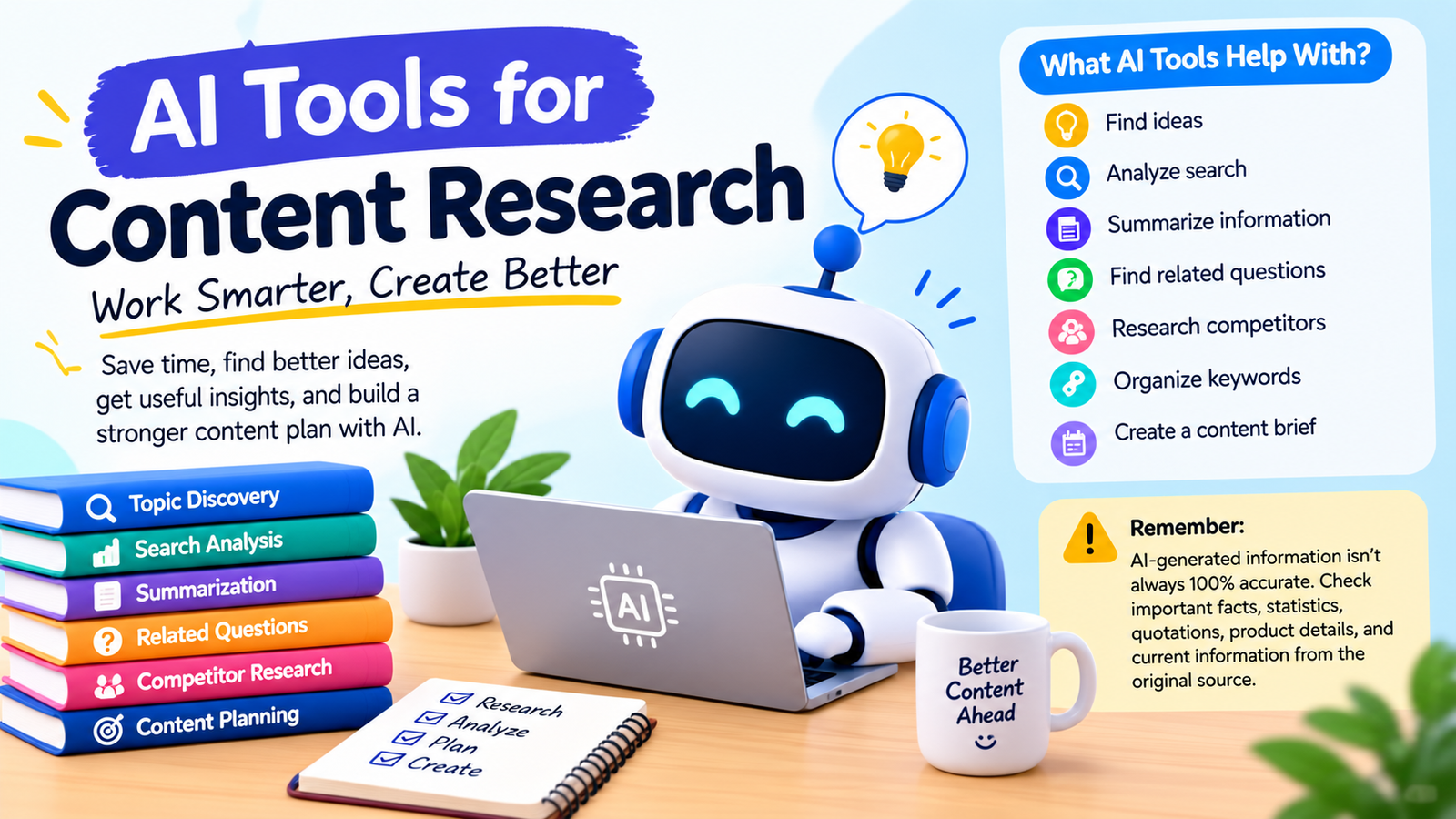
Content research can take hours when you manually search websites, compare sources, organize notes, and identify useful topics. AI tools for content research can speed up this process by helping you discover ideas, summarize information, find related questions, organize research, and create a clear content brief. The key is to use AI as a research assistant rather than treating its output as automatically accurate.
This guide explains how to use AI tools for content research effectively for faster content research, where they can save time, how to verify information, and how to turn research into a useful SEO content plan.
What Are AI Tools for Content Research?
AI tools for content research are software applications that use artificial intelligence to help with tasks such as topic discovery, search analysis, summarization, question research, competitor research, keyword organization, and content planning.
Instead of opening dozens of pages and manually collecting every useful point, you can use AI tools for content research to organize the initial research and highlight areas that deserve closer attention.
However, AI-generated information should not automatically be considered a verified source. For important facts, statistics, quotations, product details, and current information, check the original source before publishing.
Why Use AI for Faster Content Research?
The biggest advantage of using AI tools for content research is that they can reduce repetitive work. They can help you move from a broad topic to a structured research plan more quickly.
- Generate topic ideas: Discover related subjects, subtopics, and questions readers may search for.
- Organize information: Turn scattered research into categories, outlines, or content briefs.
- Summarize long material: Quickly identify the main points of lengthy documents or webpages.
- Find content gaps: Identify questions or subtopics that existing content may not cover clearly.
- Build keyword groups: Organize primary, secondary, long-tail, and semantic keywords around a topic.
- Speed up competitor research: Analyze common themes and content structures without copying another website.
The goal is not to remove human research. It is to spend less time on repetitive tasks and more time checking facts, understanding search intent, and creating useful content.
How to Use AI Tools for Content Research
A simple research workflow can make AI tools for content research much more useful. Instead of asking an AI tool to “research everything,” break the process into clear steps.
1. Start With a Clear Research Question
Begin with the exact information you need. A focused question usually produces more useful research than a vague prompt.
For example, instead of asking:
“Tell me about email marketing.”
Try:
“What should a beginner know before creating an email marketing strategy for a small online store?”
A specific question gives AI tools for content research a clearer purpose and makes it easier to separate useful information from general background material.
2. Generate Related Topics and Subtopics
Once you have your main topic, ask AI to identify related subtopics. This can reveal areas you may have overlooked and help you get more value from AI tools for content research.
For a topic such as “content marketing,” related research areas might include:
- Content strategy
- Audience research
- Keyword research
- Search intent
- Content formats
- Content distribution
- Content measurement
- Content optimization
Use these suggestions as a research map rather than automatically turning every suggestion into an article section.

3. Research Search Intent
Search intent describes what a person is trying to accomplish when they search for something. Understanding intent helps you create content that answers the actual question behind the search. AI tools for content research can help organize possible intent types before you review the search results yourself.
Common search intent types include:
- Informational: The user wants to learn something.
- Navigational: The user wants to find a specific website, page, or brand.
- Commercial: The user is researching options before making a purchase.
- Transactional: The user is ready to complete an action, such as buying or signing up.
AI can help classify the likely intent behind a keyword, but you should also examine the actual search results. Search results provide useful evidence about the type of content users are currently being shown.
4. Build a Keyword and Topic Cluster
AI tools for content research can help turn a broad keyword into a structured topic cluster. This is useful when planning an article that needs strong topical coverage.
For example, a main topic about AI content research could include related terms such as:
- AI research tools
- AI-powered content planning
- content research workflow
- SEO research
- keyword clustering
- search intent analysis
- content gaps
- topic research
Do not use every related phrase simply because an AI tool suggests it. Choose terms that genuinely help explain the subject.
5. Summarize Reliable Sources
Long reports, research papers, documentation, and industry articles can take significant time to review. AI tools for content research can help create a preliminary summary so you can identify which sections deserve deeper attention.
A useful workflow is:
- Find a reliable primary or authoritative source.
- Read the title, introduction, headings, and key sections yourself.
- Use AI to summarize the material or extract specific points.
- Compare the AI summary with the original source.
- Record important facts together with their original source.
This approach is safer than copying AI-generated summaries directly into your article.
6. Find Questions Your Audience May Ask
Questions are valuable for both readers and SEO because they reveal specific information needs. Using AI tools for content research can help you generate and organize these questions before validating them with search results and other sources.
Ask AI to generate questions related to your main topic, then group them by intent. For example, an article about AI writing tools might need to address questions about accuracy, privacy, pricing, editing, research, and human review.
Search engine results, “People Also Ask” sections, forums, customer reviews, and support documentation can provide additional evidence about real user questions.
7. Identify Content Gaps
Content gaps are areas of useful information that may be missing, unclear, outdated, or poorly explained in existing content. AI tools for content research can help organize these gaps into categories for further investigation.
AI can help compare the subjects covered across several articles and organize the results into categories. You can then look for opportunities such as:
- Questions competitors do not answer clearly
- Important beginner information that is missing
- Outdated examples or terminology
- Practical steps that are difficult to find
- Common mistakes that receive little attention
- Useful comparisons between different approaches
A content gap should be based on genuine reader value, not simply on finding another keyword to add.
Best AI Tools for Different Research Tasks
Different AI-powered tools are useful for different stages of research. When choosing AI tools for content research, consider whether you need web research, summarization, keyword analysis, document analysis, or content organization.
| Research Task | Useful AI Capability | What to Check |
|---|---|---|
| Topic discovery | Idea generation and clustering | Relevance and search intent |
| Web research | Search and source summarization | Original sources and publication dates |
| Document research | Summarization and extraction | Accuracy against the document |
| Keyword research | Keyword grouping and semantic suggestions | Actual search relevance |
| Competitor research | Content comparison | Originality and factual accuracy |
| Content planning | Outlines and briefs | Completeness and reader value |
Popular AI platforms can change their features, availability, and pricing over time. Before choosing a tool for professional work, review its current documentation and official pricing information.
How to Verify AI Research Before Publishing
Fast research is only useful when the information is reliable. AI tools for content research can produce incorrect statements, misunderstand sources, mix information from different sources, or provide outdated details.
Use a simple verification process before publishing:
- Check important facts against the original source.
- Verify dates. A correct fact from several years ago may not describe the current situation.
- Check statistics. Confirm the number, source, date, population, and context.
- Verify quotations. Never publish a quotation unless you can confirm the original wording and source.
- Check product information. Features, prices, plans, and availability can change.
- Compare important claims. When a claim matters, look for confirmation from another reliable source.
For high-stakes topics such as health, finance, law, and safety, use authoritative sources and qualified professionals where appropriate.

Use AI to Create a Content Research Brief
One of the most practical uses of AI tools for content research is turning research into a content brief. A good brief gives the writer a clear understanding of what the article needs to accomplish.
A useful content research brief can include:
- Primary topic
- Primary keyword
- Search intent
- Target audience
- Reader’s main problem
- Secondary keywords
- Related questions
- Important entities
- Recommended headings
- Evidence and source notes
- Examples to include
- Potential content gaps
- Internal linking opportunities
This turns research into an actionable plan instead of leaving you with a large collection of disconnected notes.
How to Write Better AI Research Prompts
The quality of AI-assisted research often depends on the quality of the instructions you provide. A useful prompt should define the topic, audience, task, format, and limitations.
For example:
“Research the main questions beginners have about content research. Group the questions by search intent and separate factual questions from questions that require current information. Suggest authoritative source types for verifying important claims.”
You can make prompts more useful by specifying:
- The target audience
- The geographic market, if relevant
- The date range
- The desired output format
- The type of sources to prioritize
- Which claims require verification
Instead of asking AI to make assumptions, tell it where uncertainty matters. This makes AI tools for content research more useful for practical SEO workflows.
Common Mistakes When Using AI for Content Research
Trusting AI Without Verification
An AI-generated answer can sound confident even when a detail is incorrect. Always verify important claims before publication, even when the information comes from AI tools for content research.
Using AI Research as the Final Source
AI is a research assistant, not automatically the original source. When possible, trace important information back to the official document, study, company page, government source, or other authoritative reference.
Collecting Too Many Keywords
A long list of keywords does not automatically create better content. Focus on the questions and topics that genuinely support the reader’s goal.
Copying Competitor Structures
Competitor research should help you understand what information users expect. It should not result in a rewritten copy of another website’s article.
Ignoring Content Freshness
AI tools may combine information from different periods. Always check dates when researching software, products, regulations, statistics, trends, or other topics that change frequently.
How AI Fits Into a Human Content Workflow
The most effective workflow combines automation with human judgment. AI tools for content research can handle many repetitive research tasks, while the writer remains responsible for deciding what is useful, accurate, relevant, and appropriate for the audience.
A practical workflow looks like this:
- Define the topic. Decide what question the content needs to answer.
- Explore the topic with AI. Generate subtopics, questions, entities, and possible research areas.
- Search reliable sources. Find original and authoritative information.
- Organize the findings. Group information by topic and search intent.
- Verify important claims. Check facts against original sources.
- Create the content brief. Build a clear structure based on reader needs.
- Write the article. Add original explanations, examples, and useful context.
- Edit and fact-check. Remove unsupported claims and improve clarity.
This workflow uses AI where it saves time without handing over the entire editorial process.

When AI Content Research Is Most Useful
AI tools for content research are particularly useful when you need to organize a large amount of information quickly.
- Planning blog articles
- Creating content briefs
- Finding related questions
- Grouping keywords
- Summarizing long documents
- Comparing broad topic coverage
- Creating research checklists
- Finding potential subtopics
- Preparing interview questions
- Organizing notes before writing
They are less suitable as the only research method when the subject requires precise, current, or legally significant information. In those situations, primary sources and expert review matter more than speed.
Frequently Asked Questions
What are AI tools for content research?
AI tools for content research are applications that help with topic discovery, summarization, keyword organization, search intent analysis, question research, and content planning. They can reduce repetitive research work but should not replace fact-checking.
Can AI tools replace traditional content research?
No. AI can accelerate many research tasks, but human review is still important for evaluating source quality, checking facts, understanding context, and deciding what information is useful to readers.
How can AI tools make content research faster?
AI tools can quickly generate related topics, organize keywords, summarize documents, identify questions, compare content themes, and turn research notes into a structured content brief.
How do I verify AI-generated research?
Check important claims against the original source, verify dates and statistics, confirm quotations, and use authoritative sources for sensitive or high-stakes information. This is an essential step when using AI tools for content research.
Can AI help with SEO content research?
Yes. AI tools for content research can help organize keywords, identify related topics, analyze search intent, generate content questions, and build outlines. SEO decisions should still be based on real search results, audience needs, and reliable evidence.
What should I avoid when using AI for research?
Avoid publishing unverified claims, relying on outdated information, stuffing articles with AI-generated keywords, copying competitor content, and treating confident AI output as proof that a claim is correct.
Conclusion
Using AI tools for content research can make the research process faster, more organized, and easier to manage. AI is especially useful for discovering subtopics, grouping keywords, summarizing information, finding questions, and creating content briefs.
The most reliable approach is to combine AI speed with human judgment. Use AI tools for content research to organize and accelerate research, then verify important information through original and authoritative sources. When you follow that workflow, you can spend less time on repetitive research and more time creating accurate, useful content that meets the reader’s actual needs.