
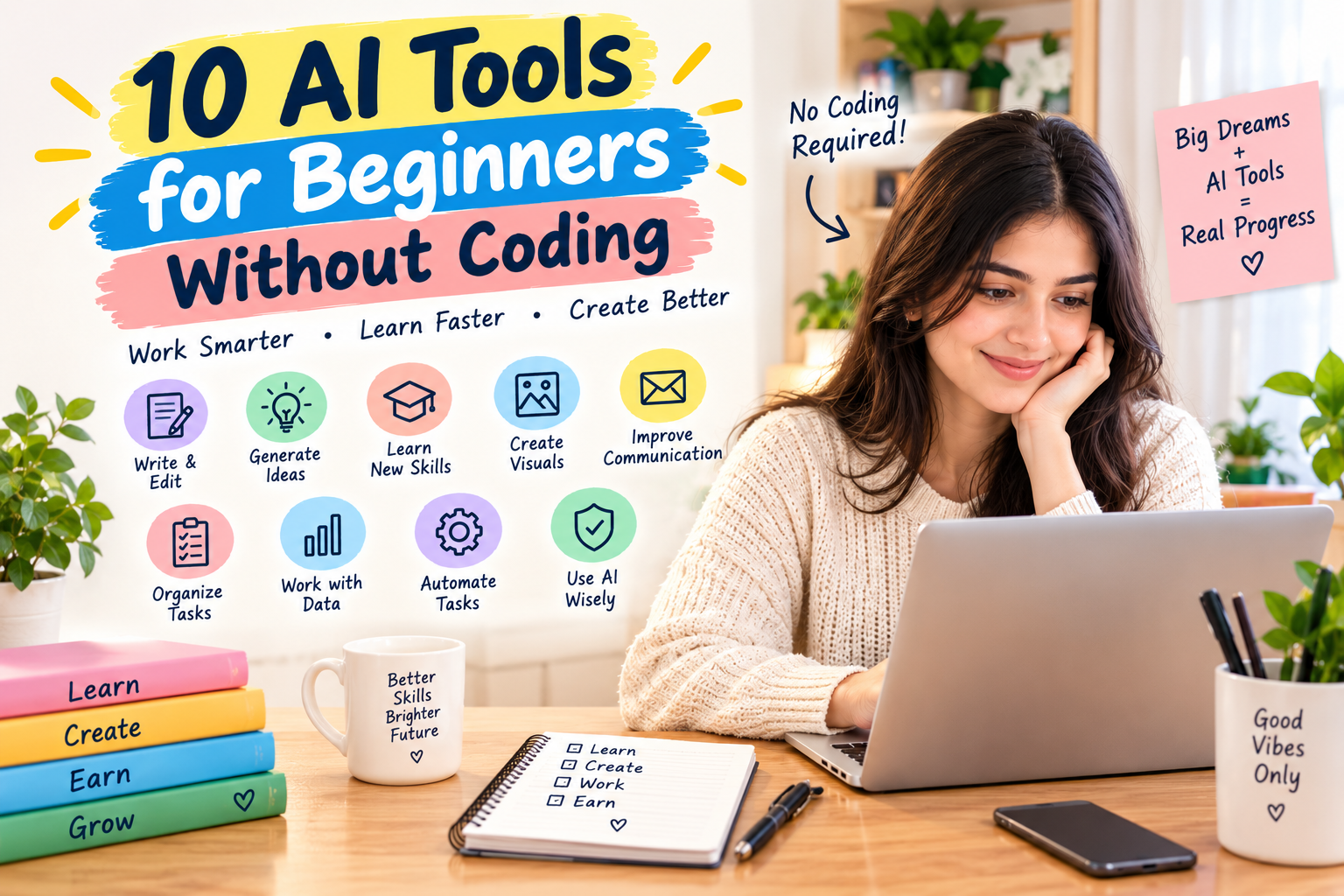
AI tools are no longer limited to programmers or technology experts. With the right approach, AI tools for beginners without coding can help anyone write content, learn new skills, organize work, generate ideas, analyze basic information, and save time. You do not need to understand programming to get useful results from modern AI applications.
For beginners, AI tools for beginners without coding provide a simple way to explore artificial intelligence through everyday tasks. Instead of learning complex programming languages, users can interact with AI through natural-language instructions.
This guide explains 10 practical ways to use AI tools for beginners without coding, what each method is good for, and how to avoid common mistakes that can lead to inaccurate or low-quality results.
Quick Summary
- Use AI tools for beginners without coding to create and improve written content.
- Summarize long documents, articles, and notes.
- Generate ideas for work, business, study, and personal projects.
- Use AI as a learning assistant.
- Create basic visual and creative content.
- Improve emails, resumes, and professional communication.
- Organize tasks, notes, and information.
- Work with simple data and spreadsheets.
- Reduce repetitive tasks with simple automation.
- Use AI as a second opinion rather than an unquestioned authority.
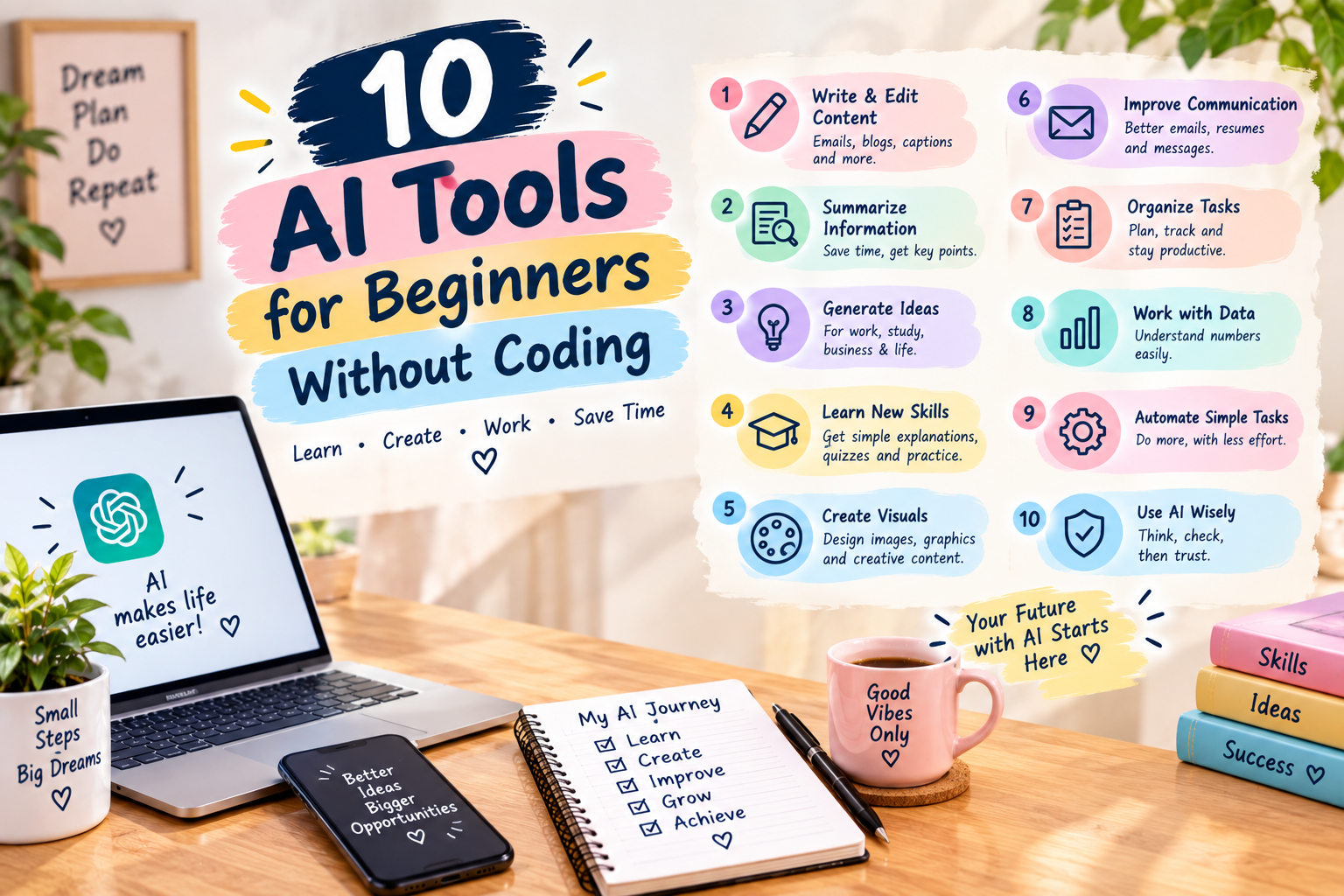
1. Use AI for Writing and Editing
One of the easiest ways to start using AI tools for beginners without coding is to use them as writing anassistts. You can ask an AI application to draft an email, rewrite a paragraph, improve grammar, create product descriptions, or turn rough notes into organized content.
For people exploring AI tools for beginners without coding, writing is an excellent starting point because you can immediately see how small changes to your instructions affect the output.
For example, instead of asking for a vague article, provide the topic, audience, desired tone, length, and important points. More specific instructions usually make the output easier to use.
Useful Writing Tasks
- Drafting emails and business messages
- Improving grammar and sentence structure
- Creating social media captions
- Writing product descriptions
- Summarizing meeting notes
- Turning bullet points into a polished document
Always review AI-generated writing before publishing or sending it. AI can misunderstand context, introduce errors, or produce wording that does not match your voice.
2. Summarize Long Information
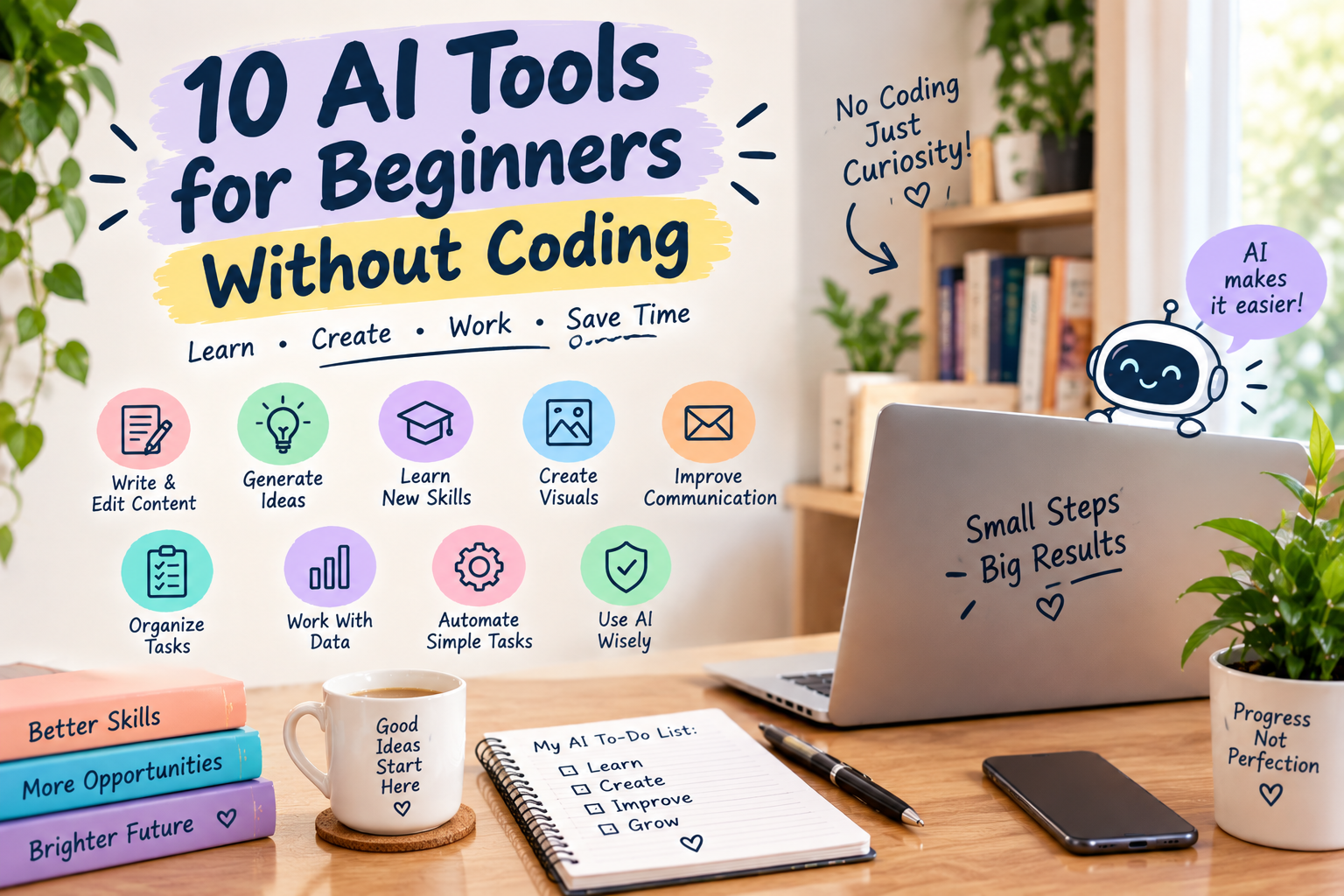
AI tools for beginners without coding can reduce the time required to understand large amounts of text. You can provide a document, article, meeting notes, or another supported source and ask for a summary of the most important information.
A useful approach is to request a specific format. For example, ask for five key points, important action items, or a short summary written for a beginner.
This is one of the most practical uses of AI tools for beginners without coding for students, employees, researchers, business owners, and anyone who regularly works with lengthy information.
Before relying on a summary for an important decision, check the original source to make sure important details or qualifications were not left out.
3. Generate Ideas When You Are Stuck
Starting from a blank page can be difficult. AI tools for beginners without coding can act as brainstorming partners by generating possible ideas that you can review and improve.
You might ask for blog topics, business ideas, product names, marketing angles, video concepts, presentation topics, or solutions to a specific problem.
For beginners, AI tools for beginners without coding are especially useful during the early stages of a project because they can quickly provide different directions to consider.
The goal is not to accept every suggestion. Instead, use AI to expand your options and then apply your own judgment to select the strongest ideas.
4. Learn New Skills with AI
AI tools for beginners without coding can make learning more interactive by explaining concepts in different ways. If a subject feels difficult, ask for a simple explanation, an example, a step-by-step breakdown, or practice questions.
For example, a beginner learning Excel could ask an AI assistant to explain formulas using a simple business example. Someone learning marketing could ask for a basic explanation of search intent, followed by a practical exercise.
AI Tools Without Coding for Learning
You do not need programming knowledge to use AI tools for beginners without coding as a personal study assistant. The key is to tell the tool your current skill level and explain exactly what you are trying to understand.
You can also ask AI to create quizzes, practice exercises, flashcards, study plans, or alternative explanations when the first explanation is difficult to understand.
However, AI should support learning rather than replace it. Check important facts against reliable sources, especially when studying technical, legal, financial, or academic subjects.
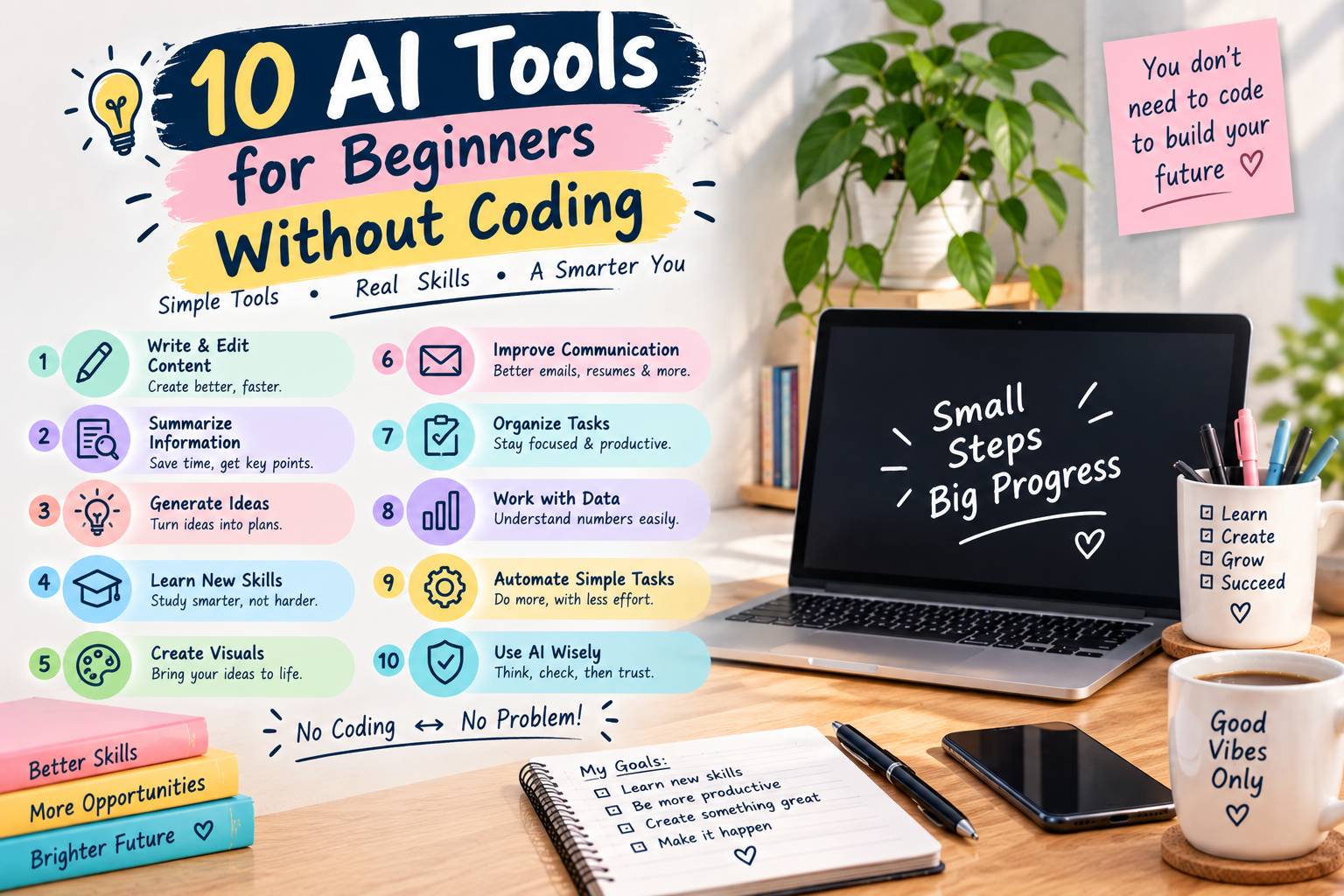
5. Create Basic Visual and Creative Content
Many modern AI services can help users create or modify visual content through simple text instructions. For beginners, AI tools for beginners without coding can be useful for concepts, illustrations, marketing graphics, presentation ideas, or social media visuals.
This is useful for people who do not have advanced design skills. Instead of learning complex software immediately, you can describe the result you want and then refine the output.
When using AI tools for beginners without coding, describe the subject, style, purpose, dimensions, and important visual elements as clearly as possible.
For professional or commercial work, check the tool’s licensing rules, image rights, and usage terms before publishing AI-generated material.
6. Improve Professional Communication
AI tools for beginners without coding can help make everyday communication clearer and more professional. You can provide a rough message and ask the tool to make it concise, friendly, formal, persuasive, or easier to understand.
This can be useful when preparing:
- Job applications
- Cover letters
- Client messages
- Business emails
- Proposals
- Customer support replies
- Professional profiles
For freelancers and professionals, AI tools for beginners without coding can save time when handling repetitive communication while still allowing the user to review and personalize the final version.
Do not allow AI to invent qualifications, experience, achievements, or personal information. Your final message should accurately represent you.
7. Organize Your Work and Daily Tasks
Another practical use of AI tools for beginners without coding is turning unorganized information into a clear plan. You can provide a list of tasks and ask the tool to group them by priority, create a schedule, or identify the next steps.
For example, a freelancer could give AI a list of client tasks and ask it to organize them by deadline and importance. A student could turn class notes into a study plan.
AI tools for beginners without coding work best here when your instructions contain clear constraints. Mention deadlines, priorities, available time, and the result you want.
You can also use AI to break a large project into smaller tasks, create checklists, and identify tasks that may require additional information.
8. Work with Basic Data
You do not need to become a data scientist to get help with simple data tasks. Depending on the AI tool and file support available, AI tools for beginners without coding may help explain spreadsheet formulas, identify patterns, organize information, or suggest ways to structure a dataset.
For example, you could ask why a spreadsheet formula is returning an unexpected result or request an explanation of a basic calculation in simple language.
People who are new to spreadsheets can use AI tools for beginners without coding to understand formulas and basic data concepts without needing advanced technical knowledge.
Be careful when working with sensitive business, financial, customer, or personal information. Before uploading data, understand the privacy and data-handling policies of the service you are using.
9. Reduce Repetitive Work with Simple Automation
Automation can sound technical, but many no-code and low-code platforms make basic workflows accessible to beginners. AI tools for beginners without coding can also help you understand what should be automated and how a workflow could be structured.
Common examples include organizing incoming information, creating draft responses, moving data between supported applications, or generating routine content for review.
If you are new to automation, start with a small workflow. AI tools for beginners without coding can help you plan the individual steps before you build the workflow.
Start with a small workflow rather than trying to automate an entire business process at once. Test each step and keep a human review stage for tasks where mistakes could cause financial, legal, customer service, or operational problems.
10. Use AI as a Second Opinion
One of the most useful ways to use AI tools for beginners without coding is not to ask for the final answer, but to ask AI to help you think.
You can present a decision and ask the AI to identify advantages, disadvantages, risks, missing information, or alternative approaches. This can help you notice considerations that you may have overlooked.
Using AI tools for beginners without coding as a second opinion can be particularly helpful when brainstorming solutions or comparing different approaches.
For important decisions, treat AI as an assistant rather than an authority. Verify critical information through trustworthy sources and use your own judgment before taking action.
How to Get Better Results from AI
The quality of an AI response often depends on the quality of the instructions. AI tools for beginners without coding are easier to use effectively when you provide clear context instead of relying on vague requests.
You do not need a complicated prompt. A clear request with useful context is usually a better starting point.
A Simple Prompt Structure
- Role: Explain what kind of assistance you want.
- Task: Clearly describe what you need.
- Context: Provide relevant background information.
- Format: Explain how you want the answer organized.
- Constraints: Mention limits such as length, audience, tone, or deadline.
For example, instead of saying, “Write an email,” you could say, “Rewrite this email for a client. Keep it professional and friendly, make it under 120 words, and clearly explain the delivery delay.”
Learning how to write clear instructions is one of the most important skills when using AI tools for beginners without coding. If the first response is not useful, provide additional context and refine your request.
Common Mistakes Beginners Should Avoid
Using AI tools for beginners without coding effectively is not simply about generating more content. Beginners should also understand the limitations of artificial intelligence.
- Trusting every answer: AI can produce incorrect or outdated information.
- Using vague prompts: Missing context can result in generic answers.
- Publishing without editing: AI-generated content still needs human review.
- Sharing sensitive information: Review privacy policies before entering confidential data.
- Using AI for every decision: Important decisions require human judgment and appropriate verification.
- Ignoring originality: Add your own knowledge, examples, experience, and perspective where appropriate.
When using AI tools for beginners without coding, remember that convenience does not eliminate the need for human judgment.
Which AI Tasks Are Best for Beginners?
| Task | Best Use | Difficulty |
|---|---|---|
| Writing | Emails, drafts, descriptions, editing | Easy |
| Summarization | Notes, articles, documents | Easy |
| Brainstorming | Ideas and planning | Easy |
| Learning | Explanations and practice | Easy |
| Visual creation | Basic creative concepts | Easy to moderate |
| Data assistance | Simple spreadsheet and data tasks | Moderate |
| Automation | Repetitive workflows | Moderate |
These categories provide a practical starting point for anyone exploring AI tools for beginners without coding for the first time.
Frequently Asked Questions
Can beginners use AI tools without technical skills?
Yes. Many AI applications are designed around natural-language instructions, so beginners can use AI tools for beginners without coding without knowing programming.
Start with simple tasks such as writing, summarizing, brainstorming, and learning. As you become more comfortable, you can explore automation, data analysis, and other advanced features.
Do I need coding knowledge to use AI?
No. Coding is useful for advanced AI development and automation, but many everyday AI tasks can be completed through ordinary written instructions.
AI tools for beginners without coding are particularly useful for people who want practical results without learning programming first.
What is the easiest way to start using AI?
Start with one recurring task, such as writing emails or summarizing information. AI tools for beginners without coding can help you complete these tasks with simple instructions.
Give the AI clear instructions, review its response, and gradually experiment with more advanced uses.
Can AI help me earn money online?
AI can support online work such as writing, research, customer communication, design assistance, marketing, and administrative tasks. AI tools for beginners without coding can help improve productivity in these areas.
However, AI does not guarantee income. Successful online work still requires useful skills, quality output, reliability, and finding legitimate opportunities.
Is AI-generated information always accurate?
No. AI tools for beginners without coding can still produce factual or contextual mistakes.
Verify important information using reliable sources, especially for medical, legal, financial, academic, or other high-stakes topics.
How can I improve my AI prompts?
Give the tool a clear task, useful context, target audience, desired format, and important restrictions. If the first answer is not useful, refine the instructions instead of simply repeating the same request.
As you gain experience with AI tools for beginners without coding, you will learn which details produce better results for different tasks.
Conclusion
You do not need to be a programmer to benefit from AI. AI tools for beginners without coding make it possible to use artificial intelligence for practical everyday tasks without requiring advanced technical skills.
From writing and learning to brainstorming, organization, basic data work, and automation, there are many ways to use AI tools for beginners without coding to save time and improve productivity.
The most important habit is to review the output, protect sensitive information, and verify important facts before relying on them.
If you are new to artificial intelligence, start with one everyday task this week. Experiment with clear instructions, review the results, and gradually expand how you use AI tools for beginners without coding as your confidence grows.