
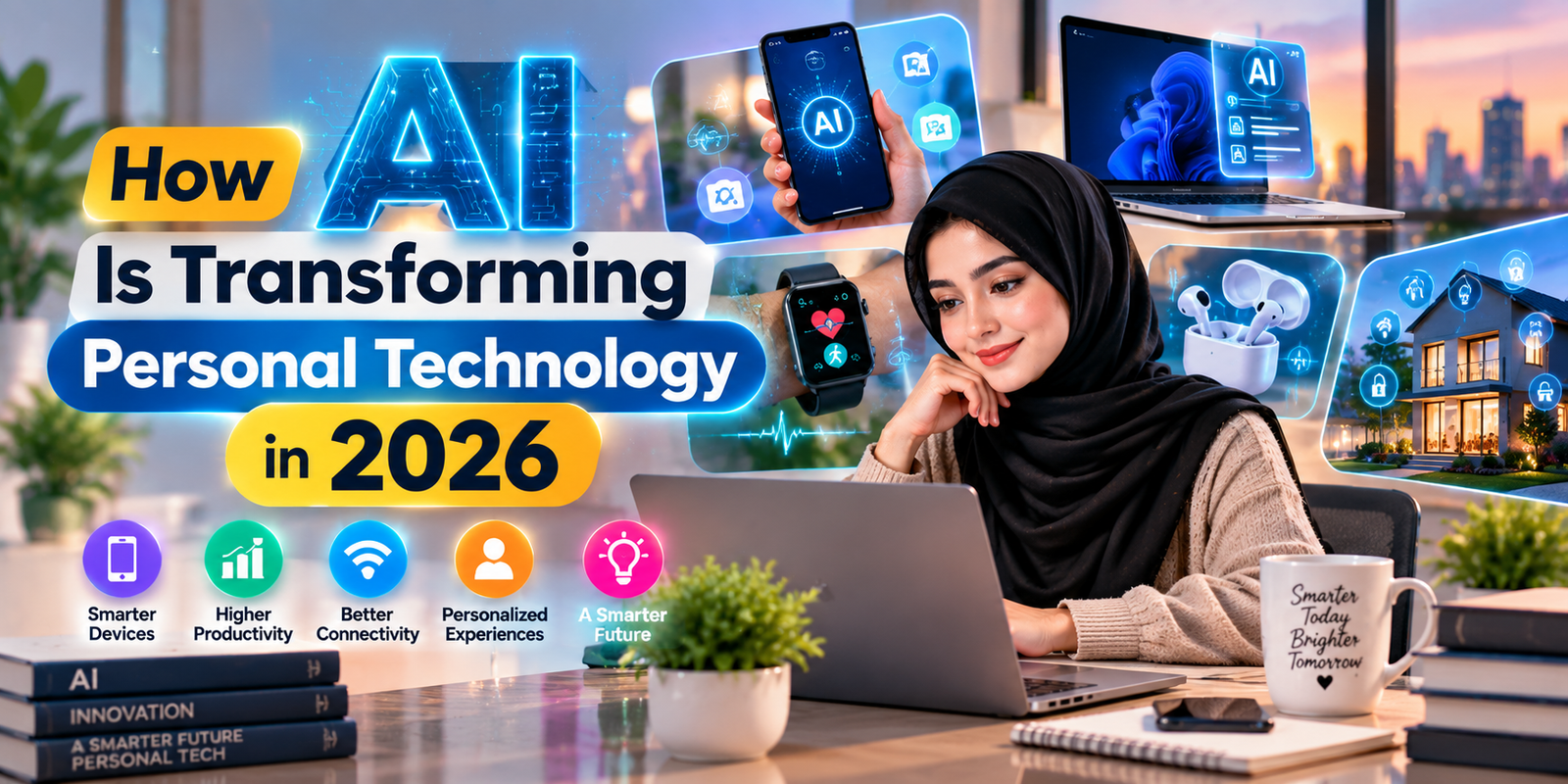
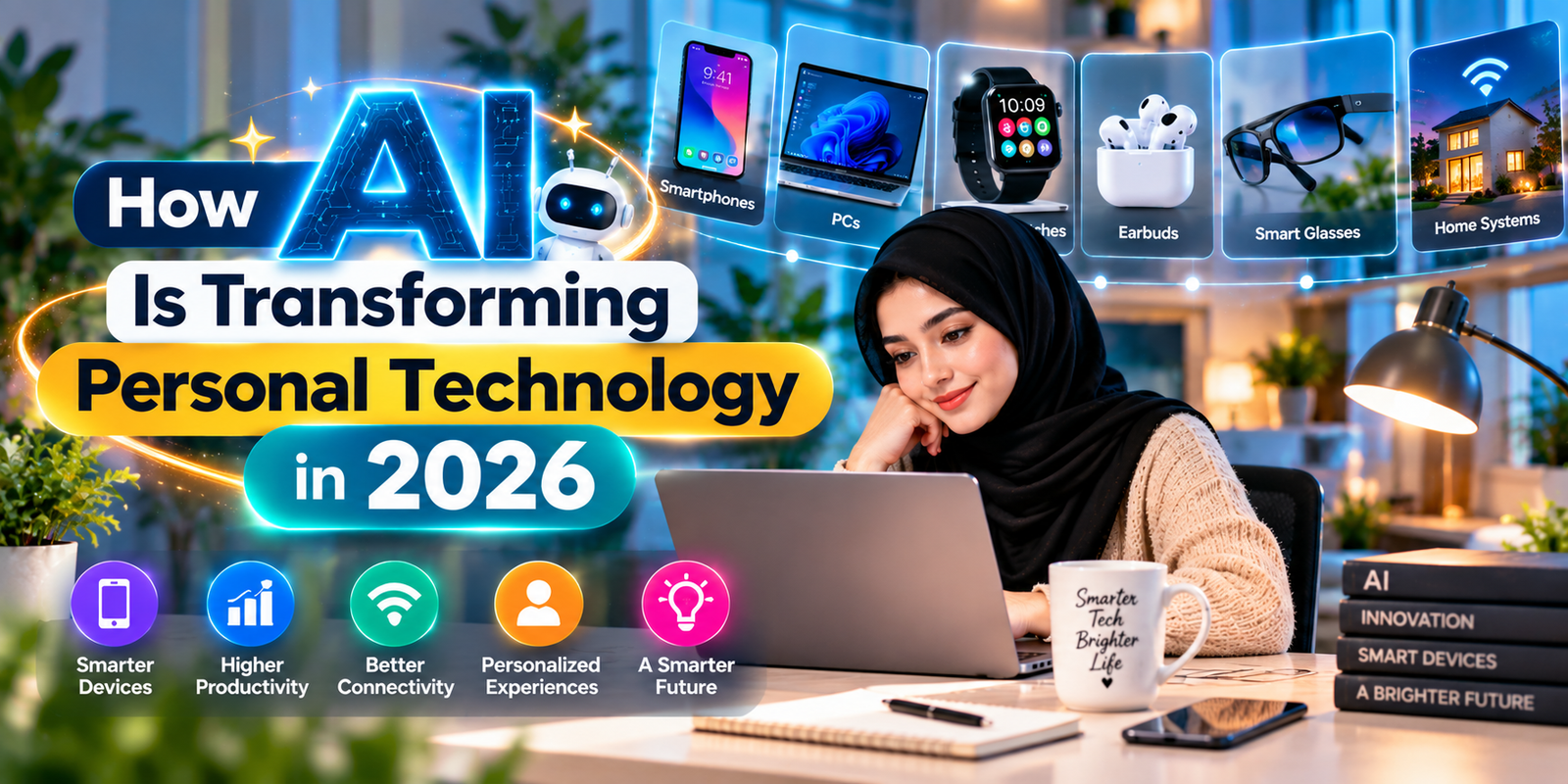
Artificial intelligence is moving beyond chatbots and standalone apps and becoming part of the devices people use every day. In 2026, AI in personal technology is increasingly appearing in smartphones, PCs, smartwatches, earbuds, smart glasses, home systems, and other connected devices. The goal is not simply to add another AI feature, but to make technology more aware of context, more responsive, and more useful in everyday situations.
Current developments show a shift toward personal AI that can work across multiple devices instead of remaining inside one application. Qualcomm describes personal AI agents that can coordinate phones, PCs, wearables, earbuds, and smart glasses, while Lenovo is also developing a cross-device approach to personal AI.
This article explains how AI in personal technology is changing the way people communicate, work, learn, manage information, use entertainment devices, and interact with their surroundings. It also looks at privacy, security, limitations, and what consumers should consider before adopting new AI-powered products.
Quick Summary
- AI is becoming a built-in capability across smartphones, computers, wearables, and smart home products.
- On-device AI can process some tasks locally, reducing the need to send every request to the cloud.
- Personal AI agents are moving toward multi-step assistance rather than simple question-and-answer interactions.
- Wearables such as smart glasses, watches, and earbuds can provide additional context for AI systems.
- AI-powered personal technology can improve productivity, accessibility, creativity, and personalization.
- Privacy, permissions, security, battery life, accuracy, and interoperability remain important considerations.
What Is AI in Personal Technology?
AI in personal technology means integrating artificial intelligence directly into consumer devices and digital experiences that people use in their everyday lives. Instead of requiring users to open a separate AI service, intelligent capabilities can be built into operating systems, applications, processors, cameras, microphones, sensors, and connected devices.
For example, an AI-enabled phone may summarize information, organize notifications, improve photographs, translate conversations, or understand what is displayed on the screen. An AI PC may assist with writing, search, meetings, content creation, and other tasks. A wearable may process voice commands or provide contextual assistance while the user is away from a keyboard.
Apple’s 2026 announcements show this direction through Apple Intelligence features integrated across products including iPhone, iPad, Mac, Apple Watch, AirPods, and Apple Vision Pro.
Why AI in Personal Technology Matters in 2026
The major change is that AI is becoming less dependent on a single application. Instead, intelligence can be distributed across several devices that a person already uses.
Qualcomm’s current personal AI vision describes an ecosystem in which phones, PCs, wearables, and other devices contribute different types of context and capabilities. Lenovo has similarly described a “one personal AI, multiple devices” approach spanning PCs, smartphones, tablets, and wearables.
This matters because people do not live inside one device. A person may begin a task on a phone, continue it on a laptop, receive a notification on a watch, and use earbuds while traveling. AI can potentially connect these experiences so the user spends less time repeating information and switching between applications.

1. Smarter Smartphones
Smartphones remain one of the most important platforms for AI in personal technology. Modern phones contain powerful processors, cameras, microphones, sensors, connectivity hardware, and operating systems that can support increasingly sophisticated AI experiences.
AI can assist with tasks such as photo editing, transcription, translation, writing, search, summarization, voice interaction, and organization. Instead of treating each function as a separate tool, future smartphone experiences are increasingly designed around understanding the user’s intent.
Context-Aware Assistance
Context is becoming an important part of personal AI. An assistant may consider information such as what is displayed on the screen, what the user is discussing, or which application is being used. The objective is to reduce the number of steps needed to complete a task.
Apple’s announced Siri AI, for example, includes personal context understanding, onscreen awareness, and integration across several Apple products.
However, context-aware assistance also requires careful permission management. Users should understand what information an AI system can access before enabling deeper personalization.
2. AI PCs Are Changing Personal Computing
Another major development in AI in personal technology is the rise of AI PCs. These computers are designed with hardware capable of running certain AI workloads locally, often using a dedicated neural processing unit, or NPU.
Local processing can be useful for tasks that benefit from low latency or reduced dependence on an internet connection. Qualcomm’s 2026 Horizon Ultra announcement, for example, describes a PC designed around CPU, GPU, and NPU processing for on-device AI.
What Can AI PCs Do?
- Assist with writing and document tasks.
- Improve meeting and communication workflows.
- Support creative applications.
- Process selected AI workloads locally.
- Provide intelligent search and organization.
- Assist with accessibility features.
The value of an AI PC depends on the software as much as the hardware. A powerful NPU does not automatically make every application intelligent. Consumers should therefore evaluate the actual features and supported applications rather than buying a device based only on an AI label.
3. Personal AI Agents Are Becoming More Capable
One of the most important changes in AI in personal technology is the movement from simple assistants toward agentic systems.
A traditional assistant generally waits for a command and provides an answer. An AI agent can be designed to understand a broader goal, plan several steps, use available tools, and complete actions with appropriate permission.
For example, instead of asking an assistant to explain a meeting schedule, a future personal agent might help identify the meeting, summarize relevant information, prepare a list of tasks, and organize follow-up actions. The exact capabilities depend on the software and permissions available.
Qualcomm’s September 2026 discussion of personal AI agents describes this shift as AI moving from a tool that responds toward a collaborator that can understand intent and take action across personal devices.
4. Wearable AI Is Expanding
Smartwatches, earbuds, rings, pendants, and smart glasses are becoming important parts of AI in personal technology. These devices can remain close to the user and provide sensors or interfaces that a traditional computer cannot always offer.
Qualcomm’s Snapdragon Wear Elite platform, announced in 2026, is designed to support on-device AI processing in wearable form factors. The company says the platform can support devices such as watches, pins, and pendants.
Why Wearables Matter
Wearables can collect useful contextual signals while keeping interactions simple. A person may speak to an assistant through earbuds, receive information on a watch, or use smart glasses for hands-free assistance.
Smart glasses are particularly interesting because they can combine cameras, microphones, displays, connectivity, and AI. Qualcomm’s Snapdragon START program is designed to help manufacturers develop personal AI devices, beginning with smart glasses and supporting hybrid experiences involving devices and cloud services.
At the same time, wearable AI raises important privacy questions. Cameras and microphones can affect not only the wearer but also people nearby. Clear indicators, permissions, and responsible data practices are therefore important.
5. On-Device AI Can Improve Privacy and Speed
A significant part of AI in personal technology is the ability to run selected AI workloads directly on the device.
On-device AI means that some processing occurs locally instead of sending every request to a remote data center. This can provide benefits such as lower latency, reduced dependence on connectivity, and potentially greater control over sensitive information.
However, local processing does not mean that every AI task stays private. Many systems use a hybrid architecture in which some tasks run locally while more demanding workloads are sent to cloud infrastructure.
Qualcomm describes this approach as a combination of on-device intelligence, edge computing, and cloud resources, with different workloads handled according to their requirements.
6. AI Is Making Personal Devices More Personalized
Personalization is another important benefit of AI in personal technology. Traditional software often provides the same interface and behavior to everyone. AI systems can potentially adapt to individual preferences, routines, language, and working habits.
A personalized system could learn that a user prefers certain notification settings, writing styles, frequently used applications, or recurring workflows. Instead of manually configuring every option, the system can use available information to make more relevant suggestions.
Personalization should still remain under user control. A system that becomes more personalized should provideAI in personal technology, Personal AI, AI technology, Smart devices, AI smartphones, AI PCs, AI wearables, Personal AI agents, On device AI, Smart technology, understandable settings for reviewing, changing, or deleting relevant information.
7. AI Is Improving Photography and Video
Smartphone cameras have already benefited from computational photography, and AI in personal technology is extending these capabilities.
AI can help identify subjects, improve image quality, remove distractions, adjust lighting, organize photographs, and generate or edit visual content. These tools can make advanced editing more accessible to people without professional software skills.
Generative AI can also create new visual content from text or modify existing images. Because generated and edited media can appear realistic, users should be careful when interpreting images that lack clear context or provenance.
8. AI Is Changing How People Communicate
Communication is another area where AI in personal technology can reduce repetitive work.
AI-powered tools can help summarize long conversations, translate languages, draft messages, improve grammar, transcribe meetings, and identify important information in large amounts of text.
Real-time translation is particularly useful for travel and international communication. AI can process speech, identify language patterns, and produce translated text or audio. Results can still vary depending on accents, background noise, technical terms, and language pairs, so important communication may require human review.
9. AI Is Making Smart Homes More Responsive
The smart home is becoming another environment for AI in personal technology. Instead of controlling each device separately, AI can potentially coordinate lighting, climate, security, entertainment, and other connected systems.
A more intelligent home could respond to routines rather than waiting for individual commands. For example, it might recognize that a person is preparing for sleep and adjust connected devices according to previously approved preferences.
Qualcomm has described AI-enabled home environments that combine contextual intelligence with connected lighting, climate, security, and entertainment systems.
These systems require strong security because smart home devices can control physical equipment and may process sensitive information about household routines.
10. AI and Accessibility
Accessibility is one of the most practical areas for AI in personal technology. AI can help people interact with devices through speech, images, captions, translation, and other adaptive interfaces.
Examples include automatic transcription, image descriptions, voice interaction, text simplification, visual recognition, and personalized interfaces. These capabilities can make digital products easier to use for people with different abilities.
The quality of accessibility features depends on accuracy and thoughtful design. AI should support users without removing their ability to control important decisions or actions.
11. AI Is Becoming More Multimodal
Modern personal AI increasingly works with more than text. Multimodal systems can process combinations of text, images, audio, video, and other signals.
This is important because human interactions are naturally multimodal. A person may point at an object, speak a question, look at a screen, and receive an answer without typing a detailed prompt.
Multimodal capabilities could make AI in personal technology feel more natural because users can interact using the input method that best fits the situation.
12. Cross-Device AI Creates a More Connected Experience
The future of AI in personal technology is increasingly about ecosystems rather than individual products.
A phone may provide communication and location context. A laptop may provide a large screen and powerful computing resources. A smartwatch may provide quick notifications and sensor data. Earbuds may provide audio interaction. Smart glasses may offer hands-free visual assistance.
When these devices can securely share relevant context, users may not need to repeat the same instructions across different products.
Lenovo’s 2026 announcements describe personal AI across PCs, smartphones, tablets, and wearables, while Qualcomm has also presented a cross-device “Ecosystem of You” approach.
13. Privacy Becomes More Important
The expansion of AI in personal technology also creates a larger privacy challenge. Personal AI can become more useful when it has access to context, but more context can also mean more sensitive information.
Before enabling an AI feature, users should consider:
- What information does the system collect?
- Where is that information processed?
- How long is it retained?
- Can the user delete stored information?
- Which applications and devices can access the data?
- Can the feature be disabled?
Privacy-by-design approaches can reduce unnecessary exposure, but users should still review the privacy settings of each device and service.
14. Security Must Keep Up With Personal AI
More capable AI systems can introduce new security risks. If an AI agent can access email, files, calendars, smart home systems, or financial applications, protecting that agent becomes extremely important.
Users should prefer products with strong authentication, clear permission controls, regular security updates, and understandable privacy policies.
AI systems can also make mistakes or misunderstand instructions. High-impact actions should therefore require confirmation rather than being executed automatically whenever the consequences could be serious.
15. The Role of Cloud and Edge Computing
Modern AI in personal technology will not necessarily depend entirely on either local or cloud computing. Hybrid systems can use both.
| Approach | Main Benefit | Common Use |
|---|---|---|
| On-device AI | Fast local processing | Voice features, image processing, selected assistants |
| Edge computing | Processing closer to the user | Connected and real-time applications |
| Cloud AI | Large-scale computing resources | Complex models and demanding workloads |
| Hybrid AI | Combines multiple approaches | Personal agents and cross-device experiences |
The best architecture depends on the task. A quick voice command may benefit from local processing, while a complex request may require cloud resources.
16. What Consumers Should Look For
When buying an AI-enabled device, do not focus only on the phrase “AI-powered.” Look at what the device can actually do.
- Useful AI features: Check whether the features solve problems you actually have.
- Processing: Find out whether important AI functions work on-device, in the cloud, or both.
- Privacy: Review permissions and data policies.
- Updates: Consider how long the manufacturer supports the device.
- Compatibility: Check whether the product works with your existing devices.
- Battery life: AI workloads can affect power consumption depending on the hardware and workload.
- Reliability: Look for clear information about limitations and supported features.
17. Common Mistakes When Using AI-Powered Devices
Buying Hardware Without Checking Software
A device may have advanced AI hardware but limited useful applications. Always review the actual features available to users.
Giving AI Too Many Permissions
Convenience should not automatically mean unlimited access. Grant only the permissions needed for a specific task.
Trusting AI Without Verification
AI can generate incorrect information or misunderstand context. Verify important information before using it for financial, professional, legal, educational, or other high-impact decisions.
Ignoring Updates
AI-enabled products depend on software improvements and security fixes. Keeping devices and applications updated can help maintain security and reliability.
18. What Does the Future of AI in Personal Technology Look Like?
The next stage of AI in personal technology is likely to focus less on adding isolated AI buttons and more on creating systems that understand context and work across devices.AI in personal technology
Personal AI may become more conversational, proactive, multimodal, and connected. Instead of asking a device to perform every individual step, users may describe an outcome and allow an agent to handle several permitted tasks.AI in personal technology
That does not mean every task should become automated. Human control will remain important, especially when an action involves money, privacy, communication, security, or physical devices.AI in personal technology
The direction is already visible in 2026 announcements from major technology companies. Apple is expanding AI across its device ecosystem, Lenovo is developing personal AI across multiple form factors, and Qualcomm is focusing on personal AI agents and on-device intelligence.AI in personal technology
Frequently Asked Questions
What is AI in personal technology?
AI in personal technology refers to artificial intelligence integrated into everyday consumer devices such as smartphones, PCs, smartwatches, earbuds, smart glasses, and connected home systems. It can help devices understand information, automate tasks, personalize experiences, and respond to users more naturally.
How is AI changing smartphones in 2026?
AI is helping smartphones provide more contextual assistance, intelligent photography, writing support, translation, summarization, search, and voice interaction. Newer systems are also increasingly designed to connect AI experiences across multiple devices.AI in personal technology
Is on-device AI more private?
On-device processing can reduce the need to send some information to remote servers, which can provide privacy benefits. However, privacy depends on the complete product architecture, settings, data retention practices, and services involved. Users should review the manufacturer’s privacy information.AI in personal technology
Are AI wearables useful?
AI wearables can be useful when hands-free interaction, quick access, or contextual information matters. Smartwatches, earbuds, and smart glasses can provide different types of input and output. Their usefulness depends on battery life, software support, accuracy, privacy controls, and compatibility.AI in personal technology
Will AI replace smartphones?
There is no established reason to assume smartphones will disappear soon. Instead, current developments suggest that AI capabilities are being integrated into smartphones while also expanding into PCs, wearables, smart glasses, cars, and other devices.
What should I consider before buying an AI device?
Consider the actual AI features, supported applications, privacy controls, processing architecture, battery life, software updates, compatibility, and price. An AI label alone does not determine whether a device will be useful for your needs.AI in personal technology
Conclusion
AI in personal technology is changing the relationship between people and their everyday devices. Smartphones, PCs, wearables, smart glasses, and connected homes are increasingly gaining AI capabilities that can understand context, assist with tasks, personalize experiences, and connect information across devices.AI in personal technology
The most important development is not simply that individual products are becoming smarter. It is that personal AI is moving toward connected ecosystems in which different devices can contribute different capabilities. Current 2026 developments from Apple, Lenovo, Qualcomm, and other technology companies show that this direction is already being explored across multiple categories.AI in personal technology
For consumers, the practical approach is to focus on useful features rather than marketing labels. Evaluate privacy, security, reliability, compatibility, battery life, and real-world benefits before adopting an AI-powered device. As personal technology becomes more intelligent, the best experiences will ultimately be those that make everyday tasks simpler while keeping users informed and in control.AI in personal technology
Suggested authoritative sources: Qualcomm personal AI agents, Apple Siri AI, and Lenovo personal AI devices.