
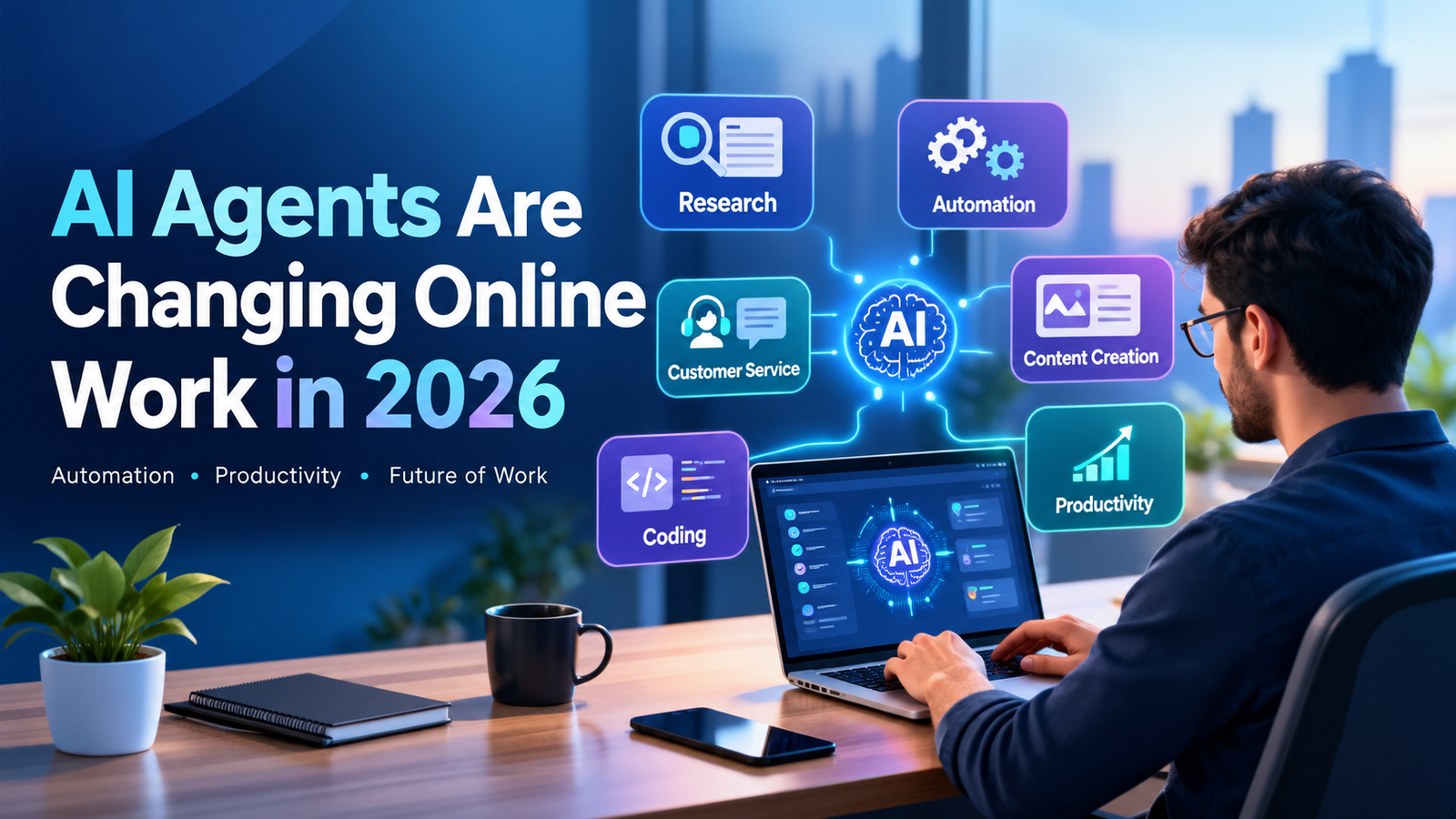
AI agents changing online work is one of the most important developments in the digital workplace in 2026. AI is moving beyond simple chat and into task execution. Instead of only answering questions, modern agents can plan multi-step tasks, use software tools, analyze information, create content, manage workflows, and complete parts of a project with limited human intervention.
This shift is changing how freelancers, employees, entrepreneurs, marketers, developers, customer-service teams, and online businesses approach everyday work. The important question is no longer just whether AI can help with a task, but which parts of a workflow should be delegated to an agent and where human judgment is still necessary.
This article explains how AI agents changing online work are being used in 2026, what benefits they offer, what risks they introduce, and how workers can adapt.
What Are AI Agents?
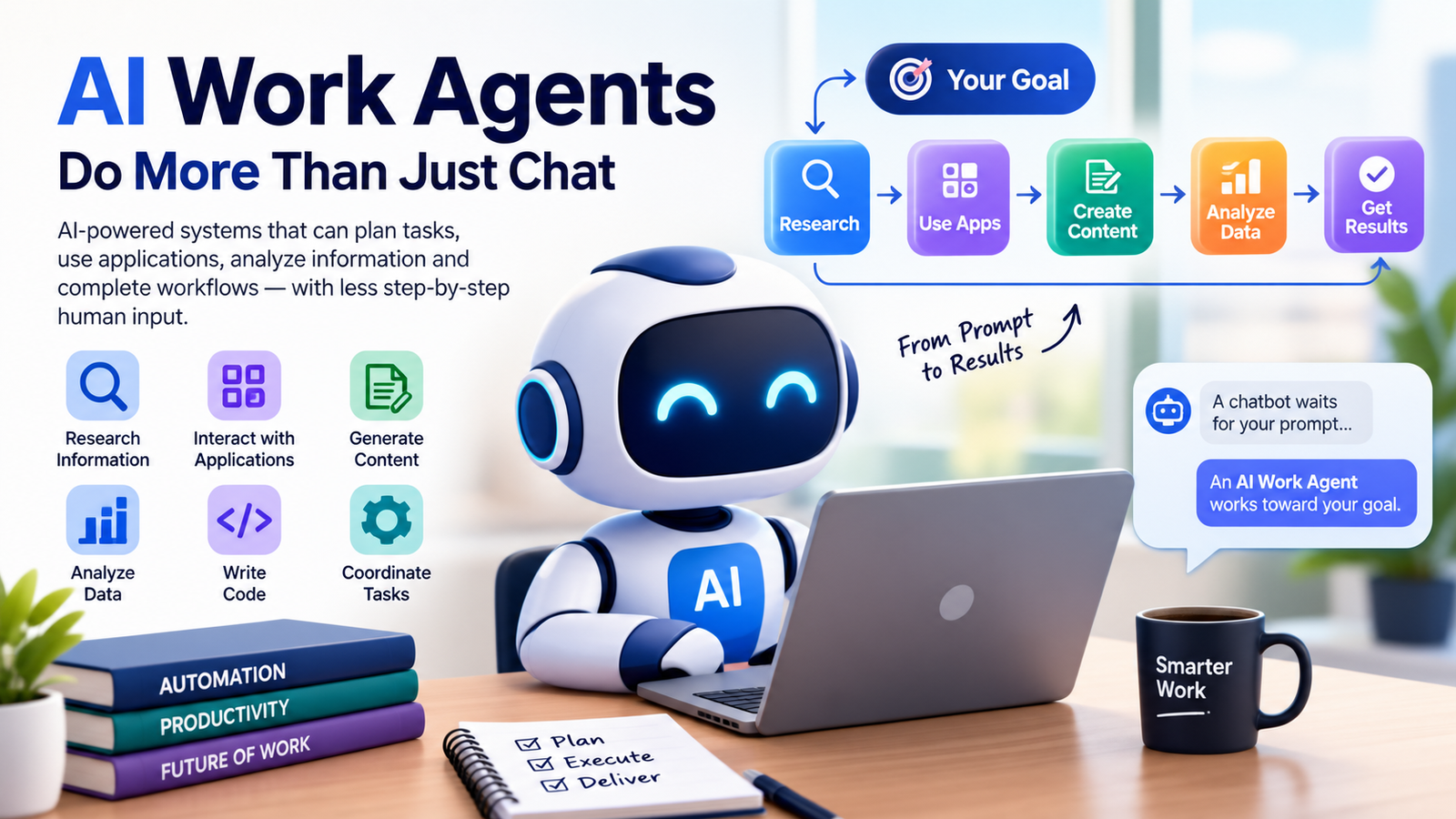
AI agents are software systems that can work toward a goal by planning actions, using digital tools, processing information, and completing multiple steps instead of responding with a single answer.
A traditional chatbot might explain how to create a spreadsheet. An AI agent may be able to gather the required data, organize it, create the spreadsheet, analyze the results, and prepare a summary.
The key difference is action. Agents are designed to operate inside a workflow rather than simply provide information.
In 2026, this distinction is becoming increasingly important because businesses are moving from basic AI assistance toward systems that can handle longer, more complex tasks. This is a major reason AI agents changing online work are receiving increased attention from businesses and digital professionals.
How AI Agents Are Changing Online Work
The biggest change is the shift from doing every task manually to delegating parts of a workflow. Workers can increasingly describe a desired outcome and allow an agent to handle several execution steps.
1. Automating Repetitive Tasks
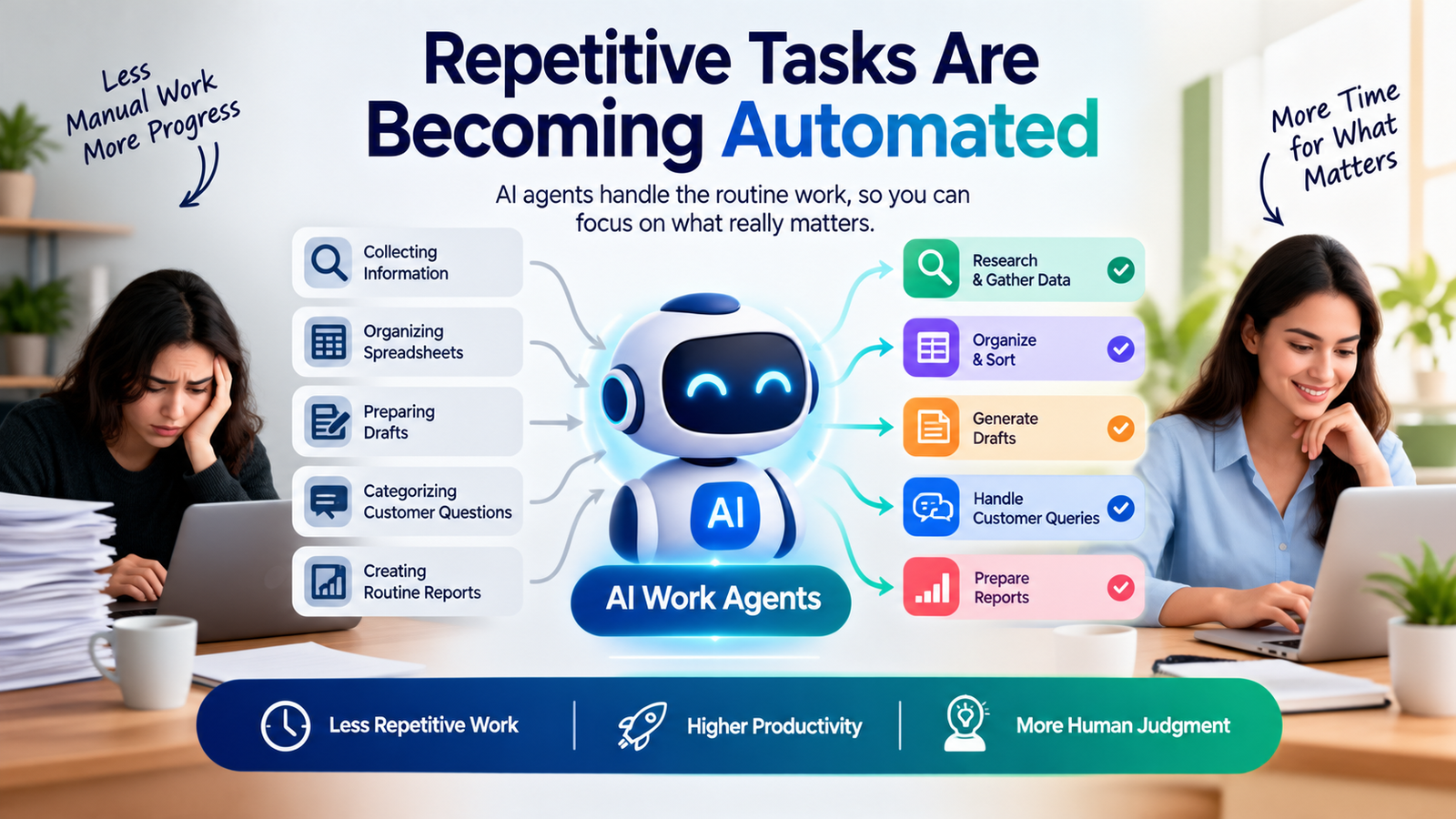
Many online jobs contain repetitive activities such as sorting information, preparing reports, organizing files, drafting routine messages, updating records, and summarizing documents.
AI agents changing online work can take over portions of these workflows, allowing people to spend more time on tasks that require judgment, communication, creativity, or decision-making.
For example, a marketing team could use an agent to collect campaign data, organize performance information, identify unusual changes, and prepare a report for human review.
2. Handling Longer Workflows
One of the most important developments in 2026 is the ability of agents to work on tasks that require multiple steps.
Research from OpenAI reports that users increasingly delegate work estimated to take more than 30 minutes, one hour, and even several hours of human effort to agentic systems.
This creates a different working model. Instead of asking AI one question at a time, a user can assign a broader objective and review the resulting work. This is another important way AI agents changing online work can alter everyday digital workflows.
3. Supporting Remote and Online Teams
Remote teams depend heavily on digital tools, making them a natural environment for AI agents.
An agent can potentially connect activities across communication, documentation, project management, research, analytics, and customer support. This can reduce the amount of manual coordination required between different tools.
Microsoft’s 2026 Work Trend Index describes this shift as giving people more room to direct work, make decisions, and own outcomes as agents take on more execution. For remote businesses, AI agents changing online work can therefore become part of everyday collaboration and workflow management.
4. Changing Freelance Work
Freelancers are also affected by the rise of AI agents. A freelancer may use agents to speed up research, organize client information, prepare drafts, analyze data, generate project documentation, or automate routine administrative work.
However, automation does not automatically replace the value of the freelancer. Clients still need people who can understand business goals, communicate clearly, make decisions, review quality, and take responsibility for the final result. This shows why AI agents changing online work should be viewed as a workflow change rather than simply a replacement for human workers.
AI Agents in Different Online Jobs
The impact of agents varies depending on the type of work. Jobs with structured, repetitive, and digital workflows are generally easier to automate than tasks requiring complex human relationships or physical activity.
| Online Work Area | Possible AI Agent Tasks | Human Role |
|---|---|---|
| Content Marketing | Research, outlines, content organization, reporting | Strategy, editing, originality, brand decisions |
| Customer Support | Ticket classification, routine responses, information retrieval | Escalations, sensitive cases, relationship management |
| Software Development | Coding, debugging, testing, documentation | Architecture, review, security, product decisions |
| Research | Information gathering, summarization, data organization | Source evaluation, interpretation, conclusions |
| Administration | Scheduling, document processing, workflow updates | Approvals, exceptions, accountability |
| Sales | Lead research, follow-ups, CRM updates | Negotiation, relationships, important decisions |
AI Agents for Content Creation
Content creation is one of the areas where AI agents changing online work can have a significant effect on the daily workflow.
A traditional AI writing tool may generate an article after receiving a prompt. An agent-based workflow can potentially handle a broader process: researching a topic, organizing information, creating an outline, drafting content, checking formatting, preparing supporting material, and producing a final document for human review.
This does not mean publishers should publish AI-generated material without checking it. Human editing remains important for accuracy, originality, tone, brand consistency, and reader value.
For SEO teams, agents can also assist with keyword research, content briefs, internal-link planning, competitor research, metadata preparation, and content audits. These applications demonstrate how AI agents changing online work can affect both content production and search marketing processes.
AI Agents and Software Development
Software development is another major area of agent adoption. The growth of coding agents is also an important part of AI agents changing online work.
Modern coding agents can work through repositories, modify files, run tests, investigate errors, and help developers complete larger programming tasks. Open AI research on Codex describes a shift toward longer-horizon coding and technical work, including automation, debugging, data transformation, and structured analysis.
The developer’s role therefore becomes less about manually writing every line of code and more about defining requirements, reviewing implementation, testing results, managing architecture, and making technical decisions.
AI Agents in Customer Service
Customer service is also moving toward agent-assisted workflows, making it another important example of AI agents changing online work.
An AI agent can potentially identify a customer’s issue, retrieve relevant account or product information, suggest a response, and complete predefined actions. More complex cases can then be transferred to a human employee.
This approach can help businesses respond faster while allowing human representatives to focus on unusual, sensitive, or high-value customer interactions.
The challenge is making sure agents have appropriate permissions and clear rules about when human approval is required.
Benefits of AI Agents for Online Work
The practical benefits of AI agents depend on the task, implementation, and quality controls. Understanding these benefits helps explain why AI agents changing online work is becoming an important topic for digital businesses.
Faster Task Completion
Agents can perform multiple digital actions without requiring a person to manually initiate every step. This can shorten workflows that previously required repeated copying, searching, formatting, and data entry. In suitable workflows, AI agents changing online work can reduce the amount of manual execution required.
More Productive Teams
When routine execution is delegated, employees can spend more time on planning, problem-solving, communication, and creative work.
Google Cloud’s research highlights agentic workflows as a way to automate complex processes and allow employees to delegate tasks while maintaining human oversight.
Better Scalability
Online businesses often struggle when workload increases faster than available staff. Agents can help automate parts of a process without requiring every additional task to be handled manually.
However, scalability should not be confused with complete automation. Human review, infrastructure, security, and customer support may still need to scale alongside AI.
More Time for Higher-Value Work
The strongest benefit may be the ability to shift human attention away from repetitive execution and toward work that requires context, judgment, creativity, and accountability.
Challenges of AI Agents in Online Work
Although AI agents changing online work can provide major productivity benefits, greater autonomy also creates new risks that businesses and workers need to understand.
Accuracy Problems
An agent can make an incorrect assumption and continue through several steps before anyone notices. The longer the workflow, the more important monitoring and verification become. This is an important consideration when evaluating AI agents changing online work for business use.
Security and Privacy
Agents may require access to email, documents, databases, websites, software, or business systems. Excessive permissions can create security problems if an agent makes a mistake or its access is compromised.
PwC recommends giving agents verified identities, defined roles, task-specific permissions, auditable records, and stronger human oversight as the consequences of their actions increase.
Loss of Human Oversight
Automation becomes risky when people assume an agent is always correct. Sensitive actions should have appropriate approval and review processes.
Research from TeamViewer found that although AI use is already widespread among surveyed employees, many respondents still prefer human oversight before AI takes action.
Changing Job Responsibilities
AI agents changing online work may reduce the amount of manual work required for some roles while increasing demand for skills such as AI supervision, workflow design, critical thinking, data analysis, communication, and quality control.
This means online workers may need to adapt their skill sets rather than simply compete with automation.
AI Agents vs Traditional AI Tools
The difference between a conventional AI assistant and an AI agent is mainly the level of autonomy and action.
| Capability | Traditional AI Tool | AI Agent |
|---|---|---|
| Answers questions | Yes | Yes |
| Generates content | Yes | Yes |
| Plans multiple steps | Limited | Core capability |
| Uses external tools | Sometimes | Often |
| Executes workflows | Limited | Designed for it |
| Works toward a broader goal | Usually limited | Yes |
| Requires human review | Recommended | Important, especially for high-impact actions |
How Online Workers Can Adapt
Learning how to work effectively with agents is becoming an important professional skill in 2026. The goal should not be to automate everything. Instead, workers should identify where agents can safely handle execution while humans retain control over important decisions.
1. Learn Workflow Design
Understanding how to design workflows is important for anyone using AI agents changing online work in a professional environment. A good workflow defines the goal, inputs, tools, approval points, and expected output.
2. Improve AI Instructions
Clear instructions help agents understand what they are expected to accomplish. Include the objective, available information, constraints, output format, and conditions that require human approval.
3. Keep Humans in the Loop
Use human approval for actions involving money, legal commitments, sensitive information, public communication, security, or important customer decisions.
4. Check the Final Output
Do not judge an agent only by how convincing its output looks. Verify important facts, calculations, sources, links, code, and actions before they affect customers or business operations.
5. Build Skills AI Cannot Easily Replace
Communication, leadership, strategic thinking, negotiation, domain expertise, creativity, and relationship management remain valuable because they involve context and human judgment.
Common Mistakes When Using AI Agents
As AI agents changing online work become more common, avoiding basic implementation mistakes becomes increasingly important.
- Giving too much access: Agents should receive only the permissions necessary for their assigned task.
- Automating before understanding the workflow: Poor processes can become poor automated processes.
- Skipping human review: Important outputs should be checked before they are used.
- Using vague instructions: Clear goals and constraints produce more reliable workflows.
- Measuring only speed: Faster work is not useful if quality, security, or accuracy declines.
- Ignoring exceptions: Workflows should define what happens when the agent encounters an unexpected situation.
What the Future of Online Work May Look Like
The workplace is increasingly moving toward collaboration between humans and digital agents rather than a simple human-versus-AI model. This is another major development connected with AI agents changing online work.
Microsoft’s 2026 Work Trend Index describes a workplace in which agents take on more execution while people retain greater responsibility for direction and outcomes.
Deloitte similarly identifies governance, strategy, workforce planning, and trust as important priorities as organizations prepare for broader agent adoption.
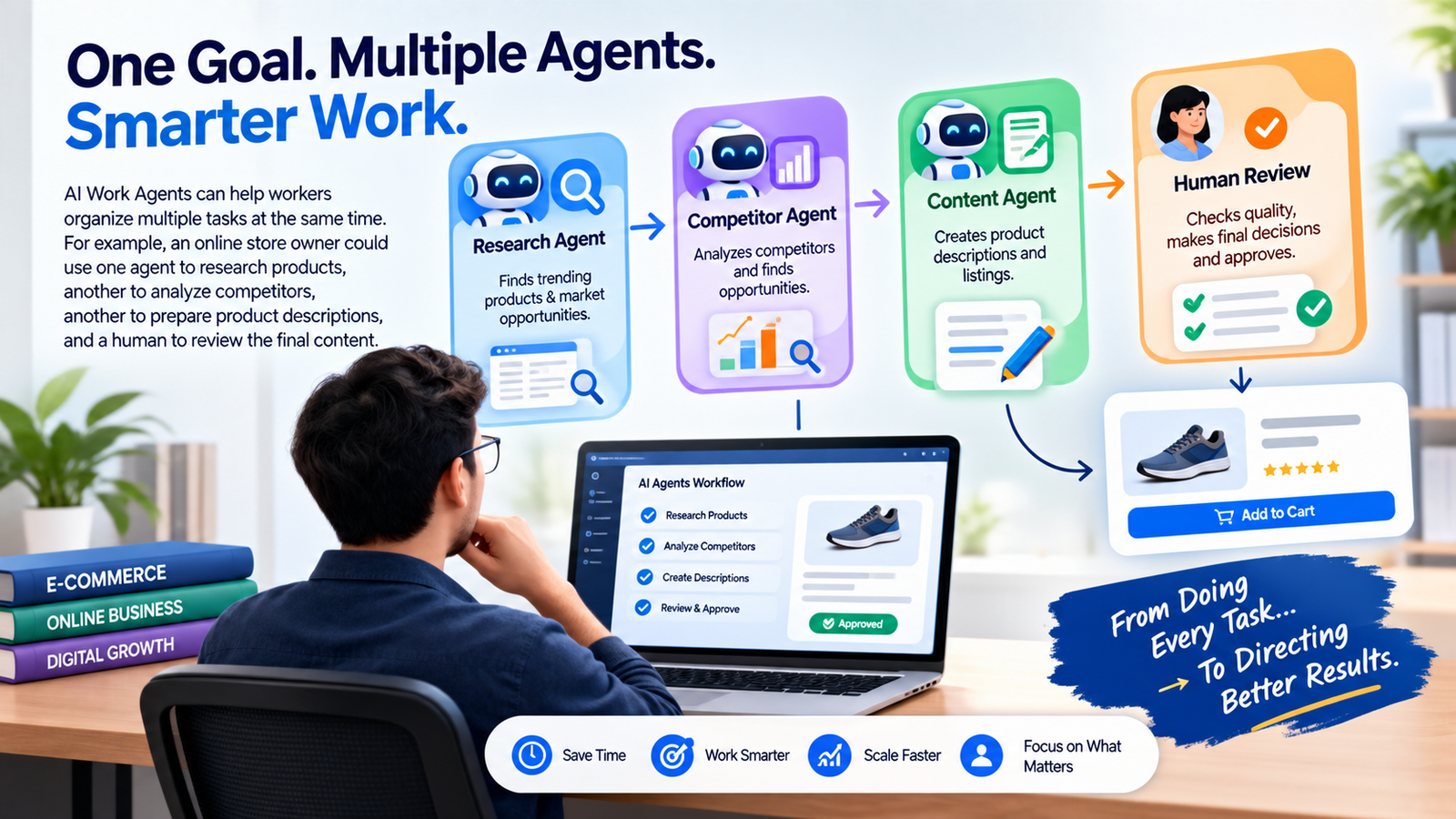
This suggests that future online work may involve people managing networks of specialized agents. One agent might research information, another could analyze data, another could prepare content, and a human could review the combined result.
The exact model will differ by industry. Highly regulated or high-risk work will generally require stronger controls than low-risk administrative tasks.
Frequently Asked Questions
What are AI agents used for in online work?
AI agents can be used for research, content workflows, software development, customer support, data processing, administration, sales operations, and other digital tasks that involve multiple steps. These applications are central to understanding AI agents changing online work.
How are AI agents changing online work?
AI agents changing online work means that people can increasingly delegate multi-step digital tasks instead of using AI only for individual questions or content generation. This shifts more human effort toward direction, review, strategy, and decision-making.
Will AI agents replace online workers?
AI agents are likely to automate some tasks and change some job responsibilities, but their impact will vary by occupation. Many roles combine automatable activities with work that requires human judgment, communication, creativity, and accountability.
Are AI agents safe for business use?
AI agents can be useful when they operate with appropriate permissions, monitoring, security controls, and human oversight. Businesses should avoid giving agents unnecessary access to sensitive systems or allowing high-impact actions without suitable safeguards.
What skills should online workers learn in 2026?
Useful skills include AI workflow design, critical thinking, data analysis, communication, domain expertise, quality assurance, automation, and the ability to evaluate AI-generated results.
What is the difference between an AI chatbot and an AI agent?
A chatbot generally responds to user prompts, while an AI agent can pursue a goal by planning multiple steps, using tools, interacting with digital systems, and completing actions within defined boundaries.
Conclusion
AI agents changing online work is more than a trend in productivity software. It represents a shift from using AI mainly for assistance toward delegating parts of digital workflows to systems that can plan and execute multiple actions.
In 2026, agents can increasingly handle multi-step digital workflows involving research, coding, content, customer service, administration, and data analysis. The most practical approach is not to hand over every task to AI. Instead, businesses and online workers should identify repetitive or structured work that can be safely delegated while keeping humans responsible for strategy, quality, sensitive decisions, and final accountability.
As agentic AI becomes more capable, the valuable skill will not simply be knowing how to use an AI tool. It will be knowing what to delegate, how to structure the workflow, how to control access, and when human judgment must remain in charge.