
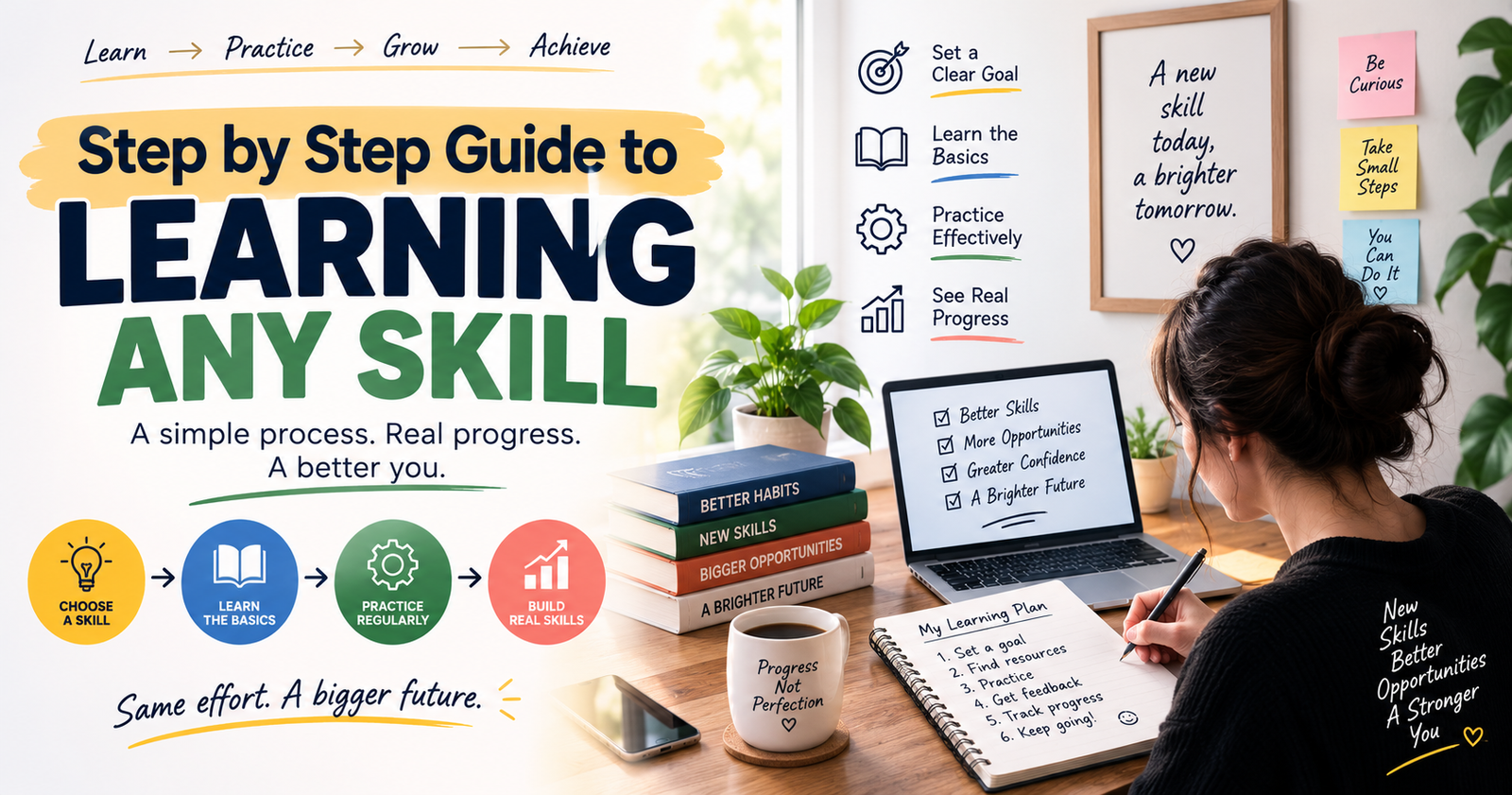
 Learning a new skill becomes much easier when you have a clear process instead of trying to absorb everything at once. Whether you want to learn coding, graphic design, writing, photography, digital marketing, cooking, a language, or another practical ability, the right learning system can help you make steady progress.
This step by step guide to learning any skill explains how to choose a skill, define your goal, find reliable learning resources, practice effectively, measure progress, overcome common obstacles, and turn knowledge into real ability. You do not need to be naturally talented to learn most skills.Step by step guide Consistent practice, useful feedback, and a structured approach matter far more than simply spending hours consuming information.
What Is the Best Way to Learn Any Skill?
The best way to learn a skill is to break it into smaller abilities, learn the fundamentals, practice regularly, get feedback, and gradually work on more difficult tasks.Step by step guide Instead of trying to master everything immediately, focus on one clear outcome at a time.
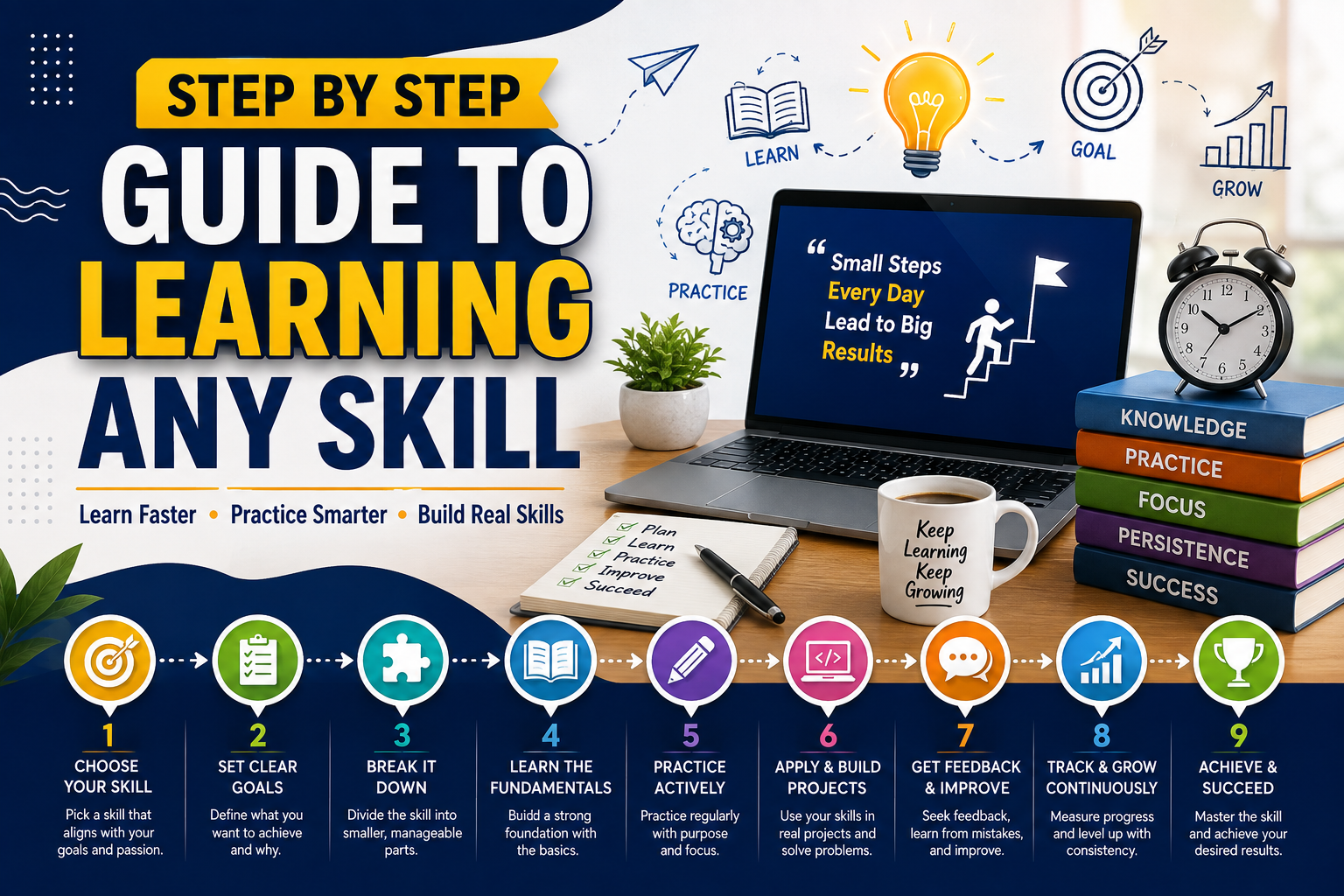
A simple learning cycle looks like this:
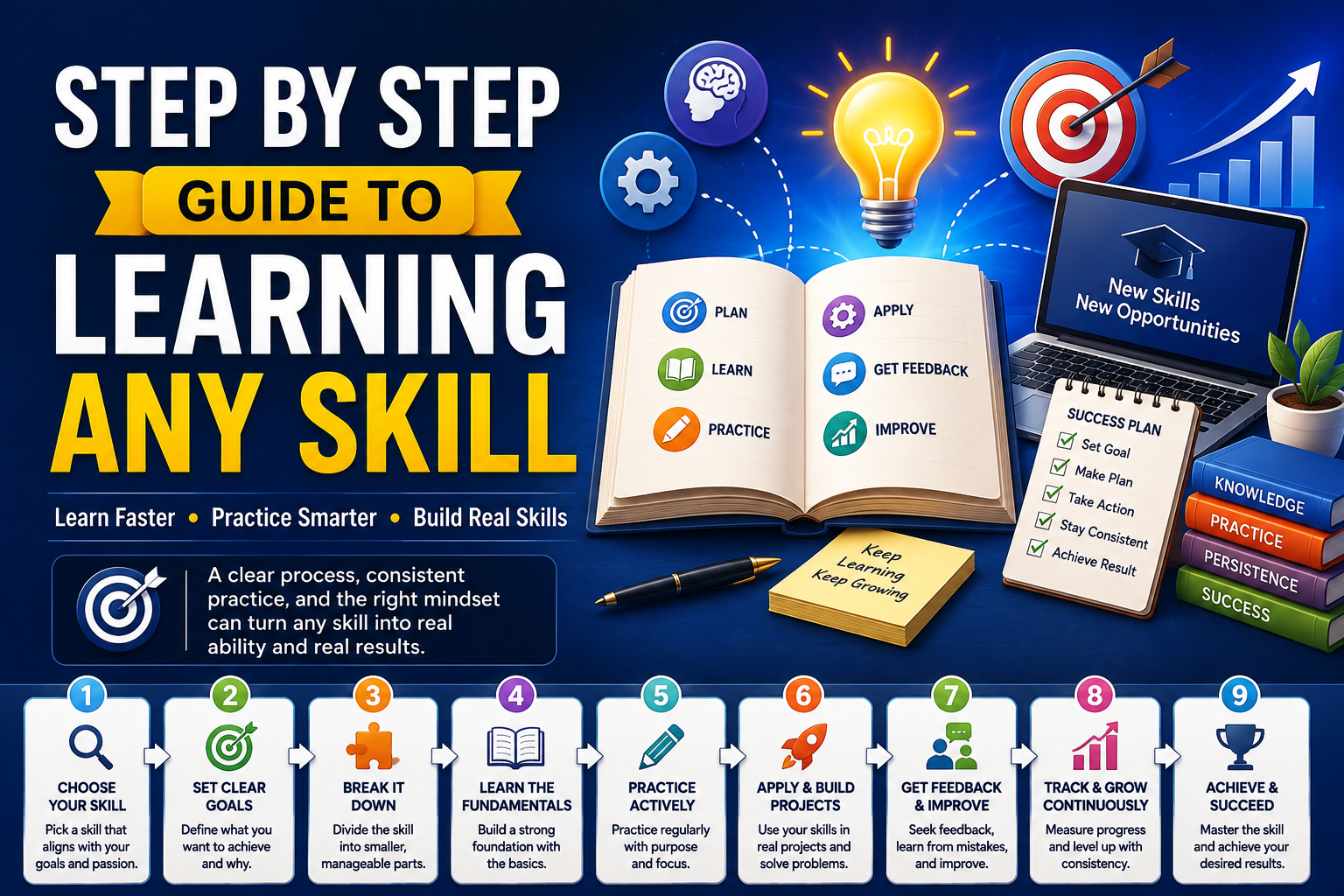
- Choose one specific skill.
- Define what you want to accomplish with it.
- Break the skill into smaller parts.
- Learn the essential fundamentals.
- Practice through active exercises.
- Create real projects or solve realistic problems.
- Get feedback and identify weaknesses.
- Repeat the process with increasing difficulty.
- Review your progress regularly.
This approach works because it turns a vague goal such as “I want to learn programming” into measurable actions such as “I will learn basic HTML and CSS, build three simple web pages, and then create a small personal website.”
1. Choose One Skill to Learn
The first step is deciding exactly what you want to learn. Step by step guideAvoid choosing a goal that is so broad that you cannot tell where to begin.
For example, “learn technology” is too broad. “Learn basic web development” is more useful.Step by step guide You can make it even more specific by choosing “learn HTML and CSS for building simple websites.”
When choosing a skill, consider:
- Why you want to learn it.
- How you expect to use it.
- How much time you can realistically dedicate.
- What level you want to reach.
- Whether the skill supports a personal, academic, or career goal.
A clear reason can help you stay motivated when the learning process becomes difficult.
2. Define a Specific Learning Goal
Once you choose a skill, define an outcome rather than simply saying you want to “get better.” A measurable goal gives you something concrete to work toward.
For example:
- Instead of “learn photography,” aim to understand camera settings and create a small portfolio.
- Instead of “learn writing,” aim to write clear 1,000-word articles.
- Instead of “learn Excel,” aim to create spreadsheets using formulas, filters, and charts.
- Instead of “learn a language,” aim to hold a basic conversation.
Your goal should be challenging enough to encourage growth but realistic enough that you can make progress without becoming overwhelmed.
3. Break the Skill Into Smaller Parts
Most skills are actually collections of smaller skills. Breaking a subject into components makes learning more manageable.
For example, learning digital marketing could involve:
- Search engine optimization
- Content marketing
- Social media marketing
- Email marketing
- Analytics
- Advertising fundamentals
You do not need to master every area simultaneously.Step by step guide Start with the foundational concepts and then move toward more specialized abilities.
4. Learn the Fundamentals First
Strong fundamentals make advanced learning easier. Beginners sometimes jump directly into complicated tutorials because they want quick results, but missing basic concepts can create problems later.
Start by learning the vocabulary, basic principles, essential tools, and common workflows associated with your chosen skill.
For example, someone learning programming should understand basic concepts such as variables, conditions, functions, and data structures before attempting complex applications.
Someone learning drawing should understand basic shapes, proportions, perspective, and observation before focusing heavily on advanced styles.
The goal is not to study theory forever. Learn enough fundamentals to start applying them.
5. Choose High-Quality Learning Resources
The internet provides thousands of courses, tutorials, books, videos, communities, and documentation. More resources do not necessarily mean faster learning. Too many choices can actually create confusion. Explore our guide to the Best Online Learning Resources to learn how to choose reliable and useful materials.
Choose a small number of trustworthy resources and follow them consistently.
Useful learning sources can include:
- Books written by knowledgeable authors
- Structured online courses
- Official documentation
- University or educational resources
- Professional tutorials
- Practice platforms
- Expert communities
For technical skills, official documentation can be especially valuable because it often provides accurate information about how a technology actually works.
6. Avoid Passive Learning
Watching videos and reading articles can introduce you to a subject, but consuming information is not the same as developing a skill.
Active learning requires you to do something with what you have learned.
For example, if you are learning graphic design, do not only watch design tutorials. Create designs.Step by step guide If you are learning programming, write code instead of only watching someone else write it. If you are learning a language, speak and write rather than only memorizing vocabulary.
A useful rule is to turn new information into action as quickly as possible.
7. Practice Deliberately
Regular practice is essential, but simply repeating an activity is not always enough. Deliberate practice focuses on specific weaknesses and gives you a clear way to improve.
Instead of saying, “I will practice for two hours,” create a more specific session:
- Choose one skill component to improve.
- Practice it at an appropriate difficulty level.
- Pay attention to mistakes.
- Compare your result with a reliable example or standard.
- Repeat the exercise while correcting the problem.
This makes practice more purposeful and helps you understand what needs improvement.
8. Build Real Projects
Projects are one of the best ways to turn knowledge into practical ability.Step by step guide A project forces you to make decisions, solve problems, handle mistakes, and combine different concepts.
Start with small projects that you can actually finish. As your ability improves, increase the complexity.
Examples of Skill-Building Projects
- Writing: Publish a series of useful articles or create a portfolio.
- Programming: Build a calculator, website, task manager, or simple application.
- Graphic design: Create social media graphics, posters, or a fictional brand identity.
- Photography: Complete themed photo assignments and organize your best work.
- Marketing: Develop a mock campaign and analyze its potential audience.
- Language learning: Record short conversations, write journal entries, or practice real dialogues.
The project does not need to be impressive.Step by step guide Its purpose is to give you practical experience.
9. Get Feedback
Feedback helps you discover problems that you may not notice yourself. Ask a teacher, experienced colleague, mentor, knowledgeable community, or trusted reviewer to evaluate your work when appropriate.
Good feedback should help answer questions such as:
- What am I doing well?
- What is holding me back?
- Which mistake should I fix first?
- What would make this work more effective?
- What should I practice next?
Do not treat criticism as failure. Useful feedback is information that can guide your next practice session.
10. Track Your Progress
Progress can be difficult to notice when you practice every day.Step by step guide Keeping simple records makes improvement easier to see.
You can track:
- Practice sessions completed
- Projects finished
- Topics mastered
- Mistakes corrected
- Test or assessment results
- Feedback received
- Tasks you can now complete independently
A learning journal or simple spreadsheet can be enough.Step by step guide Focus on evidence of ability rather than only counting hours.
11. Increase the Difficulty Gradually
Once basic tasks become comfortable, increase the challenge.Step by step guide If every exercise is too easy, your development may slow. If every exercise is far beyond your current level, you may become frustrated.
A practical progression is:
Learn → Practice → Apply → Review → Increase difficulty → Repeat.
For example, a beginner photographer might first learn exposure settings, then practice controlled shots, then photograph different subjects, and eventually work in changing lighting conditions.
12. Use Spaced Practice and Review
Learning something once does not guarantee that you will remember it.Step by step guide Review important concepts over time instead of trying to memorize everything in one long session. Learn more about learning and memory to understand how information is retained and recalled.
Spaced practice means revisiting information at intervals. You can combine it with active recall by trying to explain a concept from memory before checking your notes.
For subjects involving facts, terminology, formulas, or vocabulary, flashcards and short self-tests can be useful. For practical skills, repeated exercises and projects provide a form of review.
13. Learn From Your Mistakes
Mistakes are a normal part of skill development. Step by step guideThe important question is what you do after making one.
When something goes wrong, identify:
- What happened?
- Why did it happen?
- What should you have done differently?
- How can you practice that specific weakness?
Keeping a list of recurring mistakes can reveal patterns.Step by step guide Fixing repeated errors is often more valuable than simply completing more exercises.
14. Create a Realistic Learning Schedule
You do not need to spend all day learning. A realistic schedule that you can maintain is usually more useful than an intense plan that you abandon after a week.
For example, you might schedule:
| Time | Activity |
|---|---|
| 15 minutes | Review previous material |
| 20 minutes | Learn one new concept |
| 30 minutes | Practice actively |
| 15 minutes | Review mistakes and record progress |
The exact schedule is less important than consistency. Choose a routine that fits your responsibilities and energy level.
15. Focus on One Main Skill at a Time
Learning several unrelated skills simultaneously can divide your attention.Step by step guide If you have many interests, you can keep a list of skills you want to learn later, but give your primary attention to one major learning goal.
This does not mean you can never combine skills. Step by step guideSome abilities naturally support each other.Step by step guide For example, a web designer may learn design, basic HTML, CSS, user experience, and communication because these skills work together.
16. Use Technology as a Learning Aid
Digital tools can make learning more convenient, but they should support active practice rather than replace it.
Depending on the skill, useful tools may include:
- Note-taking applications
- Spreadsheets for tracking progress
- Flashcard applications
- Online courses
- Practice platforms
- Video tutorials
- Digital dictionaries
- Code editors
- Design software
- AI-assisted learning tools
When using AI tools, treat generated information as a learning aid rather than automatically assuming every answer is correct.Step by step guide For important subjects, verify information using reliable sources.
17. Find a Mentor or Learning Community
Learning alone can work, but guidance from experienced people can shorten the path to improvement.Step by step guide A mentor may help you identify mistakes, choose useful projects, and understand what skills matter in real situations.
Online communities can also provide feedback, discussions, examples, and accountability. Choose communities that encourage constructive learning rather than those focused mainly on unrealistic promises or shortcuts.
18. Apply the Skill in Real Situations
A skill becomes more valuable when you can use it outside a controlled learning environment.
After building basic competence, look for realistic opportunities to apply what you know. Step by step guideThis could mean helping with a small project, creating work for a portfolio, volunteering, solving personal problems, or completing practical assignments.
Real-world application exposes gaps in your knowledge that tutorials may not reveal.
How Long Does It Take to Learn a Skill?
There is no universal amount of time required to learn a skill. Step by step guideThe timeline depends on the complexity of the skill, your starting level, practice frequency, quality of feedback, learning resources, and the level of ability you want to achieve.
Learning basic competence may take considerably less time than reaching professional or expert level. Instead of focusing on a fixed number of hours, define what you want to be able to do and measure your progress against that outcome.
Common Problems When Learning a New Skill
Feeling Overwhelmed
A large subject can seem impossible when you look at everything at once.Step by step guide Reduce the scope. Choose one small topic or task and complete it before moving forward.
Losing Motivation
Motivation naturally changes. Build habits and routines so that learning does not depend entirely on feeling motivated every day. Small, consistent sessions can keep your progress moving.
Getting Stuck
When you cannot solve a problem, avoid spending unlimited time guessing. Try another explanation, review the fundamentals, search reliable documentation, or ask someone for guidance. Then return to the problem and attempt it again.
Comparing Yourself With Experts
Experts have usually spent years building their abilities.Step by step guide Comparing your early work with someone’s advanced work can make normal progress feel like failure. Compare your current performance with your own previous results instead.
Common Mistakes to Avoid When Learning Any Skill
- Trying to learn everything at once: Focus on a clear progression.
- Watching tutorials without practicing: Turn lessons into exercises.
- Changing resources constantly: Finish useful learning material before jumping to another course.
- Skipping fundamentals: Build a solid base before moving to advanced topics.
- Practicing without feedback: Look for ways to evaluate your work.
- Setting unrealistic schedules: Create a routine you can maintain.
- Chasing shortcuts: Skills generally require repeated application and correction.
- Ignoring mistakes: Use errors as clues about what to practice next.
Expert Tips for Faster Skill Development
- Start with the end result: Define what successful performance looks like before choosing learning materials.
- Practice the hardest useful part: Spend more time on weaknesses instead of repeatedly doing what is already easy.
- Use projects as milestones: Let completed projects demonstrate what you can actually do.
- Teach what you learn: Explaining a concept in your own words can expose gaps in your understanding.
- Review your process: Every few weeks, identify what is working and remove activities that provide little value.
- Keep evidence of progress: Save earlier projects so you can compare them with later work.
How to Know When You Have Learned a Skill
You do not need to know everything before considering yourself competent.Step by step guide A practical sign of learning is the ability to perform useful tasks independently and solve unfamiliar but related problems.This ability to apply what youhave learned in new situations is known as learning transfer.
Ask yourself:
- Can I complete common tasks withut step-by-step instructions?
- Can I explain the basic principles to someone else?
- Can I identify and correct common mistakes?
- Can I handle a slightly unfamiliar problem?
- Can I produce a useful result consistently?
If you can answer yes to many of these questions, you are moving beyond simple knowledge toward practical skill.
Frequently Asked Questions About Learning Any Skill
What is the best way to learn any skill?
The most effective approach is to define a specific goal, learn the fundamentals, practice actively, complete real projects, receive feedback, and gradually increase the difficulty. Consistent practice is more useful than passive information consumption.
How can I learn a new skill quickly?
Focus on the most useful fundamentals, practice the skills you actually need, avoid unnecessary resources, and get feedback early.Step by step guide Learning quickly does not mean skipping practice; it means spending your available time on activities that directly improve performance.
How many hours a day should I spend learning?
There is no universal requirement. Choose an amount of time you can maintain consistently.Step by step guide Even a focused daily session can produce meaningful progress when it includes active practice and regular review.
Is it better to learn from videos, books, or courses?
No single format is best for every learner or skill. A structured course can provide a clear path, books can offer depth, videos can demonstrate processes, and official documentation can provide authoritative technical information. Choose resources based on the type of knowledge you need.
Why do I forget what I learn?
Forgetting often happens when information is learned once but rarely recalled or applied. Use spaced review, active recall, practice exercises, and real projects to reinforce important concepts.
Can anyone learn a new skill?
Most people can improve many skills through structured learning and practice, although the pace and eventual level of performance vary. Natural differences in experience, available time, physical ability, resources, and learning environment can affect the process.
Conclusion
Learning any skill becomes more manageable when you replace vague goals with a clear process.Step by step guide Choose one skill, define a practical outcome, break it into smaller abilities, learn the fundamentals, and start practicing as soon as possible.
The most important part of this step by step guide to learning any skill is to keep moving between learning and doing. Build projects, study your mistakes, seek useful feedback, review what you have learned, and increase the difficulty gradually. You do not need perfect conditions or endless hours of study. A realistic routine, focused practice, and measurable progress can take you much further than passive learning alone.