

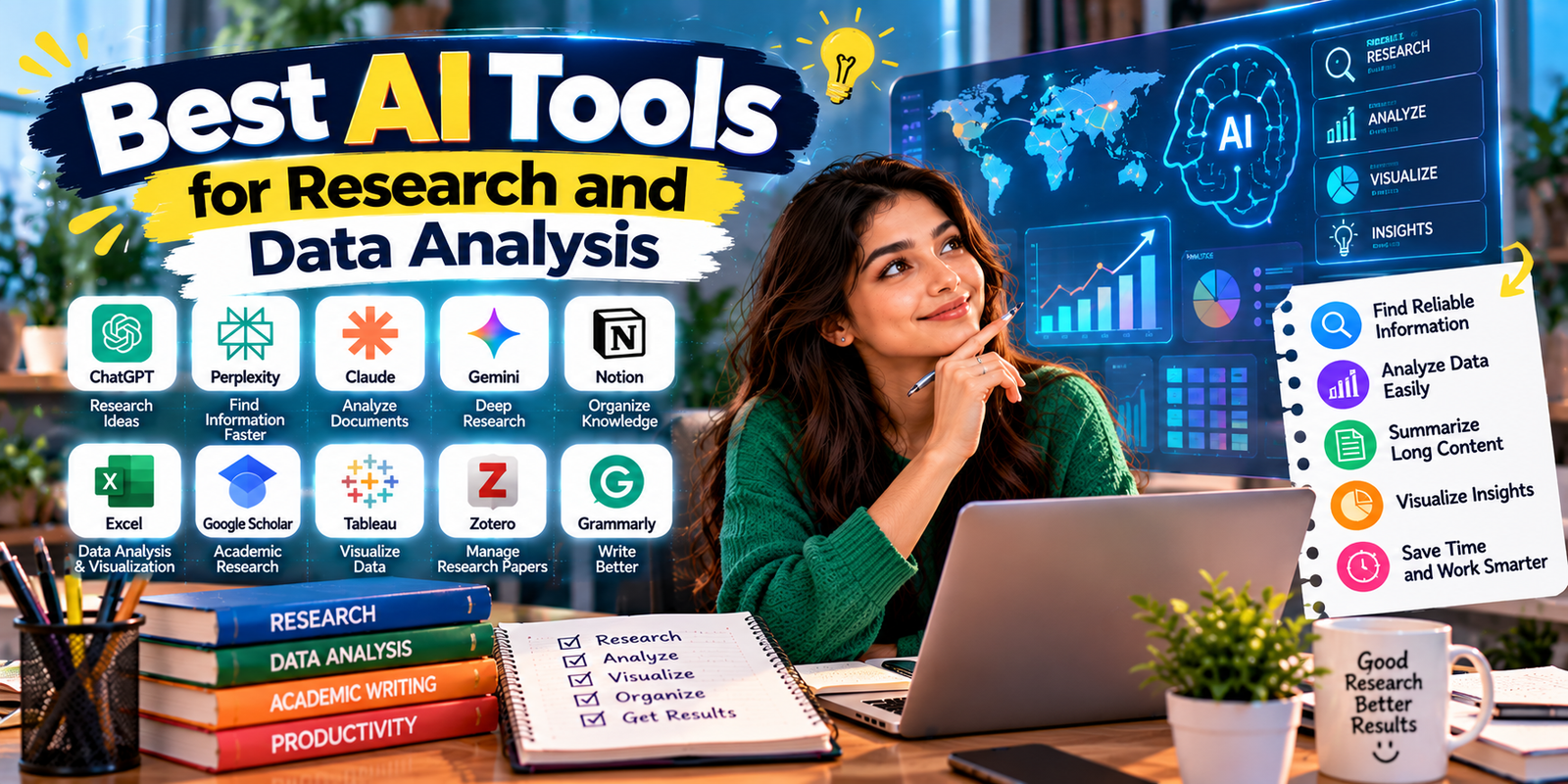
Finding reliable information, reviewing research papers, analyzing spreadsheets, and turning large amounts of data into useful conclusions can take hours. The right AI research tools can make these tasks easier by helping users search information, summarize documents, identify patterns, analyze datasets, and organize findings more efficiently.
However, not every AI platform is designed for the same type of work. Some are better for academic literature, while others are more useful for data analysis, citation checking, web research, or general-purpose research assistance. Choosing the right tool depends on the type of information you work with and the result you need.
In this guide, we explore practical AI research tools for students, researchers, analysts, professionals, and business users. You will learn what each tool does, where it fits into a research workflow, its main strengths and limitations, and how to choose the right option for your needs.
Quick Overview
| Tool | Best For | Main Strength | Research Level |
|---|---|---|---|
| ChatGPT | Data analysis and general research | Natural-language analysis | Beginner to advanced |
| Perplexity | Web research | Search with sourced answers | Beginner to advanced |
| Elicit | Academic research | Literature review workflows | Students to researchers |
| Scite | Citation analysis | Smart citation context | Researchers |
| Google Scholar | Academic discovery | Scholarly search | All levels |
What Are AI Research Tools?
AI research tools are software applications that use artificial intelligence to assist with information discovery, document analysis, literature review, summarization, data interpretation, citation analysis, and related research tasks.
Instead of manually reading every document or searching through large datasets one item at a time, researchers can use AI to speed up repetitive parts of the process. Depending on the platform, an AI tool may help locate relevant sources, summarize papers, extract information, compare documents, analyze tables, create charts, or identify relationships within a dataset.
These tools do not remove the need for human judgment. Research quality still depends on the quality of the sources, the questions being asked, the data being analyzed, and the user’s ability to verify important findings.
Why Use AI Research Tools?
The main advantage of AI research tools is efficiency. Research often involves repetitive activities such as searching, filtering, summarizing, organizing, and comparing information. AI can assist with many of these tasks while allowing the researcher to spend more time evaluating evidence and developing conclusions.
- Faster information discovery: AI can help narrow broad questions into more targeted searches.
- Document summarization: Long reports and research papers can be reduced to key points for initial review.
- Data exploration: AI can help identify trends, missing values, unusual observations, and relationships.
- Research organization: Findings can be grouped into themes, questions, or categories.
- Citation support: Specialized platforms can provide context around scholarly citations.
- Better accessibility: Natural-language interfaces allow users to ask questions without mastering complex software first.
The best results usually come from combining AI assistance with traditional research practices such as source verification, careful reading, transparent methodology, and independent judgment
 .
.
1. ChatGPT for Research and Data Analysis
ChatGPT is one of the most flexible AI research tools because it can support both research-related tasks and structured data analysis. Users can ask questions about datasets, upload supported files, create tables and charts, summarize information, compare findings, and explore patterns in data.
OpenAI’s current documentation explains that ChatGPT can analyze uploaded spreadsheets and other supported files, create tables and charts, identify issues such as missing values and duplicates, and perform several types of statistical analysis.
For example, a researcher can upload a CSV file and ask for an overview of the columns, missing values, unusual records, averages, or other relevant patterns. The user can then ask follow-up questions in natural language rather than manually writing every formula.
Best Uses
- Analyzing CSV and spreadsheet data
- Cleaning and reviewing datasets
- Creating charts and tables
- Summarizing research notes
- Comparing datasets
- Exploring statistical relationships
- Preparing research summaries
Important Limitation
AI-generated analysis should be checked before it is used in an academic paper, business report, or important decision. OpenAI itself recommends checking assumptions, verifying important numbers, and distinguishing correlation from causation when working with data.
2. Perplexity for Web Research
Perplexity is another useful option among modern AI research tools, particularly when the goal is to investigate a topic across online sources. It combines conversational search with web-based information retrieval, making it useful for initial research and source discovery.
It can be helpful when a researcher starts with a broad question and wants to identify relevant websites, organizations, articles, reports, or other sources to investigate further.
Best Uses
- Initial web research
- Finding current information
- Exploring unfamiliar subjects
- Comparing information from different sources
- Generating research directions
- Finding primary sources for additional verification
Perplexity also maintains a research-focused platform that describes work involving search, reasoning, agents, and research systems.
For serious research, an AI-generated answer should be treated as a starting point rather than the final evidence. Open the cited sources, evaluate their credibility, and use original publications when possible.
3. Elicit for Academic Research
Elicit is designed specifically for research workflows and is particularly relevant for people working with academic literature. Among AI research tools, Elicit focuses more directly on finding and working with scholarly papers rather than general web searches.
According to Elicit’s documentation, the platform supports research workflows such as academic paper searches, literature reviews, data extraction, paper summarization, research-question exploration, and interactive analysis.
This makes Elicit useful when a researcher needs to move from a broad research question toward a structured collection of relevant academic papers.
Best Uses
- Literature reviews
- Academic paper discovery
- Research question exploration
- Extracting information from papers
- Comparing findings across studies
- Organizing academic research
Elicit is particularly useful when the research process involves many papers and the researcher needs a more organized way to screen and extract information.
4. Scite for Citation Analysis
Scite is a specialized research platform focused on scholarly literature and citation context. It stands out among AI research tools because its Smart Citations are designed to show how later publications cite a particular paper.
Scite says its system classifies citation statements as supporting, contrasting, or mentioning, helping researchers understand how a study has been discussed by subsequent research. Its current platform reports extensive coverage of scholarly literature and citation data.
This can be valuable when citation counts alone do not tell the full story. A paper may be cited because another researcher supports its conclusion, challenges it, or simply mentions it. Citation context provides additional information for evaluating the literature.
Best Uses
- Checking citation context
- Evaluating scholarly claims
- Finding supporting and contrasting research
- Literature reviews
- Reference checking
- Research verification
Scite also provides tools for reference checking and access to research-related datasets, making it useful for more advanced scholarly workflows.
5. Google Scholar
Google Scholar remains a useful starting point for finding academic publications, journal papers, theses, books, conference materials, and other scholarly resources. Although it is not primarily an AI assistant, it can work alongside AI research tools as part of a broader research workflow.
A practical approach is to use an AI tool to clarify the research question and identify important concepts, then use scholarly search engines to locate original academic sources.
Best Uses
- Finding academic papers
- Locating citations
- Discovering related studies
- Checking scholarly publications
- Building an initial bibliography
Researchers should still check the publication itself instead of relying only on search-result summaries.
6. Microsoft Excel with AI Assistance
Excel remains important for research and data analysis because many organizations already store operational information in spreadsheets. When AI capabilities are available through the user’s software and account, researchers can combine familiar spreadsheet workflows with natural-language assistance.
This can be useful for tasks such as examining trends, organizing columns, creating formulas, summarizing data, and preparing charts.
For people who already understand spreadsheet basics, combining Excel with AI research tools can reduce repetitive work while keeping the underlying dataset visible and editable.
7. Google Sheets for Collaborative Analysis
Google Sheets is another practical option for collaborative data work. Teams can use spreadsheets to organize research data, collect responses, calculate metrics, and create visualizations.
When combined with AI assistance, spreadsheet-based research can become easier to explore and explain. However, teams should maintain clear definitions for columns, consistent formatting, and documented assumptions.
AI Research Tools vs Traditional Research Methods
AI research tools are best viewed as assistants rather than replacements for established research methods.
| Research Task | AI Assistance | Human Responsibility |
|---|---|---|
| Source discovery | Find possible sources and keywords | Evaluate source quality |
| Summarization | Generate initial summaries | Check the original document |
| Data analysis | Explore patterns and calculations | Validate methods and results |
| Citations | Find citation relationships | Confirm claims in original sources |
| Writing | Organize and explain findings | Maintain accuracy and originality |
This division of responsibilities helps reduce the risk of treating AI output as automatically correct.
How to Choose AI Research Tools
The right AI research tools depend on the type of research you are performing. Instead of choosing a platform only because it has many features, match the tool to your actual workflow.
For Academic Literature
Choose a platform focused on scholarly papers, literature reviews, citation relationships, and evidence extraction. Elicit and Scite are examples of specialized platforms in this area.
For Data Analysis
Look for tools that can work with spreadsheets, CSV files, tables, charts, and statistical analysis. ChatGPT can be useful for exploratory analysis and natural-language questions about supported datasets.
For Web Research
Use search-focused tools when your main objective is discovering current online information. Always inspect the underlying sources before treating a result as evidence.
For Citation Verification
Use specialized scholarly tools when you need to understand whether later research supports, challenges, or merely mentions a published finding.
How to Use AI Research Tools Effectively
Getting useful results from AI research tools depends heavily on how the research task is defined.
- Start with a clear question. Define exactly what you want to discover or measure.
- Provide context. Explain the dataset, research topic, timeframe, audience, or goal.
- Ask for a structured process. Request steps such as data cleaning, exploration, analysis, and interpretation.
- Verify important claims. Check original papers, official documents, datasets, or primary sources.
- Separate facts from interpretation. An AI-generated explanation is not automatically evidence.
- Document your method. Keep track of sources, assumptions, calculations, and decisions.
- Review the final result manually. Look for unsupported claims, missing context, incorrect numbers, and misleading conclusions.
Common Mistakes to Avoid
1. Trusting Every AI Answer
AI systems can produce convincing explanations that still require verification. Important research claims should be checked against reliable sources.
2. Ignoring Data Quality
No analysis tool can completely compensate for poor source data. Missing values, duplicate records, incorrect categories, and inconsistent measurements can affect the results.
3. Using Summaries Instead of Original Sources
A summary can help you decide what to read, but important claims should be traced back to the original research or official source.
4. Confusing Correlation With Causation
Two variables can move together without one causing the other. Researchers should examine the methodology and context before making causal conclusions.
5. Using AI Without Documentation
For academic or professional work, maintain a record of your sources, prompts where relevant, analytical methods, assumptions, and verification steps.
How AI Can Improve a Research Workflow
A strong workflow can combine several AI research tools rather than depending on a single platform.
For example, a researcher might begin by using a general AI assistant to define a research question and identify important terminology. A web research platform can then help discover current sources. An academic research platform can be used to locate relevant papers, while a citation-analysis tool can help examine how important studies have been cited. Finally, a data-analysis platform can help explore structured datasets.
This approach creates a research pipeline in which each tool has a specific job.
Are AI Research Tools Accurate?
AI research tools can be useful, but accuracy depends on the tool, source quality, data, task, and verification process. AI output should not automatically be treated as authoritative evidence.
For high-stakes research, verify important claims using original academic publications, official documentation, government data, recognized institutions, or other primary sources. When analyzing numerical data, review the calculations and assumptions before publishing the results.
Can AI Tools Analyze Research Data?
Yes. Some AI research tools can analyze structured datasets and help users identify trends, calculate statistics, create charts, detect anomalies, and summarize findings. ChatGPT’s current data-analysis documentation describes support for uploaded datasets, tables, charts, data cleaning, aggregation, and several statistical methods.
However, users should still decide whether the selected method is appropriate for the research question and verify the output before drawing conclusions.
Best Practices for Responsible AI-Assisted Research
- Use primary sources whenever possible.
- Verify important claims independently.
- Keep original datasets unchanged and preserve working copies.
- Document analytical assumptions.
- Check calculations and unusual results.
- Do not present AI-generated information as a source by itself.
- Follow your institution’s rules for AI use and academic integrity.
- Protect confidential or sensitive information before uploading it to any service.
Frequently Asked Questions
What are the best AI research tools?
The most suitable AI research tools depend on the task. ChatGPT can support general research and data analysis, Perplexity can assist with web research, Elicit focuses on academic research workflows, and Scite specializes in scholarly citation context.
Can AI tools replace academic researchers?
No. AI can automate or accelerate parts of research, but researchers still need to define questions, evaluate sources, understand methodology, verify evidence, and interpret results.
Which AI tool is useful for analyzing Excel or CSV data?
ChatGPT can analyze supported spreadsheet and CSV files, create tables and charts, explore patterns, and perform various calculations and statistical analyses. Availability can depend on the account, model, and workspace configuration.
Are AI-generated research summaries reliable?
They can be useful for quickly understanding a document, but important claims should be checked against the original paper or source. Summaries may omit qualifications, context, or methodological details.
Can AI help with literature reviews?
Yes. Specialized AI research tools such as Elicit can assist with academic paper discovery, literature-review workflows, extraction, and research-question exploration.
Should researchers verify AI-generated data analysis?
Yes. Researchers should review the source data, assumptions, calculations, statistical methods, and interpretation. OpenAI’s guidance also recommends checking important numbers and identifying limitations when using AI for data analysis.
Conclusion
The best AI research tools are not necessarily the ones with the largest number of features. The better approach is to select a tool according to the specific research task. A general AI assistant can help with data exploration and explanations, web research platforms can support information discovery, academic research tools can organize literature, and citation-focused platforms can provide additional context around scholarly evidence.
AI can significantly reduce repetitive research work, but human judgment remains essential. Verify important information, review original sources, check data quality, and document your research process. When used this way, AI research tools can become practical assistants for faster, more organized, and more evidence-aware research and data analysis.